
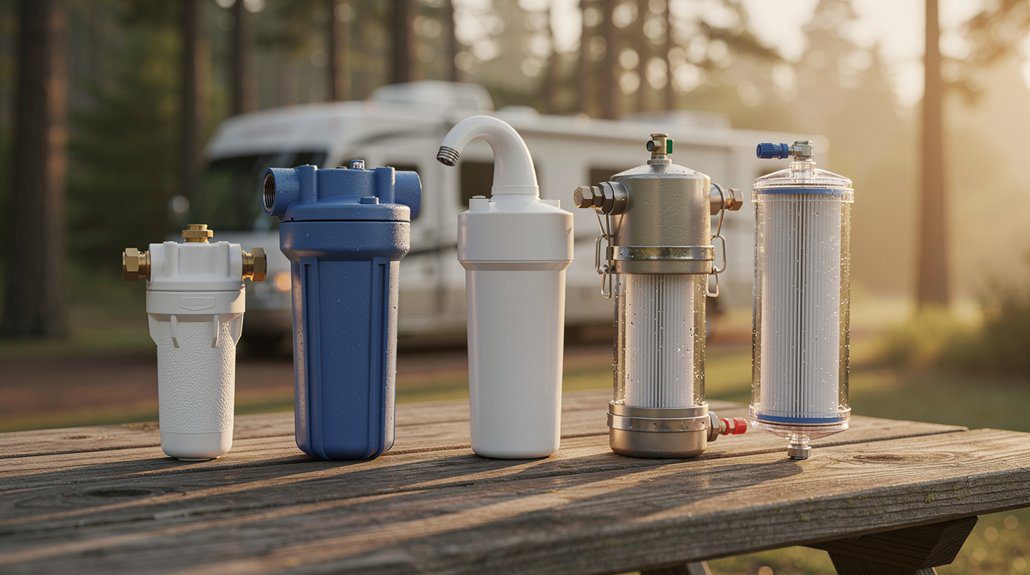
You want reliable, high‑flow RV water filtration that cuts chlorine, taste, odor, rust, and sediment while fitting standard hoses. In 2026 top picks—Camco Tastepure, Kohree, RVGUARD, Stokk, and Hourleey—use GAC+KDF cartridges, 10–20‑micron sediment stages, hose protectors or swivel fittings, and NSF/IAPMO/CSA testing on key models. Replace cartridges per gallons or months and watch for reduced flow or return of taste. Keep going to get model specifics, capacities, and hookup tips.
More Details on Our Top Picks
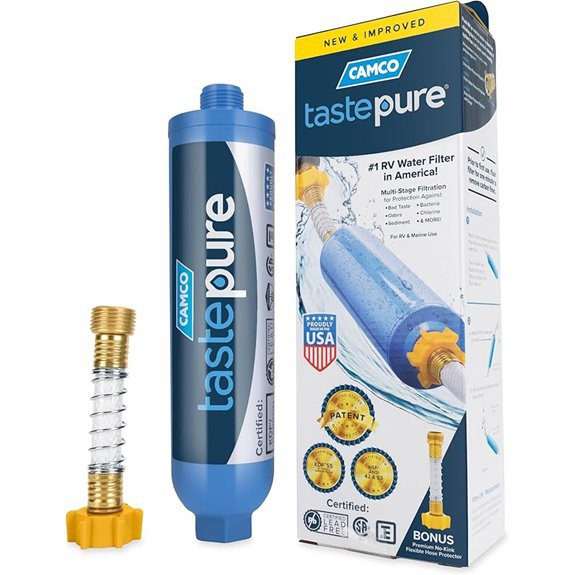
Camco Tastepure RV Water Filter – Advanced RV Inline Water Filter with Flexible Hose Protector – GAC & KDF Filtration – Made in USA – Camping Essentials for Fresh Drinking Water (40043)
If you want reliable, better-tasting water on the road, the Camco Tastepure 40043 is built for RVers, boaters, and campers who plug into municipal or campground spigots—its Hex-Flow GAC + KDF media and 20‑micron sediment stage cut chlorine, taste, odor, and sediment while the flexible hose protector keeps your connections kink-free for consistent flow. You’ll get an inline, high-flow wide-body filter that’s NSF/ANSI 42 and 53 certified, CSA lead-free certified, and made in the USA. It includes adapters, fits standard hoses, controls bacteria/mold when idle, measures 3.1×3.9×7.6 inches, weighs 16 oz, and has a one-year limited warranty.
- Filtration media:GAC + KDF
- Micron/sediment rating:20 micron internal sediment filter
- Installation type:Inline attachment to garden/drinking hose
- Target uses / compatibility:RVs, boats, camping, marine, garden, pets, car washes/detailing
- Flexible hose protector / anti-kink:Includes flexible hose protector (prevents kinks/strain)
- Certification / testing:Independently tested; certified to NSF/ANSI 42 and 53; CSA lead-free (NSF/ANSI 372)
- Additional Feature:Made in USA
- Additional Feature:Patented Hex-Flow design
- Additional Feature:Limited 1-year warranty
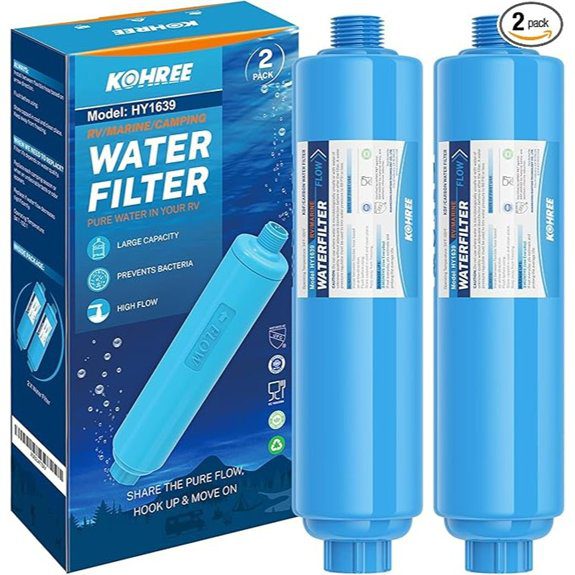
Kohree RV Water Filter NSF Certified Inline Water Filter Reduces Chlorine Bad Taste Odor RV Accessories Ideal for Campers Marine Garden Hose Boats Trailer Motorhome 2 Pack
For RV owners who prioritize clean, great‑tasting water on the road, the Kohree Inline RV Water Filter is a compact solution that cuts chlorine, odors, and common impurities with NSF‑certified GAC + KDF media. You’ll get a two‑pack of BPA‑free, food‑grade inline filters (model A-B1B2384GS-AI/HY1639-HM) that use five‑layer filtration—GAC + KDF plus a 20‑micron sediment stage—to reduce chlorine, bad taste, heavy metals, fluoride, silt and other contaminants. Each unit treats up to 1,057 gallons at 0.5 gpm, passed pressure burst tests, and should be replaced every 3–6 months. It fits standard garden/drinking hoses and includes warranty support.
- Filtration media:GAC + KDF
- Micron/sediment rating:20 micron internal sediment filter
- Installation type:Inline attachment to garden/drinking hose
- Target uses / compatibility:RVs, campers, motorhomes, boats, marine, garden, pools, car washing, pets
- Flexible hose protector / anti-kink:(Includes inline design; mentions durable connections) — includes hose-compatible inline connectors (flexible protector not specified)
- Certification / testing:NSF certified (external NSF testing)
- Additional Feature:2-pack value bundle
- Additional Feature:Filters up to 1,057 gallons
- Additional Feature:Thicker BPA-free plastic
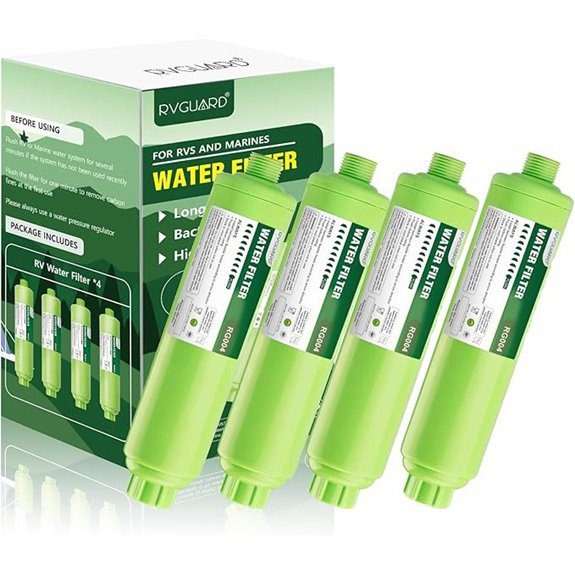
RVGUARD Inline RV Water Filter Reduces Odors Bad Taste Rust Chlorine Ideal for RV and Marine use 4 Pack
Travelers who want simple, reliable water purification will like the RVGUARD Inline RV Water Filter because its KDF + GAC media cuts chlorine, odors, bad taste, and rust while attaching directly to a standard garden hose. You’ll get a 4-pack (model RG004) certified by IAPMO R&T to NSF/ANSI 42 for material safety and chlorine reduction. Each filter is 20-micron, handles about 0.5 gallons per minute, and treats up to 15,000 gallons or roughly three months. Expect initial carbon discharge, so run water until clear. It works from 34°F–100°F at 60 psi and includes an 18-month warranty.
- Filtration media:GAC + KDF (KDF + advanced GAC)
- Micron/sediment rating:20 micron micron rating
- Installation type:Inline attachment to garden/drinking hose/faucet
- Target uses / compatibility:RV, marine, camping, gardening, planting, farming
- Flexible hose protector / anti-kink:Inline design; attaches to hose/faucet (flex protector not specified)
- Certification / testing:IAPMO R&T certified against NSF/ANSI 42
- Additional Feature:High 15,000-gallon capacity
- Additional Feature:18-month warranty
- Additional Feature:First-use carbon discharge note
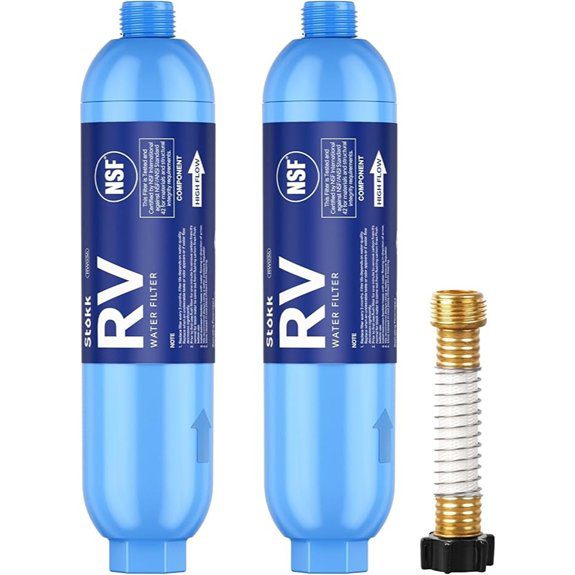
Stokk RV Water Filter with Flexible Hose Protector NSF Certified Inline Water Hose Filter for Garden Camper and Pool Greatly Reduces Bad Taste Chlorine Odor Rust and Sediment 2 Pack
Campers who want clean, great-tasting water on the road will appreciate the Stokk RV Water Filter 2-pack, which combines coconut GAC and KDF media to cut chlorine, odors, rust and sediment while maintaining high flow. You’ll get NSF/ANSI 42 listing, a 10-micron sediment stage, and a high-flow wide-body design rated for about 800 gallons and up to 300 ppm TDS. The lead-free, BPA-free housing, rust-resistant copper fittings, silicone washer and flexible hose protector with 360° swivel reduce kinks and connection stress. No power’s needed; pack includes two filters, protector and manufacturer’s warranty support.
- Filtration media:Coconut GAC + KDF
- Micron/sediment rating:10 micron internal sediment filter
- Installation type:Inline attachment to garden/drinking hose
- Target uses / compatibility:RVs, boats, camping, gardening, pools, pets, car washes
- Flexible hose protector / anti-kink:Includes flexible hose protector with 360° swivel (prevents kinks)
- Certification / testing:NSF/ANSI 42 listed (independently tested)
- Additional Feature:10-micron sediment rating
- Additional Feature:360° swivel protector
- Additional Feature:Rust-resistant copper fittings
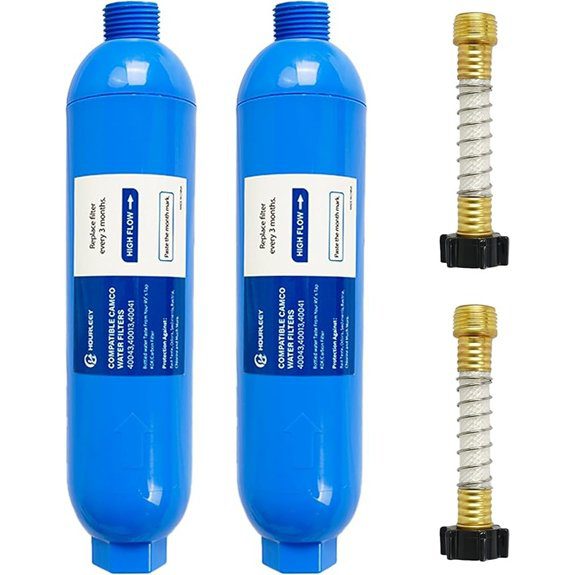
Hourleey 2 Pack RV Inline Water Filter with 2 Flexible Hose Protector Reduce Bad Taste Odors Rust Fluoride Chlorine and Sediment in Drinking Water Dedicated for RVs Campers Marines
If you want a simple, seasonal inline filter that cuts chlorine, bad tastes, rust, fluoride and sediment, the Hourleey 2-pack is a strong pick—its GAC+KDF media limits microbial growth during downtime and the 20‑micron rating handles common particulates. You’ll get two durable, food-grade plastic housings rated for up to three months’ use, plus two flexible hose protectors that prevent kinks and reduce strain at connections. Installation’s tool-free: follow the flow direction, hook standard garden hoses to input and output, and you’re set. It’s built for RVs, campers and boats but also suits gardening, pools, pets and spas.
- Filtration media:GAC + KDF
- Micron/sediment rating:20 micron
- Installation type:Inline attachment to standard garden hoses
- Target uses / compatibility:RVs, campers, boats, marines, gardening, pool, pet care, spa use
- Flexible hose protector / anti-kink:Includes flexible hose protectors (2 included)
- Certification / testing:States KDF + GAC and food-grade materials (certification not specified)
- Additional Feature:Enhanced food-grade housing
- Additional Feature:Tool-free installation
- Additional Feature:Designed for seasonal use
Factors to Consider When Choosing a Water Filter for RV
When choosing an RV water filter, you’ll want to check filtration performance metrics like micron rating and contaminant reduction. Consider the media type—carbon, ceramic, or specialty blends—along with the flow rate your rig needs and whether the connections match your hoses. Finally, look at expected filter lifespan so you’re not swapping cartridges more often than necessary.
Filtration Performance Metrics
Because your RV’s water needs are different from household plumbing, you’ll want to focus on specific filtration metrics—media type, micron rating, capacity, flow rate, and certifications—that determine what contaminants are removed, how fine the filtration is, how long a cartridge lasts, and whether the filter will keep up with your water use and pressure. Check media choices because different materials target chlorine, taste/odor, metals, and sediment. Note micron rating—RV inline filters commonly run 10–20 microns; lower numbers capture finer particles. Look at rated capacity or service life (often 800–15,000 gallons or about three months) to schedule replacements. Verify flow rate (many inline units are ~0.5 gpm) so pressure stays acceptable. Finally, confirm NSF/ANSI 42, 53, or equivalent third‑party testing for claimed reductions.
Media Types Used
You’ve looked at performance metrics; now match those specs to the actual media inside the filter so you get the protections you need. Choose granular activated carbon (GAC) when chlorine, bad taste, and organic contaminants are your main concerns—expect to replace it every 3–6 months depending on use. Add KDF (copper‑zinc) to control chlorine, heavy metals, and inhibit microbial growth during storage; it also extends carbon life. Use a sediment pre‑filter (10–20 micron common for RVs) ahead of finer media to trap sand, rust, and particulates and protect fittings. Multi‑layer cartridges that combine sediment, GAC, and KDF offer balanced particulate and chemical removal. Match media type, particle size, and ratings to your source contaminants, expected TDS, operating pressure, and seasonal use.
Flow Rate Needs
For most RVers, matching filter flow to your typical water use is essential so showers, taps, and filling the freshwater tank don’t bog down; pick a filter whose gallons-per-minute rating meets or exceeds your combined demand (think 0.5–2.0 gpm for uninterrupted showers and appliances). Determine your normal use—filling a 30–50 gallon tank, showering, or running multiple taps—and choose a filter rated at or above that combined gpm so delivery stays steady. Remember high-performance media and multi-stage cartridges often reduce flow; balance contaminant removal with gallons-per-minute to avoid bottlenecks. Check the manufacturer’s service-flow spec and plan replacements because flow declines as sediment loads. Also ensure inlet/outlet hose size won’t create a hidden restriction that negates the filter’s rating.
Connection Compatibility
Once you’ve matched filter flow to your RV’s needs, the next step is to confirm the filter will actually hook up to your system. Verify inlet and outlet thread type and size—most use 3/4″ garden hose thread (GHT)—so your hoses and RV water inlet connect directly. Check whether the unit is inline, spigot-mounted, or uses quick-connect fittings, and match that to existing hose ends or plan adapters. Confirm flow direction and that connections are reversible or oriented correctly to avoid leaks and ensure filtration works. Look for swivel or flexible hose protectors if you’ve got angled or kink-prone runs. For nonstandard RV inlets or quick-disconnects, source potable-water-rated adapters or conversion fittings before you install.
Filter Lifespan Expectations
Because filter life varies with both the media and the water, expect manufacturers to list service intervals in months or gallons (commonly ~3 months or a few hundred to a few thousand gallons), and treat those as starting points rather than guarantees. You’ll see lifespan change with water quality: high turbidity, heavy chlorine, or other contaminants shorten useful life. Finer-micron filters trap smaller particles but clog faster, so balance contaminant removal against replacement frequency. Watch flow rate, pressure, and any return of taste or odor as practical end-of-life signals. Storage matters too—media that resists biological fouling helps during off-season, but don’t rely on that indefinitely; replace after prolonged nonuse or per manufacturer time limits. Plan replacements into your maintenance routine.
Build Quality Materials
Check the materials before you buy: housing, fittings, connectors, and seals determine how well a filter will stand up to seasonal hookups, temperature swings, and everyday wear. Choose housings made from food-grade, BPA-free plastics or corrosion-resistant metals to avoid chemical leaching. Insist on lead-free-certified fittings and components to minimize heavy-metal risk. Inspect connector materials and thread types — brass, stainless steel, or reinforced plastic — to ensure durability during repeated hookups and to resist cross-threading or bursting. Prefer reinforced or impact-resistant casings and flexible hose strain-relief sleeves to prevent kinks, cracking, and stress at connection points. Finally, verify internal media and seals (silicone or EPDM washers, quality O-rings) are chemically compatible and rated for expected temperature and pressure ranges.
Certifications And Testing
Good materials and robust fittings are only part of the story—you also need proof that a filter performs as claimed. Look for NSF/ANSI certifications: 42 for aesthetic reductions like chlorine, taste, and odor, and 53 for health‑related contaminants such as lead and cysts. Verify lead‑free content via NSF/ANSI 372 or relevant federal/state compliance for potable fittings. Favor units with independent third‑party testing (IAPMO, CSA, or equivalent) rather than manufacturer self‑tests. Review lab reports showing flow rate, micron rating, and tested capacity under expected pressure and temperature so the filter matches your operational needs. Finally, read warranty terms and documented test results to confirm lifespan, burst pressure resistance, and microbial control are supported and covered.