
You’ll want hoses that keep water flowing and protect fittings through subzero nights: try the 50 ft rubber heated RV hose for short runs, the 100 ft food‑grade drinking hose with thermostat for long hookups, the 75 ft anti‑freeze reinforced hose for heavy‑duty use, the 30 ft stainless protected hose for high pressure or tight spots, and the TORVA 100 ft NSF‑certified model with continuous heating and auto shutoff. Keep going to learn specifics and compare features.
| 50FT Heated RV Water Hose (Prevents Freezing) | 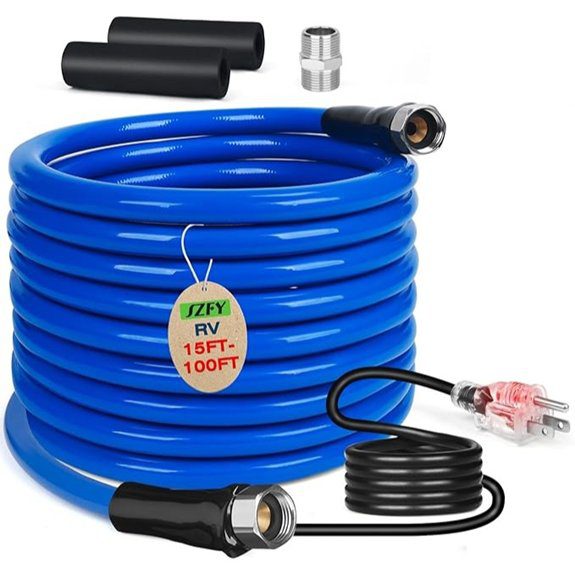 | Reliable Winter Workhorse | Length: 50 ft | Freeze Protection Temperature: down to −40°F (−40°C) | Heated (heating element present): Internal heating coil (self/ambient responsive) | VIEW LATEST PRICE | Read Our Analysis |
| 100FT Heated RV Drinking Water Hose (-45°F Protection) | 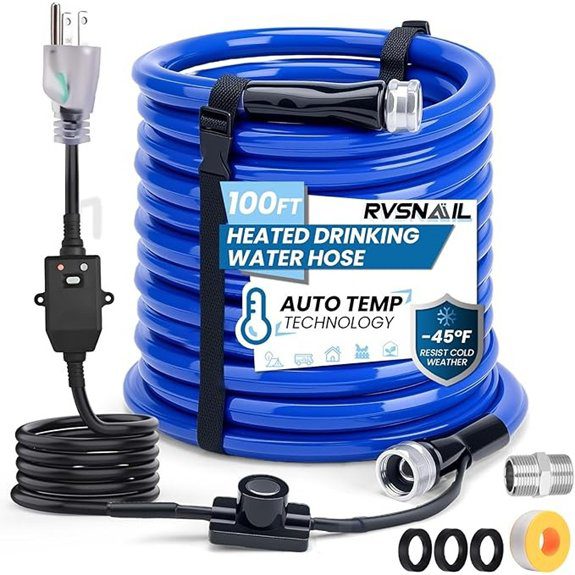 | Extreme Cold Champion | Length: 100 ft | Freeze Protection Temperature: down to −45°F (−42.7°C) | Heated (heating element present): Intelligent self-regulating heater/external thermostat | VIEW LATEST PRICE | Read Our Analysis |
| 75FT Heated Anti-Freeze RV Water Hose |  | Durable All-Season Performer | Length: 75 ft | Freeze Protection Temperature: down to −45°F | Heated (heating element present): Thickened heating wires / full heating element | VIEW LATEST PRICE | Read Our Analysis |
| 30FT Heated Anti-Freezing RV Water Hose |  | Compact Winter Essential | Length: 30 ft (also available 15 ft) | Freeze Protection Temperature: down to −45°F | Heated (heating element present): Smart self-regulating heat system | VIEW LATEST PRICE | Read Our Analysis |
| TORVA 100FT Heated RV Drinking Water Hose | 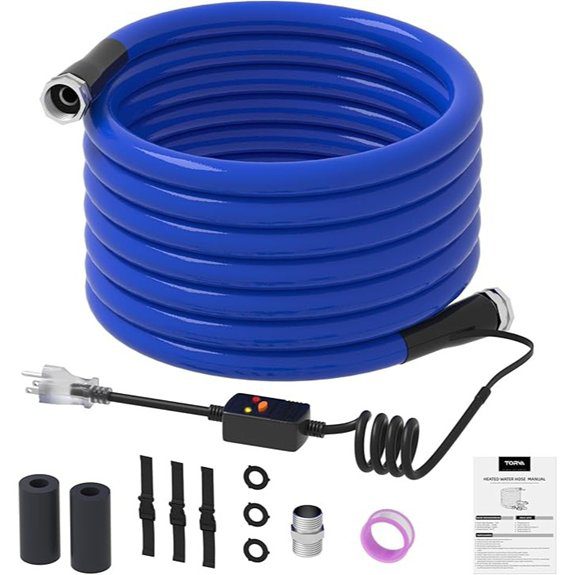 | Premium Long-Range | Length: 100 ft | Freeze Protection Temperature: (designed for winter use; rated for extreme cold — implied anti-freeze protection; full‑length heating) | Heated (heating element present): Electrically heated across full 100‑ft length | VIEW LATEST PRICE | Read Our Analysis |
More Details on Our Top Picks
50FT Heated RV Water Hose (Prevents Freezing)
If you camp or live where temperatures plunge, the 50ft FT Heated RV Water Hose is built to keep your water flowing down to -40°F, so you won’t wake up to a frozen supply. You get a 50-foot, 1/2″ rubber hose with an internal heating coil that reacts to ambient temps and a max heat of 169°F. Black sponge insulation guards joints, and a five-layer reinforced shell boosts durability for RV, garden, or farm use. Installation takes about a minute; female threads on both ends and a double-ended male adapter simplify hookups. It includes a one-year warranty and 30-day returns.
- Length:50 ft
- Freeze Protection Temperature:down to −40°F (−40°C)
- Heated (heating element present):Internal heating coil (self/ambient responsive)
- Connector Type / Thread:Female threads both ends; double-ended male thread included (thread size listed as 3/6)
- Materials / Drinking-Safe Statements:Rubber (blue); insulated joints with sponge
- Warranty / Support:1‑year manufacturer warranty; 30‑day money back + 3‑year service support
- Additional Feature:Black joint insulation sponge
- Additional Feature:Quick ~1 minute install
- Additional Feature:Five-layer reinforced shell
100FT Heated RV Drinking Water Hose (-45°F Protection)
For RV owners and winter campers who need a reliable potable water line in extreme cold, the 100ft FT Heated RV Drinking Water Hose delivers freeze protection down to -45°F and keeps water flowing even when temperatures plunge. You’ll get a food-grade, lead- and BPA-free hose with stainless fittings and a durable jacket that resists bursting. An intelligent external thermostat kicks heating in below 37°F and stops above 59°F, maintaining flow to about -35°F and thawing ice. It uses a 3/4 GHT American screw interface with double washers, includes extra washers, straps, a bandage, detailed instructions, and a 1-year warranty.
- Length:100 ft
- Freeze Protection Temperature:down to −45°F (−42.7°C)
- Heated (heating element present):Intelligent self-regulating heater/external thermostat
- Connector Type / Thread:3/4″ GHT American screw interface (includes adapter/washer set)
- Materials / Drinking-Safe Statements:Food-grade materials; lead‑free, BPA‑free
- Warranty / Support:1‑year warranty; customer support available
- Additional Feature:External self-regulating thermostat
- Additional Feature:Includes 3 × washers
- Additional Feature:Two storage straps included
75FT Heated Anti-Freeze RV Water Hose
Campers and RV owners who need reliable water in subzero conditions will appreciate the 75FT Heated Anti-Freeze RV Water Hose, which keeps water flowing down to -45°F thanks to thickened heating wires and a five-layer reinforced design. You’ll get a 75-foot blue rubber hose with thickened inner heating elements, insulation cotton for unheated joints, and German-influenced revisions for improved heat transfer. It’s built in a modern integrated factory, weighs 6.28 kg, and promises broader heat distribution and longer lifespan. WABUPD backs it with a 3-year warranty, 30-day Amazon returns, and professional support with an 11-hour response time.
- Length:75 ft
- Freeze Protection Temperature:down to −45°F
- Heated (heating element present):Thickened heating wires / full heating element
- Connector Type / Thread:(Standard garden/RV fittings; reinforcement and heated ends — specific GHT not listed)
- Materials / Drinking-Safe Statements:Rubber with wire; thickened rubber and heating wire
- Warranty / Support:3‑year manufacturer warranty; 30‑day return guarantee; customer support
- Additional Feature:Thickened heating wires
- Additional Feature:German-designed revisions
- Additional Feature:Insulation cotton for joints
30FT Heated Anti-Freezing RV Water Hose
Travelers and homeowners who need reliable winter water access will appreciate the REHOSEUP 30 ft Heated Anti-Freezing RV Water Hose, which keeps water flowing down to -45 °F with its self-regulating external thermostat. You’ll get a durable stainless steel hose with a protective jacket, double washers at both ends to prevent leaks, and a smart heat system that thaws ice gradually while maintaining flow. Rated to 700 PSI, it’s ideal for RV freshwater supply, camping, farms, henhouses, and household winter use. The 30 ft (also available in 15 ft) blue hose weighs 3.29 kg, includes a one-year warranty, and has 24/7 seller support.
- Length:30 ft (also available 15 ft)
- Freeze Protection Temperature:down to −45°F
- Heated (heating element present):Smart self-regulating heat system
- Connector Type / Thread:Standard hose fittings with double washers at both ends (stated to fit RV supply)
- Materials / Drinking-Safe Statements:Stainless steel listed for material; durable jacket; water safe (no plastic taste claims)
- Warranty / Support:1‑year manufacturer warranty; seller states 3‑year service support; 30‑day return guarantee
- Additional Feature:700 PSI maximum pressure
- Additional Feature:Double washers both ends
- Additional Feature:Stainless steel construction
TORVA 100FT Heated RV Drinking Water Hose
If you need reliable, potable water at distant campsite pedestals, the TORVA 100FT Heated RV Drinking Water Hose is built for large Class A motorhomes and remote hookups. You get a full 100-foot, 5/8″ ID hose with dual 3/4″ GHT connectors so you can route from either end. It’s NSF/ANSI 61 certified, lead/BPA/phthalate-free, and safe for drinking, showering, or coffee. The continuous heating element covers the entire length, with insulated ends, LED status, and overcurrent auto-shutoff. Thick PVC resists abrasion and UV; a Velcro strap, 2-year warranty, and 30-day return round it out.
- Length:100 ft
- Freeze Protection Temperature:(designed for winter use; rated for extreme cold — implied anti-freeze protection; full‑length heating)
- Heated (heating element present):Electrically heated across full 100‑ft length
- Connector Type / Thread:Dual-end 3/4″ GHT (garden hose thread)
- Materials / Drinking-Safe Statements:Heavy‑gauge PVC (NSF/ANSI‑61 certified; lead/BPA/phthalate‑free)
- Warranty / Support:2‑year manufacturer warranty; 30‑day return guarantee
- Additional Feature:NSF/ANSI 61 certified
- Additional Feature:Full-length continuous heating
- Additional Feature:Overcurrent automatic shutoff
Factors to Consider When Choosing a Heated Garden Hose for Winter
When choosing a heated garden hose for winter, you’ll want to check its freezing temperature rating to make sure it handles your coldest conditions. Consider hose length and flow, drinking-water safety, power and thermostat controls, and whether the connectors and seals match your fittings. These factors together determine performance, convenience, and safety.
Freezing Temperature Rating
Reliability matters most when you’re choosing a heated garden hose, so pick one whose freezing temperature rating sits well below your coldest expected lows—ideally in the -40°F to -45°F range for extreme climates—because that rating tells you whether the hose can actually keep water flowing rather than just surviving the cold. You should confirm the rating means freeze protection for internal water, not just jacket tolerance. Look for self-regulating systems that activate below about 37°F (3°C) and scale back by roughly 59°F (15°C) to prevent overheating. Allow a 10–20°F safety margin under your historic low to cover exposure, wind chill and microclimates. Finally, ensure heating runs continuously along the length, not only at connectors, so advertised minimums reflect real-world flow.
Hose Length And Flow
Knowing the hose can keep water unfrozen is only part of the picture; you also need to match length and diameter to preserve flow. Choose a length that reaches your source without excess slack—long runs (50–100 ft) raise heat loss and often need a larger bore, like 5/8″ instead of 1/2″, to maintain pressure and flow. Remember every additional foot adds friction loss, so very long runs will reduce output unless the hose has continuous or staged heating and a sufficiently wide inner diameter. If you join hoses, minimize connections and use sealed fittings: joints create restrictions and heat-loss points that cut flow. Prioritize full-length heating and adequate bore for steady delivery in extended applications.
Drinking Water Safety
Why risk off-flavors or contaminants when you can choose a heated hose that’s explicitly safe for drinking water? Pick hoses made from food-grade, lead-free, and BPA-free materials so potable water stays safe for cooking and drinking. Check for NSF/ANSI 61 (or equivalent) certification — it confirms the hose won’t leach harmful levels of chemicals. Prefer hoses with non-reactive, thicker inner linings and suitable diameters to minimize taste and odor transfer. Confirm the heating element and insulation are isolated from the water path and that electrical safeguards prevent contact or contamination. Finally, follow the manufacturer’s flushing and cleaning instructions before first use and after long idle periods to remove manufacturing residue or stagnant water.
Power And Thermostat Controls
Now that you’ve confirmed a hose is safe for drinking water, pay close attention to power and thermostat controls — they determine how reliably the hose keeps water above freezing and how much energy it uses. Check thermostat type: self-regulating units kick on below a set ambient temperature (around 37°F/3°C) and shut off above a higher threshold (about 59°F/15°C) to avoid unnecessary power draw. Verify voltage, amperage and that cord/plug are rated for outdoor, wet and sustained low-temperature use. Prefer hoses with built-in overcurrent or automatic shutoff for electrical faults or overheating. Decide between continuous or zoned heating—continuous draws steady power along the full length; zoned can save energy. Finally, assess installation and control convenience: quick-connects, external thermostats, and safe use with timers.
Connector Compatibility And Seals
Because a heated hose is only as reliable as its connections, you should confirm thread type and size (for example 3/4″ GHT or 1/2″ NPT) and inspect seals and materials before buying. Match hose and water-source threads so fittings mate without adapters and minimize leaks. Look for double washers or high-quality O-rings at both ends to hold pressure and survive temperature cycling. Choose corrosion-resistant connector materials—stainless steel, brass, or reinforced plastic—rated for outdoor winter use to avoid cracking or galling. Verify included male/female adapters and swivel fittings are consistently sized and properly tightened so joints don’t stress the heated section or freeze up. Finally, ensure connector design accepts insulation or protective collars to reduce heat loss and protect exposed ends.
Durability And Insulation
A reliable connector won’t save a hose if the body and insulation can’t handle winter stress, so next check overall durability and thermal protection. You want multi-layer construction—reinforced outer jacket, inner heating and protective layers—to resist kinks, abrasion, UV and extend service life. Confirm robust outer materials like thick rubber or heavy-gauge PVC and reinforced cores so the hose stays flexible, not brittle, at subzero temps. Verify insulation at connectors and joints; added sponges or wrap-around insulation at fittings prevents critical heat loss. Make sure heating elements and internal wires are fully encapsulated and strain-relieved to survive bending, pulling and impacts. Finally, review manufacturer specs—layer count, burst/working pressure and stated freeze-temperature tolerance—to match your winter conditions.