
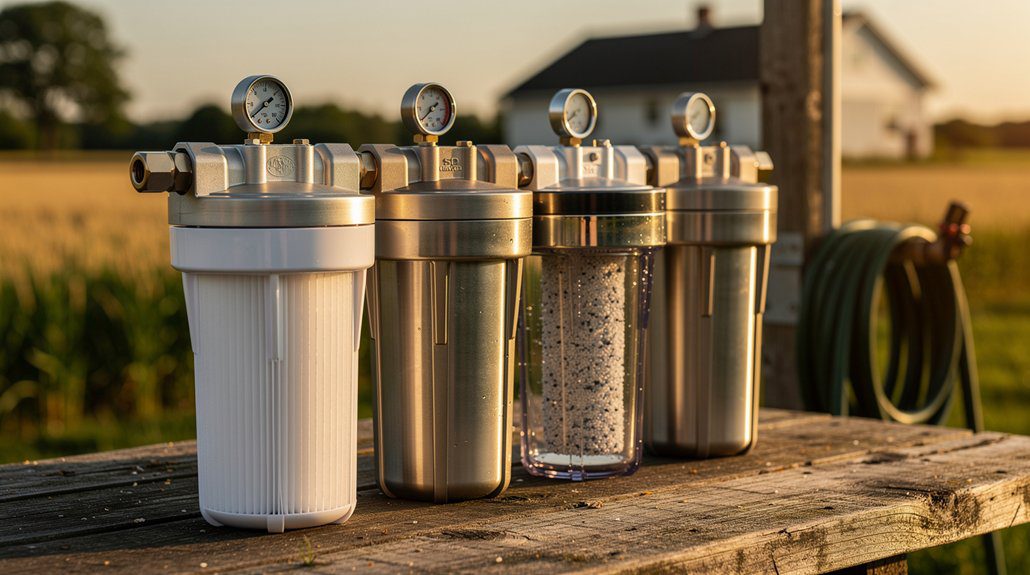
You’ll want rugged, high‑flow prefilters that cut sand, silt, and iron without constant upkeep: the PSF1 and iSpring WSP‑50 offer reusable stainless screens and easy flushes; Waterdrop Mega gives dual coarse meshes and magnetic ferrous capture for heavy turbidity; Membrane Solutions’ 5 µm string‑wound cartridges polish ahead of RO or appliances; and the SimPure DB10P housing fits 10″ cartridges with relief button and brass ports. Keep flow, micron rating, and maintenance needs in mind — keep reading for specs and installation tips.
| PSF1 Spin-Down Sediment Filter Whole House Pre-Filter for Well Water & City Water 40/100/200 Micron Reusable Stainless Steel Mesh 1″ MNPT + 3/4″ FNPT & 3/4″ MNPT Adapter | 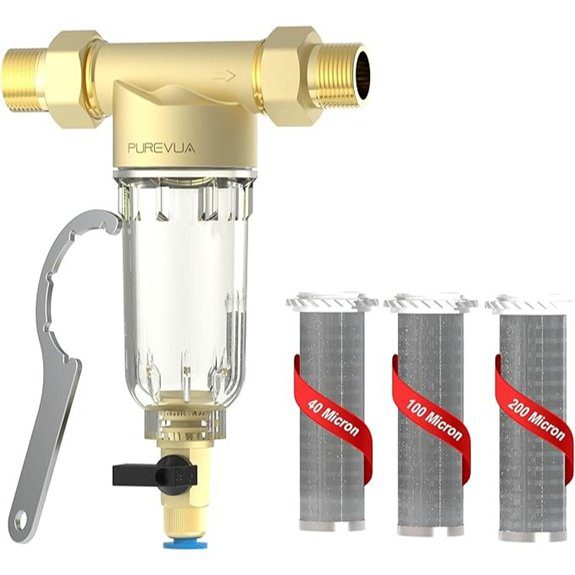 | Whole-House Protector | Intended Use: Whole-house pre-filter for well & city water | Sediment Removal: Removes sediment, rust, large particles, debris | Reusable / Replaceable Element: Reusable stainless steel mesh screens (40/100/200 µm) | VIEW LATEST PRICE | Read Our Analysis |
| iSpring WSP-50 Spin Down Sediment Water Filter Whole House Reusable Flushable Prefilter for Well Water 50-Micron 1″ MNPT + 3/4″ FNPT Lead-Free Brass | 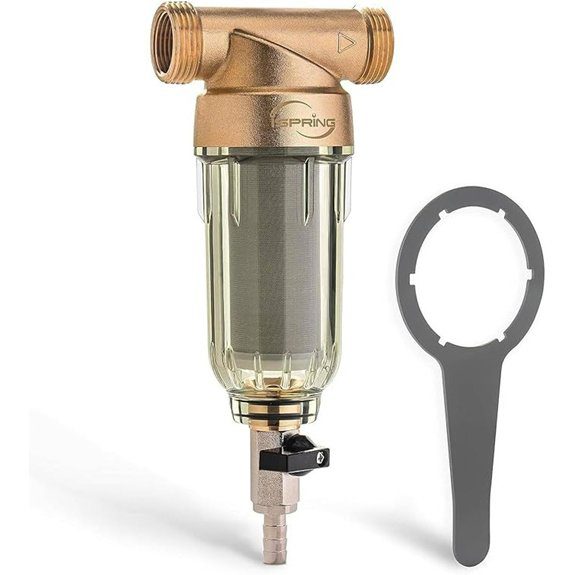 | Reliable Midrange | Intended Use: Whole-house prefilter for well water | Sediment Removal: Removes sediment, rust, dirt, sand, large particles | Reusable / Replaceable Element: Reusable stainless steel mesh screen (50 µm) — replaceable options | VIEW LATEST PRICE | Read Our Analysis |
| Waterdrop Mega Spin Down Sediment Filter Upgraded Reusable Backwash Whole House Water Filter System for City/Well Water 500 Micron+200 Micron,1″ MNPT + 3/4“FNPT BPA Free | 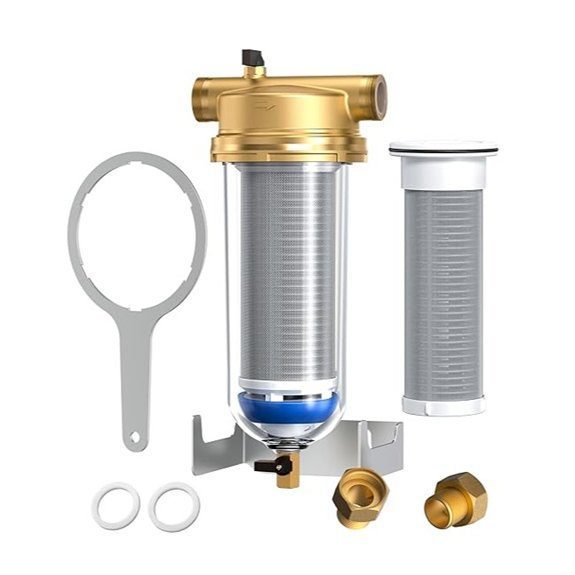 | High-Flow Heavy-Duty | Intended Use: Whole-house backwash filter for city & well water | Sediment Removal: Removes pebbles, sand, silt, rust flakes, debris | Reusable / Replaceable Element: Reusable dual stainless mesh (500 + 200 µm) with backwash | VIEW LATEST PRICE | Read Our Analysis |
| Membrane Solutions 5 Micron 10″x2.5″ String Wound Whole House Water Filter Replacement Cartridge Universal Sediment Filters for Well Water – 6 Pack | 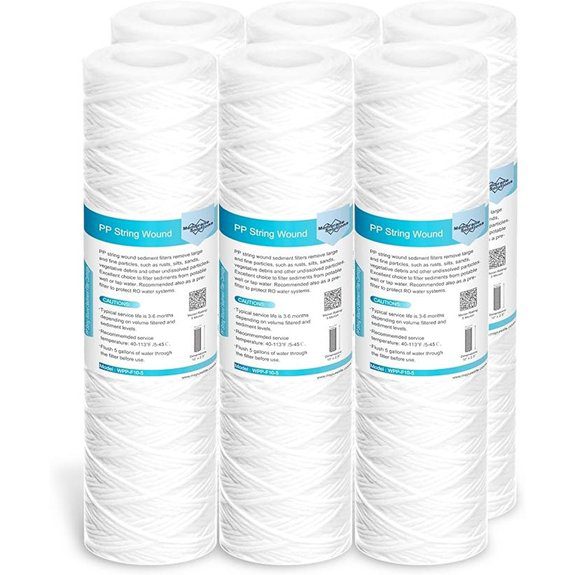 | Fine-Particle Specialist | Intended Use: Whole-house/RO prefilter sediment cartridge (replacement) | Sediment Removal: Removes rust, silt, sand, undissolved particulates (5 µm) | Reusable / Replaceable Element: Disposable/replaceable string-wound cartridges (6-pack) | VIEW LATEST PRICE | Read Our Analysis |
| SimPure Whole House Water Filter Housing (DB10P) 10″ x 4.5″ Sediment Carbon Filter Universal Housing Pre-Filtration System for Well and City Water 1″ NPT Port Pressure Release | 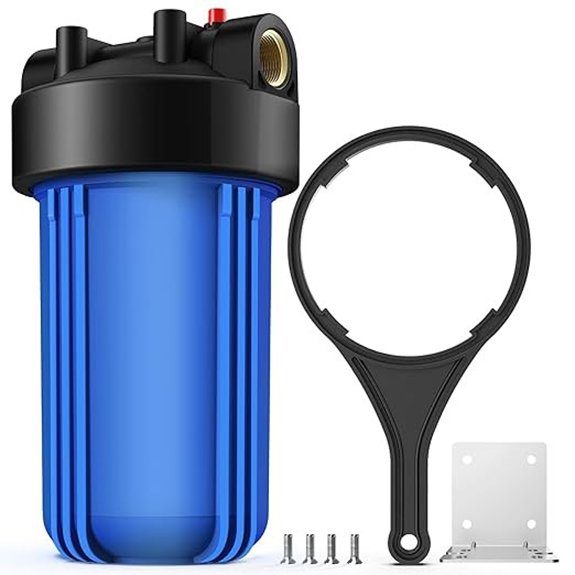 | Universal Housing | Intended Use: Whole-house pre-filtration housing for well & city water | Sediment Removal: Intended for sediment removal using compatible cartridges | Reusable / Replaceable Element: Housing accepts replaceable 4.5″x10″ cartridges | VIEW LATEST PRICE | Read Our Analysis |
More Details on Our Top Picks
PSF1 Spin-Down Sediment Filter Whole House Pre-Filter for Well Water & City Water 40/100/200 Micron Reusable Stainless Steel Mesh 1″ MNPT + 3/4″ FNPT & 3/4″ MNPT Adapter
If you’re dealing with gritty well water or heavy municipal sediment, the PSF1 spin-down pre-filter is your best choice for protecting plumbing and appliances—it traps rust and large particles with reusable 40/100/200 µm stainless-steel screens and lets you flush debris away in seconds without replacing cartridges. You’ll install it as a whole-house pre-filter to shield heaters, washers, and RO systems, extending their life. The clear BPA-free housing lets you monitor buildup; three stainless screens swap quickly. It handles up to 20 GPM with minimal pressure drop, uses reinforced O-rings and gaskets for leak resistance, and includes a 24″ drain hose.
- Intended Use:Whole-house pre-filter for well & city water
- Sediment Removal:Removes sediment, rust, large particles, debris
- Reusable / Replaceable Element:Reusable stainless steel mesh screens (40/100/200 µm)
- Connection / Port Size:1″ MNPT + 3/4″ FNPT (includes 3/4″ MNPT adapter)
- Visual / Inspection Capability:Transparent BPA-free housing for visual monitoring
- Maintenance / Cleaning:Spin-down flush valve — quick bi-monthly flush (~30 sec)
- Additional Feature:Three mesh micron options
- Additional Feature:24″ drain hose included
- Additional Feature:Dual-thread head adapters
iSpring WSP-50 Spin Down Sediment Water Filter Whole House Reusable Flushable Prefilter for Well Water 50-Micron 1″ MNPT + 3/4″ FNPT Lead-Free Brass
Homeowners with private wells that frequently carry sand, rust, or coarse sediment will find the iSpring WSP-50 an effective upfront protector for their plumbing and finer filters. You’ll get a 50-micron stainless steel mesh in a see-through, lead-free brass head that lets you monitor buildup and flush the sediment via a garden-hose barb. It connects with 1″ MNPT and 3/4″ FNPT threads for straightforward indoor installation, includes a wrench and manual, and fits operating ranges of 40–100°F and 15–115 psi. For very heavy sediment, consider larger micron screens or bigger spin-down models to avoid rapid clogging.
- Intended Use:Whole-house prefilter for well water
- Sediment Removal:Removes sediment, rust, dirt, sand, large particles
- Reusable / Replaceable Element:Reusable stainless steel mesh screen (50 µm) — replaceable options
- Connection / Port Size:1″ MNPT + 3/4″ FNPT (double-thread ends)
- Visual / Inspection Capability:See-through housing for visual monitoring
- Maintenance / Cleaning:Flushable/reusable — periodic flushing recommended
- Additional Feature:Lead-free brass head
- Additional Feature:Garden-hose flush barb
- Additional Feature:Compact 3.5″x9″ size
Waterdrop Mega Spin Down Sediment Filter Upgraded Reusable Backwash Whole House Water Filter System for City/Well Water 500 Micron+200 Micron,1″ MNPT + 3/4“FNPT BPA Free
You’ll appreciate the Waterdrop Mega Spin Down if you’re dealing with muddy well water and need a high-flow, easy-to-clean prefilter: its dual 500 μm + 200 μm mesh catches everything from coarse sand and rust flakes to silt and algae fragments, while a 25 GPM capacity and enlarged chamber keep water pressure steady for whole-house use. You’ll benefit from a 20× larger chamber, outer mesh 7× and inner mesh 4.2× larger than standard. A 3.2 lb nano-coated brass head resists corrosion and 200,000 water-hammer cycles. Magnetic tech reduces scale and attracts ferrous particles. Use the 2-way bypass and 360° power flush; clean biweekly.
- Intended Use:Whole-house backwash filter for city & well water
- Sediment Removal:Removes pebbles, sand, silt, rust flakes, debris
- Reusable / Replaceable Element:Reusable dual stainless mesh (500 + 200 µm) with backwash
- Connection / Port Size:1″ MNPT + 3/4″ FNPT
- Visual / Inspection Capability:BPA-free see-through design (large chamber for visibility)
- Maintenance / Cleaning:Manual forward/reverse backwash with 360° power flush; recommended clean every 2 weeks
- Additional Feature:Dual-stage 500/200μm
- Additional Feature:Magnetic ferrous capture
- Additional Feature:360° reverse flush
Membrane Solutions 5 Micron 10″x2.5″ String Wound Whole House Water Filter Replacement Cartridge Universal Sediment Filters for Well Water – 6 Pack
For well owners dealing with heavy sediment, the Membrane Solutions 5-micron 10″x2.5″ string-wound cartridges are a strong, cost-effective prefilter choice that protects downstream systems and appliances. You get six 100% food-grade polypropylene cartridges with a deep graded honeycomb string-wound design that traps large particles outward and finer sediment toward the core. Certified by NSF for material requirements, they remove up to 99% of rust, silt, sand, and undissolved particulates. They claim four times the dirt-holding capacity and double the flow of standard PP filters, lasting up to 15,000–20,000 gallons; replace at least every six months.
- Intended Use:Whole-house/RO prefilter sediment cartridge (replacement)
- Sediment Removal:Removes rust, silt, sand, undissolved particulates (5 µm)
- Reusable / Replaceable Element:Disposable/replaceable string-wound cartridges (6-pack)
- Connection / Port Size:Designed to fit standard 10″x2.5″ housings (works with standard ports)
- Visual / Inspection Capability:N/A for individual cartridge (intended for use inside visible housings)
- Maintenance / Cleaning:Replace cartridge every ~6 months (service life 15k–20k gallons)
- Additional Feature:String-wound graded density
- Additional Feature:NSF ANSI 42 certified
- Additional Feature:Up to 20k gallon life
SimPure Whole House Water Filter Housing (DB10P) 10″ x 4.5″ Sediment Carbon Filter Universal Housing Pre-Filtration System for Well and City Water 1″ NPT Port Pressure Release
If you need a robust pre-filter that fits standard 4.5″ x 10″ cartridges and handles up to 20 gallons per minute, the SimPure DB10P is a solid pick for whole-house sediment and carbon filtration. You get a reinforced polypropylene housing with brass 1″ NPT ports, a food-grade, NSF-tested design, and a built-in red pressure-relief button for safe, easy cartridge changes. It mounts with a heavy-duty steel bracket and includes a wrench and screws; cartridges and push fittings are sold separately. Compatible with many 4.5″ x 10″ cartridges, it supports up to 500 ppm TDS and 40°C operating temperature.
- Intended Use:Whole-house pre-filtration housing for well & city water
- Sediment Removal:Intended for sediment removal using compatible cartridges
- Reusable / Replaceable Element:Housing accepts replaceable 4.5″x10″ cartridges
- Connection / Port Size:1″ NPT port
- Visual / Inspection Capability:Housing (opaque/reinforced polypropylene) designed to accept visible cartridges; pressure-relief makes cartridge changes visible/accessible
- Maintenance / Cleaning:Cartridge change via pressure-release button; requires periodic cartridge replacement
- Additional Feature:Built-in pressure-relief
- Additional Feature:Includes mounting bracket
- Additional Feature:Universal 4.5″x10″ fit
Factors to Consider When Choosing a Sediment Filter for Well Water
Before you pick a sediment filter for well water, consider your water source and the typical particle sizes it contains so you match the right micron rating. Check the system’s flow rate to make sure it can handle your household demand without pressure loss. Also weigh maintenance needs and cleaning frequency to find a durable, low‑upkeep option.
Water Source Characteristics
When you’re sizing a sediment filter, start by characterizing your well water’s solids and flow so the system matches actual conditions. Measure turbidity (NTU) and suspended solids (mg/L); very turbid water (>5 NTU) or high solids often needs coarse prefilters (≥200–500 μm) or multi-stage setups. Identify dominant sediment—sand, silt, iron floc, organic matter—because abrasive sand demands robust, larger-diameter screens while fine silt and iron require finer micron ratings or sequential filtration. Determine peak and typical household flow rates (10–25 GPM common) so filters don’t create excessive pressure drop. Test for seasonal spikes and drawdown variability; intermittent surges may call for spin-down or backwash-capable units. For iron-rich or magnetic particles, consider magnetic/chemical pretreatment or larger-capacity filters to reduce fouling and maintenance.
Particle Size Range
Because particle size controls what your sediment filter can catch and how often you’ll need to service it, start by identifying the dominant sizes in your well water—coarse sand (200–500+ µm), silt (20–63 µm), and colloidal clay (<2 µm)—and match those to appropriate micron ratings and filter types. Use coarse pre-filters (100–500 µm) to strip grit and protect finer stages, then employ 5–50 µm cartridges for silt and rust. Know whether ratings are nominal or absolute: nominal screens remove a percentage at the stated size, while absolute ratings capture nearly all larger particles. Very fine particles and colloids (<5 µm) often bypass simple mesh, so plan depth or string-wound cartridges and multi-stage or coagulation options. Account for seasonal spikes by choosing interchangeable elements.
Filtration Micron Rating
You’ve matched particle sizes to filter types and staged pre-filters to catch grit; now pick micron ratings that balance removal efficiency, flow, and maintenance. Choose ratings by the particles you need to remove: 100–500 µm or ≥200 µm for initial pre-filters that stop sand and pebbles with low pressure drop and long service intervals; 50 µm for general sediment protection; and ≤5 µm for polishing ahead of point-of-use systems, RO membranes, or fine-media filters. Remember finer microns remove silt, rust, and reduce turbidity and appliance wear but clog faster and may require larger housings or spin-down designs to avoid loss of usable capacity. Stage coarse-to-fine to maximize dirt-holding capacity, extend life, and minimize maintenance frequency.
Flow Rate Requirements
If your household runs several fixtures at once, add their flow rates to find your peak demand so the sediment filter can handle that combined GPM without creating a noticeable pressure drop. Once you’ve totaled simultaneous flows (showers ≈2.5 GPM, washer 3–5 GPM, etc.), choose a filter rated at or above that peak plus a 10–25% safety margin — for example, pick a 20 GPM prefilter for a 16–18 GPM peak. Verify the filter’s pressure-drop specs at your expected flow and aim for low differential pressure (<5–10 psi at rated flow). For large properties or heavy use, use higher-flow models or parallel/filter-bank setups. Match micron size and media surface area to flow: coarser or larger-area filters sustain higher GPM with less clogging.
Maintenance And Cleaning
Sizing and flow specs matter, but regular upkeep determines how well a sediment filter keeps working over time. Check and clean or flush pre-filters (spin-down or housings) every 2–8 weeks depending on visible turbidity to prevent clogging and pressure drop. Replace disposable cartridges per the manufacturer—typically every 3–6 months for whole-house 5–10″ cartridges or sooner if flow or differential pressure degrades. Inspect O-rings, threaded seals, and drain valves at each service; lubricate O-rings with food-grade silicone grease and replace damaged seals to avoid leaks. When cleaning reusable stainless-steel screens, backflush or rinse with clean water and use a soft brush—never harsh wires or chemicals. Keep a maintenance log with flush dates, cartridge changes, and inlet/outlet pressures to track well-condition trends.
Material Durability
Because well water can be abrasive, corrosive, and variable in temperature and pressure, choose housings, heads, and filter media built from corrosion-resistant and impact-tolerant materials (stainless steel, brass, or reinforced polypropylene) so the system lasts and needs fewer emergency repairs. You should pick stainless steel mesh screens or high-quality polypropylene cartridges that resist abrasion and repeated backwashing. Verify pressure and temperature ratings match your pump and seasonal extremes, and confirm components tolerate water hammer. Inspect seals and O-rings for chemical and UV resistance—EPDM or Viton suit harsher conditions. Favor units tested for impact, freeze tolerance, and cycle endurance, and prefer designs with easy-to-replace wear parts. That approach reduces downtime and keeps maintenance predictable over the system’s service life.
Installation Compatibility
When you pick a sediment filter, make sure its connections, dimensions, and performance match your plumbing so installation won’t require costly adapters or rearrangements. Check thread sizes and types (1″ vs 3/4″, NPT/MNPT/FNPT) and confirm compatible adapters or fittings for a leak-free seal. Verify housing dimensions and clearance so you can inspect and remove cartridges or screens easily. Ensure the filter’s max flow rate (GPM) and pressure rating exceed your peak household demand and local pressure to avoid restrictions or damage. Confirm port material and locations suit indoor or outdoor use, freeze risk, and whether mounting brackets are provided. Finally, make sure plumbing layout can accommodate required maintenance access—drain hose, bypass valve, or pressure-relief features—without major rework.
Downstream Protection
For protecting pumps, water heaters, and sensitive appliances downstream, pick a sediment filter that stops particles small enough to cause damage and that won’t bottleneck your household flow. Choose a micron rating appropriate to appliance sensitivity—typical prefilters run 5–50 microns—and ensure flow capacity meets or exceeds household demand (whole-house systems often need 20–25 GPM) to avoid pressure drop. Place a reusable spin-down or coarse prefilter ahead of fine cartridges to capture large debris, reduce clogging, and extend membrane and carbon life. Match housing, ports, and seals to your plumbing using robust materials (brass ports, reinforced O-rings) to prevent leaks. Finally, factor maintenance interval and ease of flushing or cartridge swaps; frequent, quick service for high-sediment wells minimizes particulate breakthrough.