

You’ll get industrial-grade filtration, portability, and true HEPA performance with three top picks for 2026: the VEVOR 550 CFM air scrubber (H13 HEPA, carbon, MERV‑10, up to 550 CFM), the Abestorm MEVR‑10 (stackable, negative‑air capable, true HEPA and carbon, 270–550 CFM), and the ALORAIR 3‑Stage scrubber (daisy‑chainable to 1,650 CFM, MERV‑10, carbon, HEPA). Choose by CFM, portability, and maintenance needs, and keep going to see detailed specs and comparisons.
| VEVOR 550 CFM Air Scrubber with H13 HEPA | 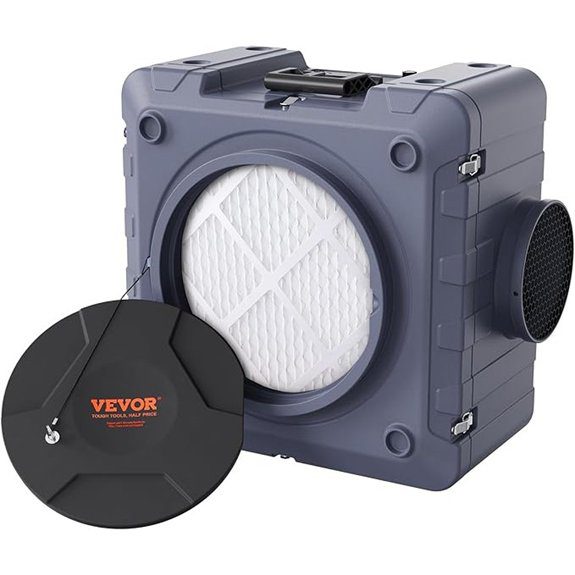 | Professional Grade | Filtration stages: Three-stage (pre-filter MERV-10, carbon, H13 HEPA) | HEPA effectiveness: Captures 99.97% of particles ≥ 0.3 microns | Airflow range / max CFM: Maximum 550 CFM (adjustable) | VIEW LATEST PRICE | Read Our Analysis |
| Abestorm MEVR-10 Air Scrubber with HEPA & Carbon | 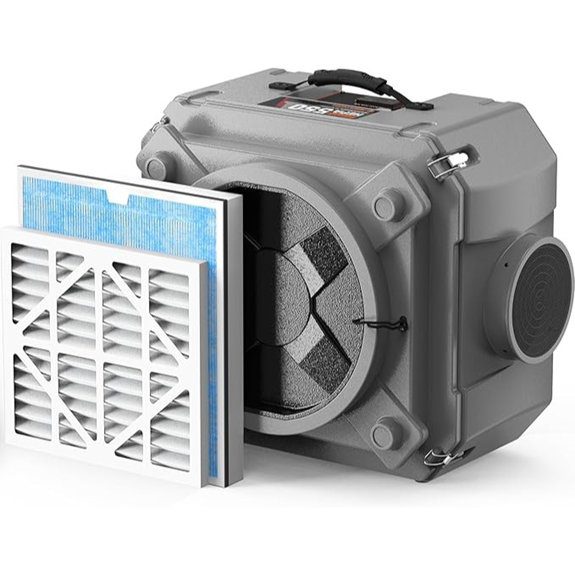 | Compact Performer | Filtration stages: Three-stage (MERV-10 pre-filter, HEPA, activated carbon) | HEPA effectiveness: Captures 99.97% of particles ≥ 0.3 microns | Airflow range / max CFM: Adjustable 270–550 CFM (max 550 CFM) | VIEW LATEST PRICE | Read Our Analysis |
| ALORAIR 3-Stage Commercial Air Scrubber (MERV-10 HEPA) | 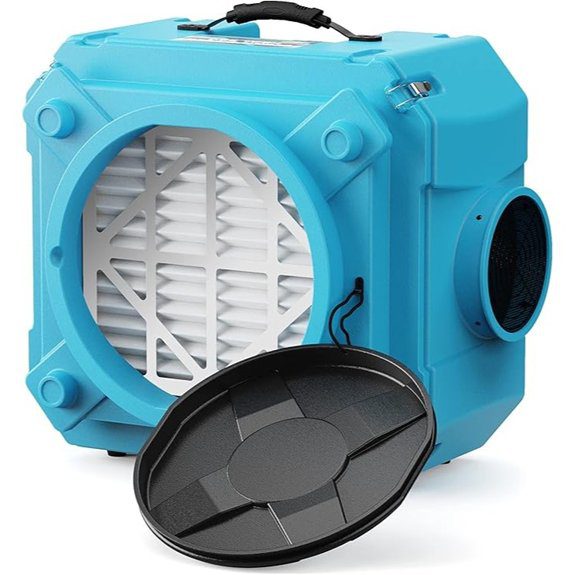 | Trusted Durability | Filtration stages: Three-stage (MERV-10 prefilter, activated carbon, HEPA) | HEPA effectiveness: Captures 99.97% of particles ≥ 0.3 microns | Airflow range / max CFM: Adjustable 270–550 CFM (max 550 CFM) | VIEW LATEST PRICE | Read Our Analysis |
More Details on Our Top Picks
VEVOR 550 CFM Air Scrubber with H13 HEPA
If you need a powerful, portable unit for large spaces or job sites, the VEVOR 550 CFM Air Scrubber with H13 HEPA is a top pick—its three-stage filtration (MERV-10 pre-filter, carbon, and H13 HEPA) captures 99.97% of particles ≥0.3 microns while delivering up to 550 CFM and coverage for 5,500 cubic feet, so you can set it up quickly and clear the air on painting, restoration, or construction jobs. You’ll adjust airflow via the control panel, use the resettable timer, and monitor the filter-change light. At 35 pounds with a foldable handle, stackable body, daisy-chain sockets, and a copper motor, it’s built for rugged, efficient performance.
- Filtration stages:Three-stage (pre-filter MERV-10, carbon, H13 HEPA)
- HEPA effectiveness:Captures 99.97% of particles ≥ 0.3 microns
- Airflow range / max CFM:Maximum 550 CFM (adjustable)
- Coverage volume:Filtration coverage up to 5,500 cubic feet
- Portability / stackability:Foldable handle, stackable, 35 lb
- Intended applications:Home, industrial, commercial; painting, construction, sewage/fire restoration, repairs
- Additional Feature:High-efficiency copper motor
- Additional Feature:Two auxiliary sockets
- Additional Feature:Foldable single-person handle
Abestorm MEVR-10 Air Scrubber with HEPA & Carbon
Professionals who need rugged, high‑flow filtration will appreciate the Abestorm MEVR-10, which pairs a MERV‑10 pre‑filter, true HEPA and activated carbon to capture 99.97% of particles ≥0.3 μm while handling 270–550 CFM and covering up to 800 sq ft—stack up to three units for even larger jobs or configure it as a negative air machine. You’ll get three-stage filtration that traps allergens, pet dander and microscopic pollutants while activated carbon cuts odors. The rotomolded shell withstands demanding sites, it’s portable at 39.6 lb with a handle, includes GFCI outlet, plug‑and‑play operation and two MERV‑10 filters.
- Filtration stages:Three-stage (MERV-10 pre-filter, HEPA, activated carbon)
- HEPA effectiveness:Captures 99.97% of particles ≥ 0.3 microns
- Airflow range / max CFM:Adjustable 270–550 CFM (max 550 CFM)
- Coverage volume:Coverage up to 800 sq ft (5,500 cubic feet)
- Portability / stackability:Portable handle, stackable up to 3 units, 39.6 lb
- Intended applications:Home repairs, construction, water/fire damage, sewage repairs, salons, shops, printing
- Additional Feature:Rotomolded ultra-sturdy shell
- Additional Feature:Built-in GFCI outlet
- Additional Feature:Configurable as negative air
ALORAIR 3-Stage Commercial Air Scrubber (MERV-10 HEPA)
Choose the ALORAIR 3-Stage Commercial Air Scrubber when you need a rugged, high-capacity unit that balances strong HEPA filtration with effective odor and smoke removal for mid-size jobsites and restoration projects. You get a MERV-10 prefilter, activated carbon stage, and HEPA capturing 99.97% of ≥0.3 µm particles across 5,500 cu ft. Airflow runs 270–550 CFM (max 550); daisy-chain up to three units for 1,650 CFM. The rotomolded LLDPE shell weighs 39.6 lb, stacks vertically/horizontally, and includes an integrated handle. Controls are simple, with indicator lights, GFCI outlets, a reset breaker, ETL safety certification, and a 10-year limited warranty.
- Filtration stages:Three-stage (MERV-10 prefilter, activated carbon, HEPA)
- HEPA effectiveness:Captures 99.97% of particles ≥ 0.3 microns
- Airflow range / max CFM:Adjustable 270–550 CFM (max 550 CFM)
- Coverage volume:Filtration coverage up to 5,500 cubic feet
- Portability / stackability:Integrated handle, stackable horizontally/vertically up to 3 units, 39.6 lb
- Intended applications:Home repairs, construction, sewage/water/fire restoration, salons, printing shops
- Additional Feature:ETL-certified electrical safety
- Additional Feature:10-year limited warranty
- Additional Feature:16″ inlet compatibility
Factors to Consider When Choosing a Commercial Air Purifier
When choosing a commercial air purifier, you’ll want to check filtration efficiency ratings and the specific filter types included to make sure it captures the particles you care about. Also compare airflow and capacity against the square footage you need to treat, and consider portability and weight if you’ll be moving units between spaces. Finally, inspect durability and construction so the unit holds up to heavy use and maintenance.
Filtration Efficiency Ratings
Because filtration ratings tell you what a purifier can actually remove from the air, you should focus on both filter class (HEPA H13, MERV levels) and system design (pre-filters, activated carbon stages) to match contaminants and space requirements. HEPA H13 captures ≥99.97% of particles ≥0.3 microns, so it’s essential for smoke, pollen, and many aerosols. Use MERV ratings (commonly MERV-8 to MERV-13) to gauge performance across particle sizes—higher MERVs catch smaller particles but can raise airflow resistance. Evaluate activated carbon by adsorbent volume and surface area for gases, VOCs, and odors. Prefer multi-stage systems (pre-filter + HEPA + carbon) to protect HEPA life and sustain efficiency. Finally, verify certified metrics—percent removal at specific sizes and CADR/CFM—to ensure the unit meets your air-cleaning targets.
Airflow And Capacity
Although airflow often gets treated as a secondary spec, it directly determines how fast a purifier removes contaminants, so you should match CFM to room volume or desired ACH; for example, a 550 CFM unit can serve roughly 5,500 cubic feet and will turn that air over much faster than a lower‑CFM model. You’ll use CFM to size units—higher CFM speeds pollutant removal, lower CFM reduces noise and energy. Adjustable settings let you trade speed for comfort during occupied hours. For larger areas, place multiple stackable or daisy‑chainable units to multiply effective CFM instead of one oversized machine. If you plan ducting or negative pressure, check inlet/outlet diameters and expected pressure loss so declared CFM holds up in your configured layout.
Filter Types Included
If you want reliable, broad-spectrum removal, choose units that pair a MERV-10 pre-filter, activated carbon, and a true HEPA stage—each layer tackles a different problem so the system performs efficiently and lasts longer. You’ll rely on the MERV-10 to catch hair, lint and drywall dust, protecting the HEPA so it keeps capturing fine particles like smoke, pollen and aerosolized pathogens at 99.97% efficiency down to 0.3 microns. The activated carbon layer adsorbs VOCs and odors from paint, smoke and chemical spills, improving air quality beyond particulate removal. Before buying, verify filter dimensions, expected service life and whether the unit has replacement indicators—timely swaps preserve rated airflow and capture efficiency.
Portability And Weight
When you’ll be moving units between rooms or sites, portability and weight become as important as filtration efficiency; check the listed weight (many commercial models run 30–40+ lbs) and whether a single person can lift or maneuver it safely. Confirm built-in handles, foldable grips, or smooth wheels so you can transport units without awkward holds or extra equipment. Look for compact footprints or stackable designs when you need to store or ship multiple units. Test balance and center of gravity to ensure stable carrying and placement and to avoid tip-overs during moves. If you’ll relocate often, prioritize lower weight per CFM—this gives you better portability relative to airflow performance and reduces strain over repeated moves.
Durability And Construction
Because commercial units take a beating on jobsites and during frequent moves, you’ll want a purifier built from impact-resistant materials like rotomolded polyethylene or reinforced metal, with reinforced corners and a stackable design that protects the shell and control panel. Pay attention to weight and handle design—models around 35–40 lb with integrated or foldable handles hit the sweet spot between portability and ruggedness. Inspect seals, gasket quality, and filter access doors to ensure tight closures that prevent air bypass and keep moisture and contaminants out. Confirm corrosion-resistant fasteners and durable latches for repeated use. Finally, verify safety certifications and protective hardware for long-term reliability, but focus here on construction quality that survives transport, stacking, and harsh environments.
Safety And Controls
Good construction keeps a unit intact through rough handling, but you also need controls and safety features that protect people and equipment during operation. Check for a resettable circuit breaker or thermal cutoff to prevent motor overheating and electrical overloads. Ensure outlets are GFCI-protected or grounded and components carry ETL/UL certification to lower shock and fire risk. Use control panels with clear airflow settings plus a timer/reset so you can limit run time and avoid unattended continuous operation. Rely on visual indicators—filter change lights or alarms—to prevent bypass from clogged filters and maintain performance. When configuring multiple units, verify stacking/daisy-chain specs, weight limits, and secure handles or latches to avoid tipping or accidental disconnection.
Maintenance And Costs
If you want predictable operating costs, start by tallying filter and consumable replacement schedules and prices—HEPA elements usually last 6–12 months, pre‑filters may need monthly swaps, and carbon or specialty media can require replacement every 3–12 months depending on odor and VOC load. Also factor in labor and downtime: plan quarterly or semiannual inspections, routine cleaning of intake/outlet grilles, and budget technician visits for motor or electrical issues. Include energy costs tied to fan speed and runtime—higher airflow raises electricity use and speeds filter loading. Check warranty terms and parts availability; longer warranties and easy access to replacement filters reduce total cost of ownership and prevent service delays. Add consumables, parts lead times, and realistic labor rates to your budget.