

You’ll want a high‑CADR HEPA purifier with activated carbon and smart airflow to cut mold spores, fragments, and musty odors fast. For medium rooms pick the Clorox HEPA with 360° airflow and auto sensor; for large spaces consider Afloia or PuroAir 240 for 1,000+ sq ft coverage and multi‑stage filters. GermGuardian AC4825E is a compact budget HEPA tower, and the Levoit Core Mini‑P suits small rooms. Keep filters fresh and follow placement tips to get the best results if you want specifics.
| Clorox HEPA Air Purifier for Medium Rooms |  | Best for Medium Spaces | Filtration Stages: 3-stage (pre-filter, True HEPA, activated carbon) | HEPA-Level Filtration: True HEPA (99.97% at 0.1 µm) | VOC / Odor Reduction (Carbon): Active carbon filter for VOCs and odors | VIEW LATEST PRICE | Read Our Analysis |
| Afloia Air Purifier for Large Rooms (1076 ft²) |  | Best for Large Rooms | Filtration Stages: 3-stage (triple-stage filter) | HEPA-Level Filtration: HEPA-grade (captures pet dander, dust, pollen, smoke) | VOC / Odor Reduction (Carbon): Neutralizes stubborn household odors (carbon stage) | VIEW LATEST PRICE | Read Our Analysis |
| PuroAir 240 HEPA Air Purifier for Large Rooms |  | Best Smart Performance | Filtration Stages: 3-layer (pre-filter, HEPA, activated carbon) | HEPA-Level Filtration: HEPA (filters 99.9% of pollutants; lab-tested) | VOC / Odor Reduction (Carbon): Activated carbon layer for VOCs/odors | VIEW LATEST PRICE | Read Our Analysis |
| GermGuardian HEPA Tower Air Purifier AC4825E |  | Best with UV Protection | Filtration Stages: 3-layer True HEPA H13 + activated carbon (+ optional UV-C) | HEPA-Level Filtration: True HEPA H13 (99.97% at 0.1 µm) | VOC / Odor Reduction (Carbon): Activated carbon filter for odor reduction | VIEW LATEST PRICE | Read Our Analysis |
| LEVOIT Core Mini-P Air Purifier (White) | 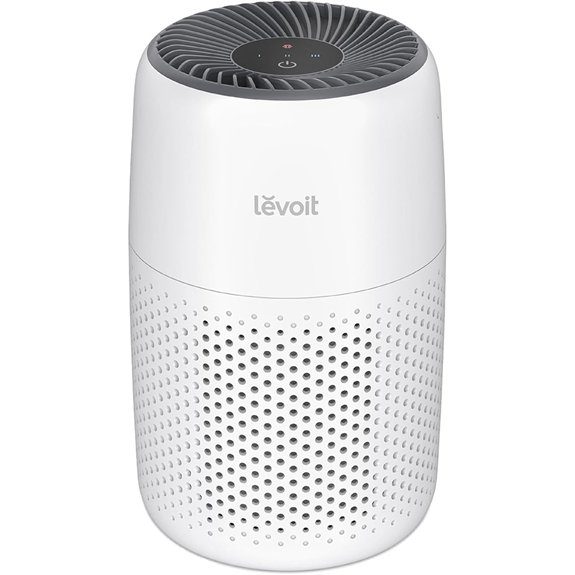 | Best Compact Option | Filtration Stages: 3-in-1 filter (pre-filter + main HEPA-type + activated carbon) | HEPA-Level Filtration: HEPA-type (captures particles down to 0.1 µm; AHAM verified) | VOC / Odor Reduction (Carbon): Activated carbon in 3-in-1 filter for odors/fumes | VIEW LATEST PRICE | Read Our Analysis |
More Details on Our Top Picks
Clorox HEPA Air Purifier for Medium Rooms
If you’re looking for a quiet, ENERGY STAR–rated purifier that tackles mold spores and other fine particles in medium to large rooms, the Clorox True HEPA model is a solid choice — it captures 99.97% of particles down to 0.1 micron and combines HEPA with carbon filtration and 360° airflow to reduce mold, smoke, odors, and allergens while running whisper-quiet in occupied spaces. You’ll get 3-stage filtration (pre-filter, True HEPA, active carbon), PM2.5 display, auto mode with sensor, and a red filter light after ~4,380 hours. It cleans up to five times hourly in 225 sq. ft. and suits rooms up to 1,000 sq. ft.
- Filtration Stages:3-stage (pre-filter, True HEPA, activated carbon)
- HEPA-Level Filtration:True HEPA (99.97% at 0.1 µm)
- VOC / Odor Reduction (Carbon):Active carbon filter for VOCs and odors
- Coverage / Room Size:Up to 1,000 sq. ft. (cleans 5×/hr in 225 sq. ft.)
- Quiet / Sleep Mode Noise:Whisper quiet operation (30 dB typical)
- Filter Replacement Interval:Replace every 6–12 months; indicator ~4,380 hours
- Additional Feature:Auto mode with sensor
- Additional Feature:PM2.5 digital display
- Additional Feature:Energy Star certified
Afloia Air Purifier for Large Rooms (1076 ft²)
For large open areas where mold spores circulate unchecked, the Afloia air purifier gives you powerful coverage—clearing up to 1,076 ft² within an hour and delivering four air changes per hour in rooms up to 269 ft² so you’ll get faster reduction of airborne mold and allergens. You’ll appreciate its imported 3-stage filter that traps mold, pollen, dust, pet dander, smoke, and hair while neutralizing odors. Choose specialized replacement filters for pet allergy or antibacterial needs. It runs quietly (22 dB sleep mode), offers 7-color auto-dimming lighting, adjustable fan speeds, and 2/4/8 hour timers. Replace filters every 4–6 months.
- Filtration Stages:3-stage (triple-stage filter)
- HEPA-Level Filtration:HEPA-grade (captures pet dander, dust, pollen, smoke)
- VOC / Odor Reduction (Carbon):Neutralizes stubborn household odors (carbon stage)
- Coverage / Room Size:Up to 1,076 ft² (1 hour); 4 ACH for 269 ft²
- Quiet / Sleep Mode Noise:Ultra-quiet Sleep Mode (22 dB)
- Filter Replacement Interval:Replace every 4–6 months recommended
- Additional Feature:7-color atmosphere lighting
- Additional Feature:Multiple filter variants
- Additional Feature:Timer (2/4/8 hrs)
PuroAir 240 HEPA Air Purifier for Large Rooms
Choose the PuroAir 240 when you need powerful, whole-room protection—it’s built to clean up to 1,000 sq ft in an hour and captures particles 700× smaller than a human hair, making it ideal for households battling mold spores, dust, and allergens. You’ll get a 3-layer system—pre-filter, HEPA, activated carbon—that removes up to 99.9% of pollutants including pollen, smoke, pet dander, and VOCs. A smart particle sensor boosts fan speed when needed, and sleep mode keeps operation quiet for continuous use. Lab-tested benefits include reduced allergen symptoms and better sleep. It’s certified (CARB, ETL, ISO, UL) and backed by a 2-year warranty.
- Filtration Stages:3-layer (pre-filter, HEPA, activated carbon)
- HEPA-Level Filtration:HEPA (filters 99.9% of pollutants; lab-tested)
- VOC / Odor Reduction (Carbon):Activated carbon layer for VOCs/odors
- Coverage / Room Size:Up to 1,000 sq. ft. (1 hour)
- Quiet / Sleep Mode Noise:Built-in sleep mode for quiet 24/7 operation
- Filter Replacement Interval:(Not explicitly stated) designed for continuous use; replacement intervals vary by model/options
- Additional Feature:ISO/independent lab tested
- Additional Feature:SleepScore–linked benefits
- Additional Feature:Smart particle sensor
GermGuardian HEPA Tower Air Purifier AC4825E
The GermGuardian AC4825E is ideal for someone who wants a budget-friendly, compact tower that actively reduces mold spores with True HEPA H13 filtration and optional UV‑C sanitizing. You’ll get a 22″ tower that captures 99.97% of particles down to 0.1 microns, an activated carbon layer for odors, and a UV‑C bulb that’s verified zero-ozone. It cleans 153 sq. ft. in 12.5 minutes (up to 743 sq. ft./hr), runs at 55 watts and about 55 dB, and offers three speeds with a quiet low setting. CARB and ETL certified, it includes filters, bulb, and a three-year warranty.
- Filtration Stages:3-layer True HEPA H13 + activated carbon (+ optional UV-C)
- HEPA-Level Filtration:True HEPA H13 (99.97% at 0.1 µm)
- VOC / Odor Reduction (Carbon):Activated carbon filter for odor reduction
- Coverage / Room Size:Up to ~743 sq. ft. per hour (153 sq. ft. in 12.5 min)
- Quiet / Sleep Mode Noise:Quiet operation (lowest setting usable as white noise; 55 dB spec)
- Filter Replacement Interval:Replacement filters available (interval depends on use; UV-C bulb replacement specified)
- Additional Feature:Optional UV‑C light
- Additional Feature:Tower form factor
- Additional Feature:Zero‑ozone certified UV‑C
LEVOIT Core Mini-P Air Purifier (White)
If you need a compact, whisper-quiet purifier for small rooms or bedrooms, the LEVOIT Core Mini-P delivers AHAM-verified filtration for spaces up to about 255 sq ft while running as low as 25–27 dB. You’ll get a 3-in-1 filter (pre-filter, main HEPA-grade, activated carbon) that traps 0.1 µm particles, capturing dust, pet dander, smoke, and allergens that often carry mold spores. It’s ETL and ENERGY STAR certified, uses just 7 W, and weighs 2.2 lb. Controls are simple touch buttons with sleep and aroma pad options—use only 2–3 drops. Maintain performance with Genuine Levoit replacement filters.
- Filtration Stages:3-in-1 filter (pre-filter + main HEPA-type + activated carbon)
- HEPA-Level Filtration:HEPA-type (captures particles down to 0.1 µm; AHAM verified)
- VOC / Odor Reduction (Carbon):Activated carbon in 3-in-1 filter for odors/fumes
- Coverage / Room Size:Up to 255 sq. ft.
- Quiet / Sleep Mode Noise:Sleep mode; described as quieter than a whisper (25–45 dB)
- Filter Replacement Interval:Replace every 4–6 months (genuine replacement filters recommended)
- Additional Feature:Built‑in aromatherapy pad
- Additional Feature:Adapter stored inside
- Additional Feature:AHAM & ENERGY STAR certified
Factors to Consider When Choosing an Air Purifier for Mold Spores
When picking an air purifier for mold spores, you’ll want to check HEPA filtration efficiency and whether it’s rated to capture the tiny sizes of mold spores. Consider the unit’s air changes per hour for your room size, plus activated carbon if you need odor and VOC adsorption. Also make sure it works with your humidity control strategy, since moisture affects mold growth and purifier performance.
HEPA Filtration Efficiency
Because HEPA media capture particles as small as 0.3 microns with 99.97% efficiency, you’ll get reliable removal of most mold spores (which are usually 1–30 microns), while true HEPA performance at smaller sizes also helps trap fine spore fragments and hyphae. You should prioritize true HEPA-rated filters and check CADR to ensure sufficient airflow for your room size—higher CADR moves more air through the media and increases real-world capture. Confirm the unit has a well-sealed filter housing so air doesn’t bypass the media. Monitor pressure drop or follow replacement intervals because loaded filters reduce airflow and efficiency. Remember HEPA captures but doesn’t kill spores; pair filtration with humidity control and source remediation or adjunct germicidal options to prevent regrowth.
Mold Spore Size Capture
Although mold spores vary from about 1 to 20 micrometers, most indoor species fall between roughly 2 and 10 µm, so you should pick a purifier that reliably captures particles down to at least 1 µm—true HEPA filters rated for 0.3 µm (99.97% efficiency) will catch the vast majority, while filters with finer-rated media (around 0.1 µm) give extra protection against tiny spores and fragments. You’ll want mechanical HEPA capture because interception, impaction, and diffusion effectively remove micron-sized spores. Remember filters trap but don’t inactivate viable spores, so sealed removal and timely replacement are essential to prevent re-release. Prioritize certified HEPA media and a unit with good sealing and easy filter-change procedures to maintain long-term performance.
Air Changes Per Hour
In considering air changes per hour (ACH), focus on how quickly a purifier can replace the air in your room, because higher ACH directly cuts airborne mold spore levels faster. You’ll use ACH to match a purifier to room volume: calculate ACH = (CADR × 60) / room volume, where CADR is for the particle sizes that include mold spores. For general residential spaces aim for 3–6 ACH; for high-risk or contaminated areas target 6–12+ ACH. Higher ACH shortens removal time—for example, about 95% of airborne particles are removed at roughly 6 ACH after 30 minutes of continuous operation. Remember ACH only measures air turnover; you still need moisture control and surface remediation to address settled mold.
Activated Carbon Adsorption
After you size a purifier for adequate ACH, look at what it does to the air beyond particle removal—specifically how it handles mold-related gases and odors. Activated carbon adsorbs VOCs and musty smells by trapping gases and organics in pores; it doesn’t remove or kill mold spores. Prioritize high-porosity carbon (hundreds to over 1,000 m²/g) because greater surface area captures more gaseous compounds emitted by mold. Use carbon alongside a HEPA filter to address both odors and airborne spores. Remember carbon works best when fresh—plan replacements roughly every 3–12 months depending on exposure. Also note environmental conditions matter: very high humidity and temperature can compete for adsorption sites and reduce carbon effectiveness, so performance may vary.
Humidity Control Compatibility
When you’re fighting mold spores, control of humidity matters as much as filtration. You’ll need a dehumidifier to keep relative humidity between 30–50%—mold thrives above about 60%—because air purifiers don’t remove moisture. Use HEPA filtration alongside dehumidification: the dehumidifier tackles the source while the purifier captures spores released during remediation or daily disturbance.
Check compatibility: ensure placement space and airflow patterns don’t work against each other, and confirm continuous operation won’t overheat the room or disrupt microclimates. Smart-home integration or separate hygrometers can automate coordination, triggering dehumidification when RH climbs above your setpoint (e.g., <50%). In high-humidity areas like basements or bathrooms, prioritize a correctly sized dehumidifier before relying on filtration.
True UV-C Sanitization
Although UV‑C can inactivate mold spores by damaging their DNA, you’ll only get meaningful results if the device delivers the correct dose—irradiance multiplied by exposure time—inside a purpose‑built UV chamber or coil. When choosing a unit, confirm the wavelength (~254 nm), manufacturer‑specified fluence for mold species, and engineered airflow that ensures sufficient exposure rather than a lone bulb in an open room. Remember UV‑C reduces viability but doesn’t remove spores, fragments, or allergens—pair it with true filtration to capture debris. Check safety features: shielding to prevent human exposure and clear instructions for bulb replacement, since output declines with age. Prefer models with lab validation or third‑party testing that document effective doses against target organisms.
Noise And Placement
If you want continuous spore removal without losing sleep, pick a purifier that runs quietly (ideally ≤30 dB for bedrooms) and place it where air naturally circulates through the unit—centrally in the room or near the mold source—with at least 12–24 inches of clearance from walls or furniture so intake and exhaust aren’t blocked. Position the intake toward the likely spore source (damp wall, HVAC return) rather than tucked in a corner. Run higher fan speeds when you stir spores (cleaning, vacuuming, handling damp items) and drop to a quieter setting overnight. In multiroom homes, treat the affected room with its own appropriately sized purifier instead of relying on distant units. That balances noise tolerance with effective clean-air delivery to the problem area.
Filter Replacement Frequency
Regularly replacing filters is crucial because trapped mold spores and dust will reduce airflow and let performance slip over time. Replace HEPA filters every 6–12 months under typical use, but swap pre-filters and carbon filters every 3–6 months since they clog and can harbor mold faster. If you have visible mold, high humidity, wildfire smoke, or heavy contamination, inspect and replace filters every 1–3 months to avoid spore re-release and preserve efficiency. Use manufacturer filter-life hours (often ~4,000–5,000 hours) as a baseline, yet watch for pressure drop, reduced airflow, or worsening air-quality readings as signs to change filters sooner. Always replace disposable filters promptly and store spares dry and sealed to prevent pre-installation contamination.