
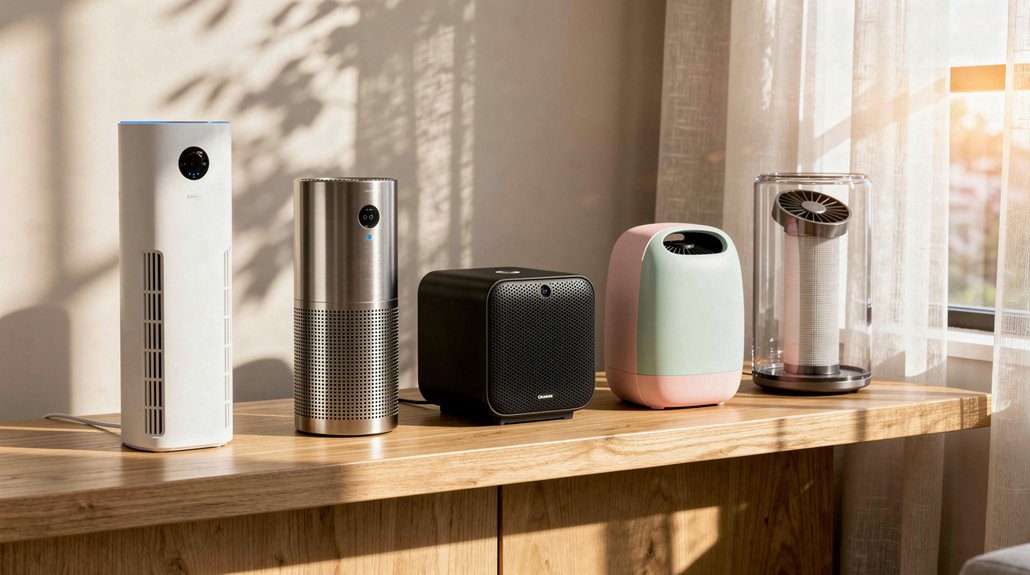
You want fast, reliable allergy relief—pick one of these five: LEVOIT Core300-P for bedrooms, LEVOIT Vital 200S for large rooms with smart control, Quiet H13 for compact, ultra-quiet performance, Purivortex AC400 for high-capacity coverage, or KNKA APH4000 for pet homes with washable pre-filters. They use True HEPA/H13 media, carbon stages for odors, low-noise sleep modes, and verified CADR/ACH figures so you’ll know they work—scroll on to get specs, placement, and filter-care tips.
| LEVOIT Core300-P Air Purifier for Home (White) | 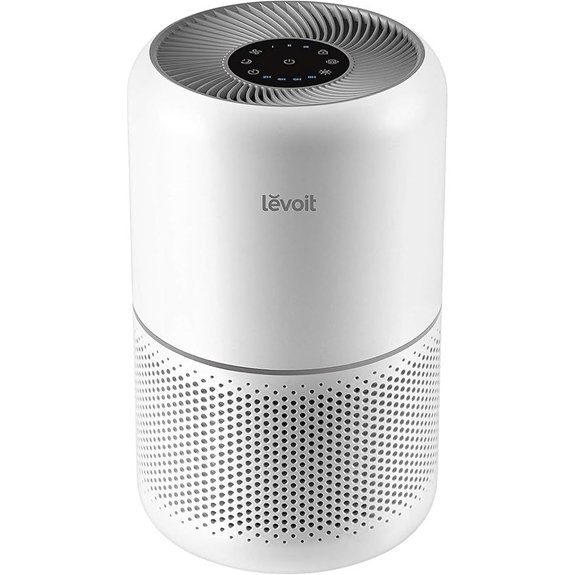 | Compact Bedroom Pick | CADR / Airflow: CADR 143 (smoke) / 153 (dust) / 167 (pollen) CFM | Coverage / Room Size: Refreshes air 4.8×/hr in 222 ft²; 1×/hr in 1,073 ft² | HEPA Filtration: 3-in-1 Levoit Original HEPA-grade filter (99.97% for 0.1–0.3 µm) | VIEW LATEST PRICE | Read Our Analysis |
| LEVOIT Vital 200S Air Purifier for Large Rooms | 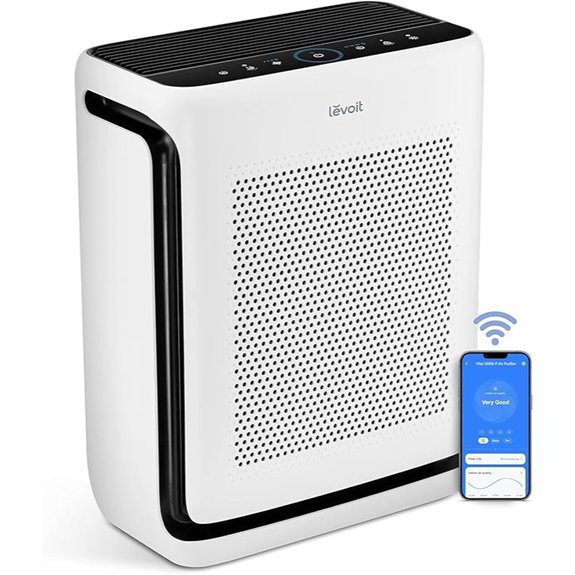 | Best for Large Rooms | CADR / Airflow: CADR 250 (smoke) / 254 (dust) / 289 (pollen) CFM | Coverage / Room Size: Designed for rooms up to 1,875 ft² | HEPA Filtration: True HEPA (99.97% for 0.1–0.3 µm) | VIEW LATEST PRICE | Read Our Analysis |
| Quiet H13 HEPA Air Purifier for Home (White) | 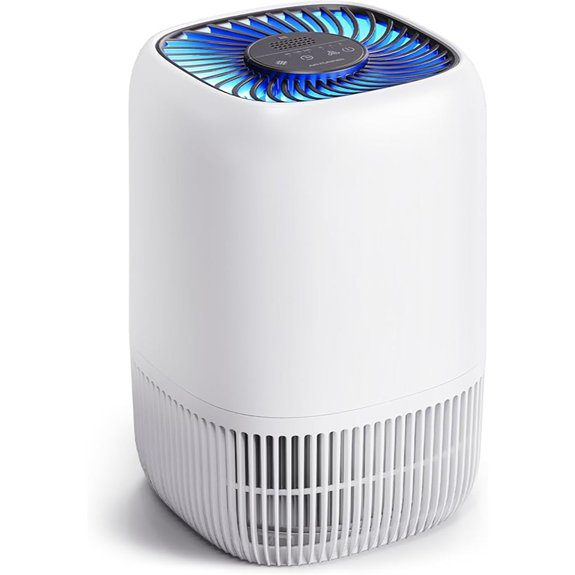 | Ultra-Quiet Desk Unit | CADR / Airflow: Cleans 250 ft² per 15 min (equivalent to ~1,000+ ft²/hr); H13 HEPA airflow for room coverage (explicit CFM not listed) | Coverage / Room Size: Cleans 250 ft² every 15 minutes; covers up to 1,076 ft² per hour | HEPA Filtration: H13 True HEPA triple-layer filter (99.97%) | VIEW LATEST PRICE | Read Our Analysis |
| Purivortex AC400 Quiet HEPA Air Purifier (880 sqft) | 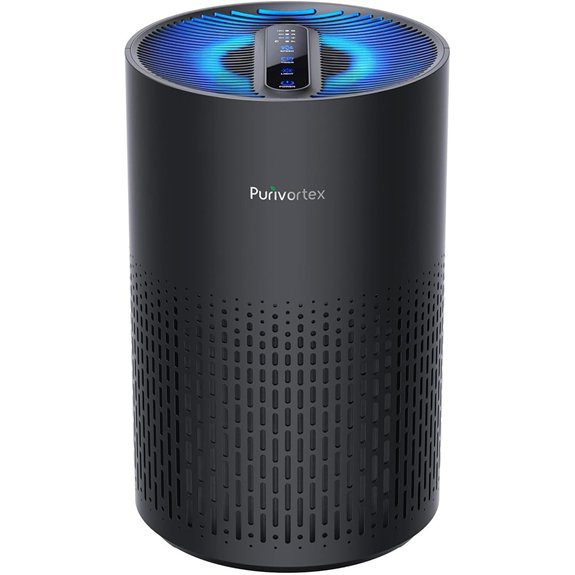 | High-Capacity Performer | CADR / Airflow: Purifies up to 880 ft²/hr; lab-tested (CFM not listed explicitly) | Coverage / Room Size: Purifies rooms up to 880 ft² in one hour; 215 ft² in ~15 minutes | HEPA Filtration: HEPA layer capturing up to 99.97% (filters to 0.1 µm) | VIEW LATEST PRICE | Read Our Analysis |
| KNKA HEPA Air Purifier for Large Rooms (APH4000) | 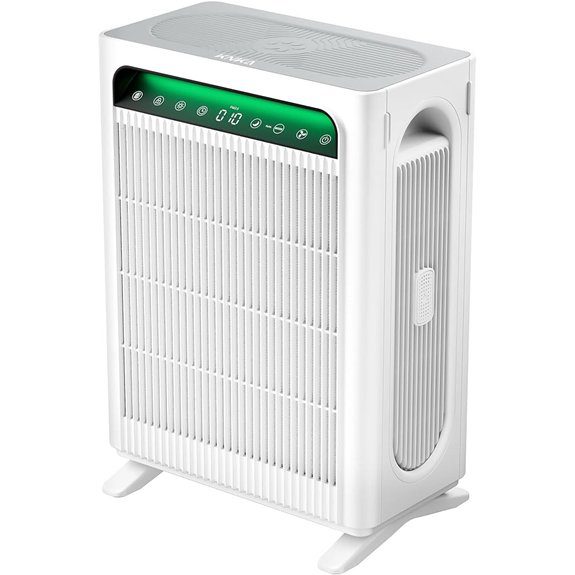 | Best for Pet Households | CADR / Airflow: CADR 226 (smoke/dust/PM2.5) / 244 (pollen) CFM | Coverage / Room Size: 4.8×/hr in 350 ft²; 1×/hr in 1,695 ft² | HEPA Filtration: True HEPA filter in 3-stage cartridge (captures microscopic particles) | VIEW LATEST PRICE | Read Our Analysis |
More Details on Our Top Picks
LEVOIT Core300-P Air Purifier for Home (White)
If you’re looking for a compact, bedroom-ready purifier that tackles pollen, dust, and pet dander with medical-grade efficiency, the LEVOIT Core300-P is a strong choice — it captures 99.97% of 0.1–0.3 μm particles, runs nearly silent in Sleep Mode at 24 dB, and refreshes air in a typical 222 ft² room nearly five times an hour. You’ll get AHAM VERIFIDE performance ratings, CARB compliance, and FCC/ETL safety. The 56W motor delivers CADR up to 167 CFM for pollen. Choose genuine 3-in-1 HEPA filters or specialty options for smoke, toxins, or pet allergy needs. Controls include timers and a dimmable display.
- CADR / Airflow:CADR 143 (smoke) / 153 (dust) / 167 (pollen) CFM
- Coverage / Room Size:Refreshes air 4.8×/hr in 222 ft²; 1×/hr in 1,073 ft²
- HEPA Filtration:3-in-1 Levoit Original HEPA-grade filter (99.97% for 0.1–0.3 µm)
- Activated Carbon / Odor Removal:Optional filters include Smoke Remover / Toxin Absorber (for VOCs/odors)
- Quiet / Sleep Mode Noise:Sleep Mode down to 24 dB (QuietKEAP)
- Auto / Smart Modes & Controls:Timer, display lights off, check filter indicator (manual controls; modes include Sleep)
- Additional Feature:FCC/ETL/CARB certified
- Additional Feature:Sleep Mode 24 dB
- Additional Feature:Multiple filter options
LEVOIT Vital 200S Air Purifier for Large Rooms
The LEVOIT Vital 200S is a strong pick for people with allergies who need powerful, quiet purification in large, pet-friendly spaces. You’ll get AHAM VERIFIDE assurance and independent CADR scores—Smoke 250, Dust 254, Pollen 289 CFM—and 99.97% removal of 0.1–0.3 μm particles. It’s built for rooms up to 1,875 ft², with a high intake plus a U-shaped inlet to trap pet hair and odors while reducing clogs. Use Auto, Sleep, Pet, or manual modes. The VeSync app and voice integration let you schedule, monitor filter life, and dim the display for overnight allergy relief.
- CADR / Airflow:CADR 250 (smoke) / 254 (dust) / 289 (pollen) CFM
- Coverage / Room Size:Designed for rooms up to 1,875 ft²
- HEPA Filtration:True HEPA (99.97% for 0.1–0.3 µm)
- Activated Carbon / Odor Removal:High-performance filter captures odors and particulates (includes pet/hair/odor handling; implied carbon)
- Quiet / Sleep Mode Noise:Sleep Mode (HEPA-grade quiet operation); designed for quiet bedrooms
- Auto / Smart Modes & Controls:Auto Mode (AQ-based), VeSync app control, scheduling, voice assistant integration
- Additional Feature:VeSync app control
- Additional Feature:U-shaped pet hair inlet
- Additional Feature:Light-detection sensor
Quiet H13 HEPA Air Purifier for Home (White)
You’ll appreciate this compact purifier if you want powerful filtration without taking up much space: the Quiet H13 HEPA cleans 250 ft² every 15 minutes (over 1,000 ft² per hour) while operating as low as 22 dB, making it ideal for bedrooms, home offices, or small apartments where quiet, continuous air cleaning matters. You’ll get H13 True HEPA triple-layer filtration that captures 99.97% of airborne pollutants and 360° intake for full-room circulation. Its tiny 6.69 x 6.69 x 9.84-inch footprint fits desks or corners. Controls are one-tap with three speeds, timer, and an essential oil tray; DOE, ETL, FCC, CARB, CE, ROHS certified.
- CADR / Airflow:Cleans 250 ft² per 15 min (equivalent to ~1,000+ ft²/hr); H13 HEPA airflow for room coverage (explicit CFM not listed)
- Coverage / Room Size:Cleans 250 ft² every 15 minutes; covers up to 1,076 ft² per hour
- HEPA Filtration:H13 True HEPA triple-layer filter (99.97%)
- Activated Carbon / Odor Removal:Triple-layer H13 filter (includes odor control layer; essential-oil tray for scent)
- Quiet / Sleep Mode Noise:Quiet operation down to 22 dB; 3 speeds and timer
- Auto / Smart Modes & Controls:One-tap control, three speeds, timer (simplified controls; no app)
- Additional Feature:360° air intake
- Additional Feature:Built-in essential-oil tray
- Additional Feature:Very compact footprint
Purivortex AC400 Quiet HEPA Air Purifier (880 sqft)
Designed for larger living spaces and allergy sufferers who need fast, powerful cleaning, the Purivortex AC400 quietly purifies up to 880 ft² in an hour and tackles particles down to 0.1 microns. You’ll get a 3-layer system—pre-filter, HEPA (captures up to 99.97%), and activated carbon—to remove dust, pollen, pet dander, smoke, VOCs, and light odors. Its taller 6.6-inch filter boosts airflow for faster cleaning; filter paper is FSC-certified. Certified ETL, FCC, CARB and SGS-tested, it runs ozone-free and includes 3 timers, 4 fan and night-light modes, and a 2-year warranty for peace of mind.
- CADR / Airflow:Purifies up to 880 ft²/hr; lab-tested (CFM not listed explicitly)
- Coverage / Room Size:Purifies rooms up to 880 ft² in one hour; 215 ft² in ~15 minutes
- HEPA Filtration:HEPA layer capturing up to 99.97% (filters to 0.1 µm)
- Activated Carbon / Odor Removal:3-layer (pre-filter, HEPA, activated carbon) for VOCs/odors
- Quiet / Sleep Mode Noise:Sleep mode available (low/noise night modes); multiple fan speeds
- Auto / Smart Modes & Controls:4 fan modes (Sleep/Low/Med/High), 3 timers, night light modes (button controls)
- Additional Feature:Oversized 6.6″ filter
- Additional Feature:Multicolor night lights
- Additional Feature:2-year warranty
KNKA HEPA Air Purifier for Large Rooms (APH4000)
If you live with pets or need fast, whole-room cleaning, the KNKA APH4000 delivers powerful coverage and targeted pet removal—its PET Mode and dual cartridges ramp airflow to clear large rooms quickly, refreshing air about every 30 minutes in typical living spaces. You get strong CADR (226 CFM smoke/dust, 244 CFM pollen) and refresh rates up to 4.8x/hour for 350 ft² or 1x/hour for 1,695 ft². Dual intakes and side outlets boost circulation. Each cartridge has a washable pre-filter, True HEPA, and activated carbon. Modes include ECO, Auto, Sleep (22–24 dB), plus AQI monitoring and filter alerts.
- CADR / Airflow:CADR 226 (smoke/dust/PM2.5) / 244 (pollen) CFM
- Coverage / Room Size:4.8×/hr in 350 ft²; 1×/hr in 1,695 ft²
- HEPA Filtration:True HEPA filter in 3-stage cartridge (captures microscopic particles)
- Activated Carbon / Odor Removal:3-stage filter with activated carbon layer for odors
- Quiet / Sleep Mode Noise:Sleep Mode ultra-quiet at 22–24 dB
- Auto / Smart Modes & Controls:Auto Mode, PET Mode, ECO Mode, Sleep Mode, 4 fan speeds, AQI display and filter indicator
- Additional Feature:Dual intake/outlet design
- Additional Feature:Real-time AQI display
- Additional Feature:Dual replaceable cartridges
Factors to Consider When Choosing an Air Purifier for Allergies
When choosing an air purifier for allergies, you should prioritize true HEPA filtration and check how efficiently it captures particles. Make sure the unit’s room size coverage and CADR ratings match the space you’ll use it in, and note how often filters need replacing. Also consider noise levels so you’ll actually run the purifier when you need it.
HEPA Filtration Efficiency
Think of HEPA filtration as the backbone of allergy control: true HEPA filters capture at least 99.97% of particles down to 0.3 microns—removing pollen, dust mite fragments, and pet dander—while higher-grade H13/H14 media grab even smaller, ultra-fine allergenic pieces; but remember overall performance also depends on airflow (CADR), room air changes, filter condition and replacement, and that HEPA won’t remove gases or VOCs without added activated carbon. You should choose true HEPA or H13/H14 when allergens are your main concern. Check CADR and intended air changes per hour so the filter can actually process the room’s air. Replace filters per the manufacturer; clogged or old media cut capture rates and airflow. If odors or chemical sensitivities trouble you, pair HEPA with activated carbon.
Room Size Coverage
HEPA quality matters, but sizing your purifier to the room determines whether that filtration actually matters—you’ll need a unit with enough CADR and coverage to cycle the room’s air frequently. First, aim for 4–5 air changes per hour (ACH) so pollen, dust, and dander are removed often. Convert square footage and ceiling height into room volume—many purifiers assume an 8-foot ceiling, so increase capacity for taller rooms. Use the manufacturer’s ft² or CADR-to-room-size guidance to pick a unit that can refresh air every 12–15 minutes in high-allergen situations. For open-concept or connected spaces, size for the combined area rather than a single zone to maintain consistent allergen reduction throughout your living space.
CADR Ratings Importance
Because CADR tells you how much cleaned air a purifier actually delivers per minute, it’s the quickest way to judge how fast it will cut pollen, dust, or smoke in your room. Use CADR to match unit performance to room area: aim for a pollen/dust CADR at least two-thirds of the square footage so you get multiple air changes per hour. Compare particle-specific CADR values—pollen for seasonal allergies, dust for mite/allergen control, smoke for very fine particulates—and prioritize the value tied to your main trigger. Rely on independently tested, AHAM-certified CADR figures to avoid overstated claims. Note CADR doesn’t cover gases, VOCs, or odors; add activated carbon or specialty filters if chemical irritants matter.
Filter Replacement Frequency
Regularly replacing filters makes the biggest difference in how well an air purifier controls your allergies, so plan replacements based on use and exposure rather than a fixed calendar date. HEPA filters usually need changing every 6–12 months, but heavy allergen loads or pets can shorten that to 3–6 months. Clean or replace pre-filters and washable carbon layers every 1–3 months to capture larger particles and odors, which extends HEPA life. Don’t rely only on calendars: watch for reduced airflow or CADR drops and heed filter-life indicators. Expect more frequent changes during pollen season, renovations, smoking, cooking, or when you host guests. Always use genuine, appliance-specific replacement filters to preserve rated removal efficiency and avoid fit or performance losses.
Noise Level Considerations
When you’re picking an air purifier for allergy relief, don’t overlook noise: a unit that runs quietly at night (around 22–25 dB) makes a big difference for sleep and comfort. For bedroom use, target models rated at or below ~25 dB in Sleep/Night mode since typical quiet settings reach 22–24 dB. Remember higher fan speeds that boost CADR usually increase noise, so balance necessary air changes per hour with acceptable decibels. Prefer units with a distinct Sleep/Night mode that lowers motor speed and dims displays to the low-20s dB. Expect some models to use intermittent higher-speed bursts (Auto Mode) to scrub air faster; decide if brief noise spikes are tolerable. Always check measured dB ratings per fan speed rather than vague “quiet” labels.
Airflow And Placement
Noise and placement go hand in hand: even a whisper-quiet purifier won’t help much if it’s trapped against a wall or tucked behind curtains. Aim for a unit with CADR high enough to deliver 4–5 ACH in the room you use most; higher ACH clears allergens faster. Position the purifier centrally or along a wall with 12–24 inches of unobstructed intake and outlet clearance to prevent short-circuiting of cleaned air. In bedrooms, place it near the bed and away from large furniture or drapery so the breathing zone benefits while you sleep. For open-plan or high-ceiling spaces, use multiple smaller units or one with high CADR and 360° intake to promote whole-room circulation. Keep doors and windows closed during operation.
Smart Controls And Sensors
Because airborne allergen levels can change quickly, choose a purifier with reliable particle sensors and real‑time AQI readouts so the unit can raise fan speed automatically when needed. You’ll want smart controls—app and voice integration—that let you schedule runs, monitor air quality remotely, and switch modes without going to the unit. Prefer Auto Mode that adjusts fan speed based on sensor data rather than fixed timers so CADR rises during pollen or dust spikes. Nighttime features like ambient light and sleep‑mode sensors help by dimming displays and lowering fan noise for undisturbed sleep while still filtering. Finally, verify sensor accuracy and filter‑life monitoring so you get timely, trustworthy alerts to replace HEPA or carbon filters before performance and allergen capture decline.
VOC And Odor Removal
If you’re trying to reduce allergy-like symptoms, don’t ignore gaseous pollutants: volatile organic compounds from paints, cleaners, cooking, and furnishings won’t be captured by HEPA alone and need adsorption. You should choose a purifier with activated carbon or other high-surface-area adsorbents, since they chemically trap gases and odors. Compare specified carbon quantity or bed thickness rather than relying on particle CADR; more adsorbent surface generally means longer VOC life. Remember adsorption is finite: filters saturate and need replacement on schedule (months to a year, depending on exposure) to stay effective. For stubborn gases like formaldehyde, look for impregnated carbon, zeolites, or combine filtration with source control and increased ventilation for best results.