
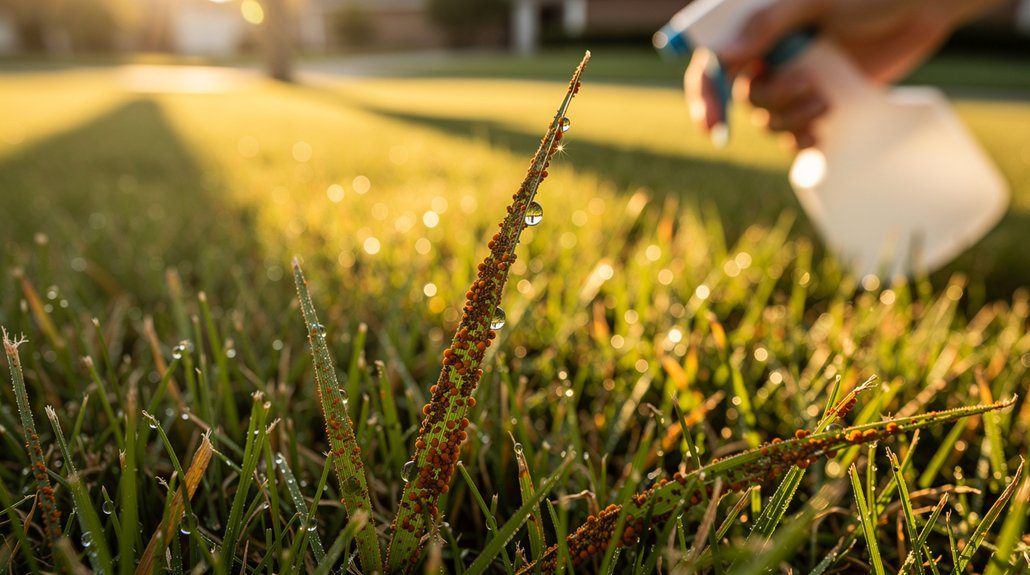
For fast, reliable rust control in 2026, choose from five top picks: Scotts DiseaseEx (10 lb treats 5,000 sq ft), BioAdvanced Ready‑to‑Spray (32 oz hose‑on), Atticus Gravex 20EW (myclobutanil systemic), Atticus Gunner (14.3% propiconazole MEC), and Bonide Infuse Ready‑to‑Spray (32 oz). They offer systemic or durable contact action, 2–4 week residuals, and user‑friendly application options; follow labels for turf safety and resistance management, and keep going to see application tips and rotation guidance.
| Scotts DiseaseEx Lawn Fungicide – Treats 5,000 sq ft | 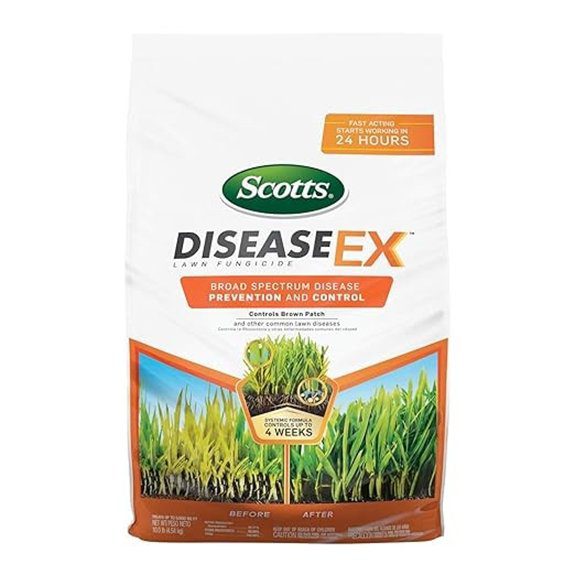 | Best for Prevention | Target use: Lawn fungicide (lawn disease control/prevention) | Controls rust: Lists rust (stem/stripe rust) among targets | Systemic action / uptake: Systemic/works within plant (begins working within 24 hours; safe for all grasses) | VIEW LATEST PRICE | Read Our Analysis |
| BioAdvanced Ready-to-Spray Lawn Fungicide (32 oz) | 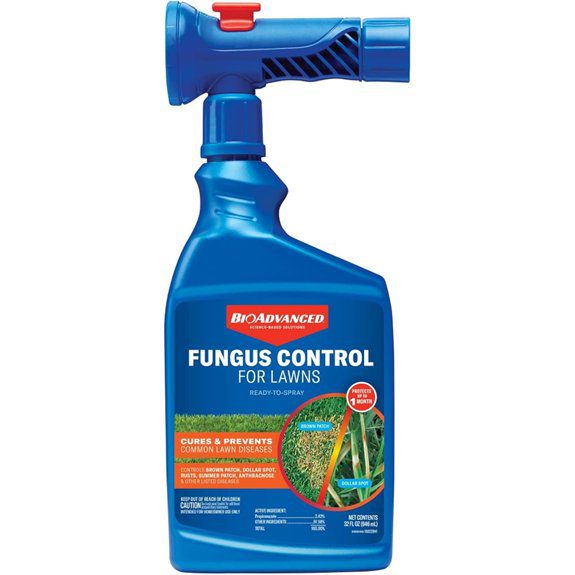 | Easiest to Use | Target use: Lawn fungicide (cures and prevents lawn diseases) | Controls rust: Lists Rust among targets | Systemic action / uptake: Systemic formula absorbed by grass (resists wash-off) | VIEW LATEST PRICE | Read Our Analysis |
| Atticus Gravex 20EW Fungicide (16 oz) | 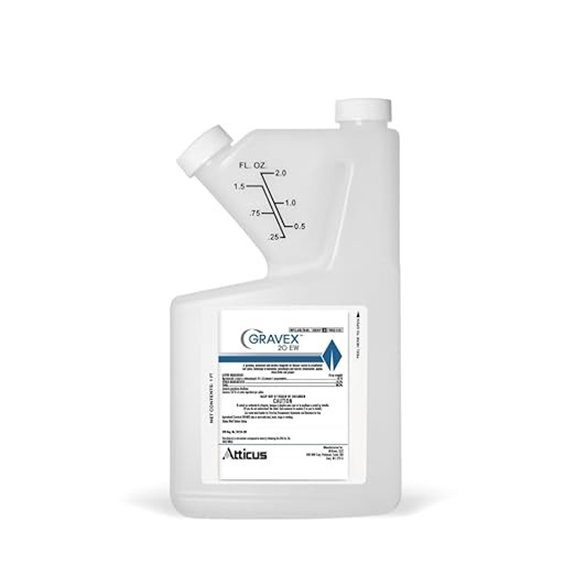 | Pro-Level Control | Target use: Multi-site fungicide (lawns, landscapes, turf) | Controls rust: Lists rusts among turf targets | Systemic action / uptake: Systemic (myclobutanil; upward mobility protects new growth) | VIEW LATEST PRICE | Read Our Analysis |
| Atticus Gunner Propiconazole Fungicide 32 oz | 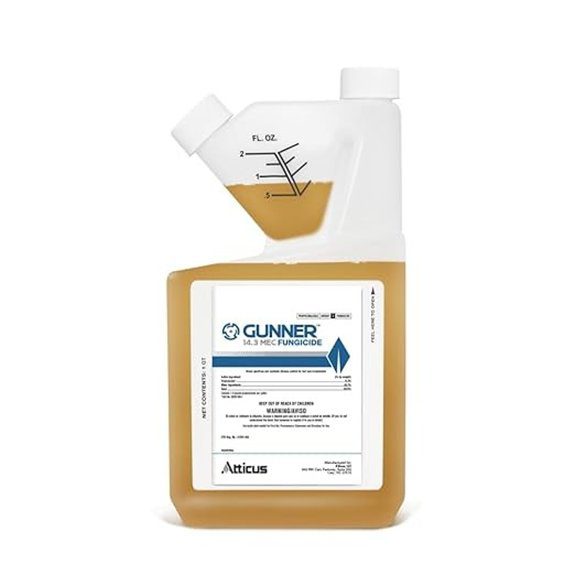 | Long-Lasting Strength | Target use: Turf/landscape/golf course fungicide | Controls rust: Lists rusts among targets | Systemic action / uptake: Systemic uptake via root or stem absorption | VIEW LATEST PRICE | Read Our Analysis |
| Bonide Infuse Systemic Fungicide Ready-to-Spray 32 oz | 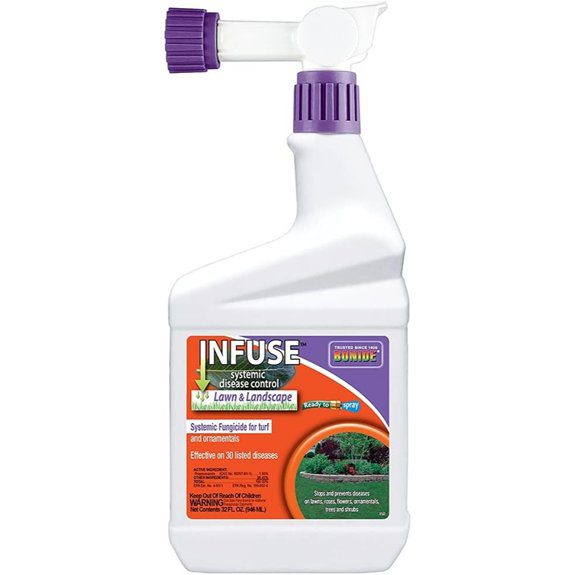 | Versatile Treatment | Target use: Lawn and landscape fungicide | Controls rust: Lists rust among targets | Systemic action / uptake: Systemic fungicide (long-lasting control) | VIEW LATEST PRICE | Read Our Analysis |
More Details on Our Top Picks
Scotts DiseaseEx Lawn Fungicide – Treats 5,000 sq ft
If you want reliable, broad-spectrum rust control for a medium-to-large yard, Scotts DiseaseEx is a strong choice—one 10 lb. bag treats up to 5,000 sq. ft. and starts working within 24 hours. You’ll get protection against 26 listed diseases, including stem and stripe rust, brown patch, powdery mildew, and anthracnose. It’s labeled safe for all grass types when applied as directed and provides up to four weeks of control. Apply before symptoms appear or at first signs for best results. Use it proactively during conditions that favor disease to keep your lawn healthy and resilient.
- Target use:Lawn fungicide (lawn disease control/prevention)
- Controls rust:Lists rust (stem/stripe rust) among targets
- Systemic action / uptake:Systemic/works within plant (begins working within 24 hours; safe for all grasses)
- Duration of protection:Up to 4 weeks
- Application format / convenience:Granular 10 lb bag (broadcast application; treats 5,000 sq ft)
- Coverage / treatable area:Treats up to 5,000 sq ft per bag
- Additional Feature:Controls 26 diseases
- Additional Feature:Works within 24 hours
- Additional Feature:10 lb bag
BioAdvanced Ready-to-Spray Lawn Fungicide (32 oz)
Choose BioAdvanced Ready-to-Spray if you want a fast, no-mess solution that treats rust and other common turf diseases across up to 5,000 sq ft. You connect the 32 oz ready-to-use bottle to your hose, spray spotty or whole areas, and the systemic formula absorbs into grass to cure and prevent rust, red thread, brown patch, dollar spot, summer patch, and listed diseases. Protection lasts up to 30 days and resists rain wash-off. It’s suitable for all lawn types and intended to control disease without harming turf when used as directed, offering a convenient, science-based option for routine care.
- Target use:Lawn fungicide (cures and prevents lawn diseases)
- Controls rust:Lists Rust among targets
- Systemic action / uptake:Systemic formula absorbed by grass (resists wash-off)
- Duration of protection:Up to 30 days
- Application format / convenience:Ready-to-spray 32 fl oz hose-attach bottle
- Coverage / treatable area:Covers 5,000 sq ft per bottle
- Additional Feature:Ready-to-spray hose connection
- Additional Feature:Rain-resistant systemic formula
- Additional Feature:32 fl oz bottle
Atticus Gravex 20EW Fungicide (16 oz)
Atticus Gravex 20EW is ideal for homeowners and turf managers who want a strong, systemic option—its 19.7% myclobutanil formulation moves into new growth to give up to 28 days of curative and preventive control against rust and many other turf fungi. You’ll get a 16 oz 20 EW package that controls over 38 plant fungi, including brown patch, anthracnose, spring dead spot, red thread, dollar spot, and rusts, plus powdery mildew and scab on ornamentals and fruit trees. Use it on lawns, landscapes, golf courses, greenhouses, and residential fruit trees per label. Check state registrations and follow label directions.
- Target use:Multi-site fungicide (lawns, landscapes, turf)
- Controls rust:Lists rusts among turf targets
- Systemic action / uptake:Systemic (myclobutanil; upward mobility protects new growth)
- Duration of protection:Up to 28 days
- Application format / convenience:Concentrate 16 oz (20 EW) requiring dilution and spray equipment
- Coverage / treatable area:Coverage varies by dilution and label (labeled for turf/landscape uses) — see label for sq ft
- Additional Feature:Myclobutanil 19.7% AI
- Additional Feature:Labeled for 38+ fungi
- Additional Feature:Upward systemic mobility
Atticus Gunner Propiconazole Fungicide 32 oz
You’ll appreciate this 32 oz propiconazole concentrate if you need a fast-acting, long-lasting solution for rust and other turf diseases on lawns, golf courses, or nurseries. You’ll get Atticus Gunner 14.3 MEC (32 fl oz) with 14.3% propiconazole, a low-odor microemulsion concentrate that mixes easily, resists separation, and stays tank-mix compatible. It controls rusts, brown patch, dollar spot, blights, and powdery mildew, protecting turf up to 28 days when applied per label. Apply as foliar spray (resistant to wash-off after drying) or water-in for soil diseases. Check label, state registration, and local sales restrictions before use.
- Target use:Turf/landscape/golf course fungicide
- Controls rust:Lists rusts among targets
- Systemic action / uptake:Systemic uptake via root or stem absorption
- Duration of protection:Up to 28 days
- Application format / convenience:32 fl oz microemulsion concentrate (dilute and spray)
- Coverage / treatable area:Coverage varies by label rates and target use — see label for sq ft
- Additional Feature:14.3% propiconazole
- Additional Feature:MEC microemulsion concentrate
- Additional Feature:Low-odor formula
Bonide Infuse Systemic Fungicide Ready-to-Spray 32 oz
If you want a ready-to-use option that treats large lawns without mixing concentrates, Bonide Infuse Systemic Fungicide Ready-to-Spray is a solid pick—its hose-end applicator and one-quart size cover up to 3,200 sq. ft., so you can quickly protect turf and nearby ornamentals from rust and other common diseases. You’ll attach it to your hose, spray after mowing, and rely on systemic, broad-spectrum activity against over 30 listed diseases like rust, blight, powdery mildew, scab, and leaf spot. Expect control lasting up to four weeks when you follow label directions for safe, effective application.
- Target use:Lawn and landscape fungicide
- Controls rust:Lists rust among targets
- Systemic action / uptake:Systemic fungicide (long-lasting control)
- Duration of protection:Up to 4 weeks
- Application format / convenience:Ready-to-spray 32 oz hose-end sprayer
- Coverage / treatable area:One quart treats up to 3,200 sq ft
- Additional Feature:Treats up to 3,200 sq. ft.
- Additional Feature:Hose-end ready-to-spray
- Additional Feature:Labeled for ornamentals too
Factors to Consider When Choosing a Fungicide for Lawn Rust
Before you pick a product, make sure you’ve accurately identified lawn rust so you treat the right problem. Check the active ingredient’s spectrum, whether it’s systemic or contact, and how long it protects the turf. Also consider how easy it is to apply and the best timing for treatments to fit your lawn care routine.
Disease Identification Accuracy
When diagnosing lawn rust, confirm the disease by looking for orange to reddish-brown pustules on blades and stems and rubbing suspect grass with a white cloth—rust spores will come off as a colored dust. You should differentiate rust from nutrient deficiency, drought, or insect damage by checking for those pustules and the slower, patchy growth rust causes versus uniform yellowing or chewed foliage. Inspect turf species and recent conditions: cool, wet weather or high nitrogen can favor rust, so correlate symptoms with maintenance and weather history. Estimate severity by sampling multiple areas and scoring percent affected and lesion density—localized light rust may not need fungicide, but widespread, dense infections usually do. Detecting spores early, even in morning dew, improves treatment success.
Active Ingredient Spectrum
Having confirmed rust and gauged its severity, you’ll next want to focus on the active ingredients in any fungicide you consider. Pick ingredients proven against rust fungi—demethylation inhibitors (triazoles) or strobilurins/quinone outside inhibitors—since they control spores and lesions effectively. When rust is established, favor systemic actives that translocate within grass to protect new growth as well as existing tissue. Check each product’s labeled spectrum: choose actives that also target common co-occurring turf diseases (brown patch, dollar spot, leaf spot) to avoid juggling multiple products. Note residual duration—typically 2–4 weeks—and time applications to match disease pressure and rainfall. Finally, verify mode-of-action groups and rotate between classes to slow resistance development.
Systemic Vs Contact
If you want curative power and protection of new growth, choose a systemic fungicide; if you need broad, surface-level prevention with shorter persistence, use a contact product. Systemics are absorbed and move inside grass, reaching infections within tissue and protecting new blades you can’t fully spray. Contacts stay on leaf surfaces, preventing spores where they’re applied but offering little cure once rust penetrates. Because contacts wash off more easily, you’ll reapply after heavy rain or irrigation; systemics hold up better once taken up. Don’t rely solely on one mode: differing resistance risks mean you should rotate or tank-mix systemic and contact chemistries to lower the chance of resistant rust strains while balancing curative reach and surface coverage.
Residual Protection Duration
Many fungicides will protect your lawn for roughly 2–4 weeks, so you should plan reapplications on a 14–28 day cycle to maintain effective rust control. Choose systemic products when you want longer in-plant protection—they commonly last up to 3–4 weeks—whereas contact fungicides only protect while residue sits on leaves. Check rainfastness: wash-off prone materials lose field life quickly, so their effective interval will be shorter than on the label. Account for environmental stressors—high heat, heavy rain, rapid turf growth, and strong UV can all shorten residual activity and force earlier retreatment. Time applications to match periods of high disease pressure and always follow the labeled residual interval to avoid unnecessary repeats while keeping protective levels steady.
Application Ease And Timing
Residual protection windows tell you how often to reapply, but practical success comes down to how and when you put the product down. Choose a formulation that matches your comfort and gear—ready-to-spray or pre-mixed liquids mean minimal setup, while concentrates or dry mixes require measuring and dilution. Apply at the first signs of rust or proactively when warm days, cool nights, and high humidity favor disease; many fungicides work best preventatively and within 24–48 hours of needed coverage. Time sprays so foliage can dry and avoid imminent irrigation or rain; contact products wash off, while systemic types tolerate light rain after drying. Follow label reapplication intervals (often every 2–4 weeks) and treat during calm, cool periods to reduce drift and stress.
Safety For Grass Types
Because turf species vary in how they tolerate active ingredients, always confirm a fungicide’s label lists your grass (Kentucky bluegrass, tall fescue, perennial rye, bermudagrass, zoysia, etc.) before applying—registered uses reflect safety testing and legal approval. Check whether the product is systemic or contact and pick based on your grass sensitivity and growth stage: systemic products protect new growth, while some contact fungicides can cause phytotoxicity on sensitive varieties. Follow label rates and intervals specific to your turf; overapplication or too-frequent sprays can injure sensitive species and disrupt physiology. Avoid products not registered for your turf species or region. When trying a new active ingredient on an unfamiliar grass, perform a small patch test and monitor 7–14 days for discoloration, burning, or growth suppression.