
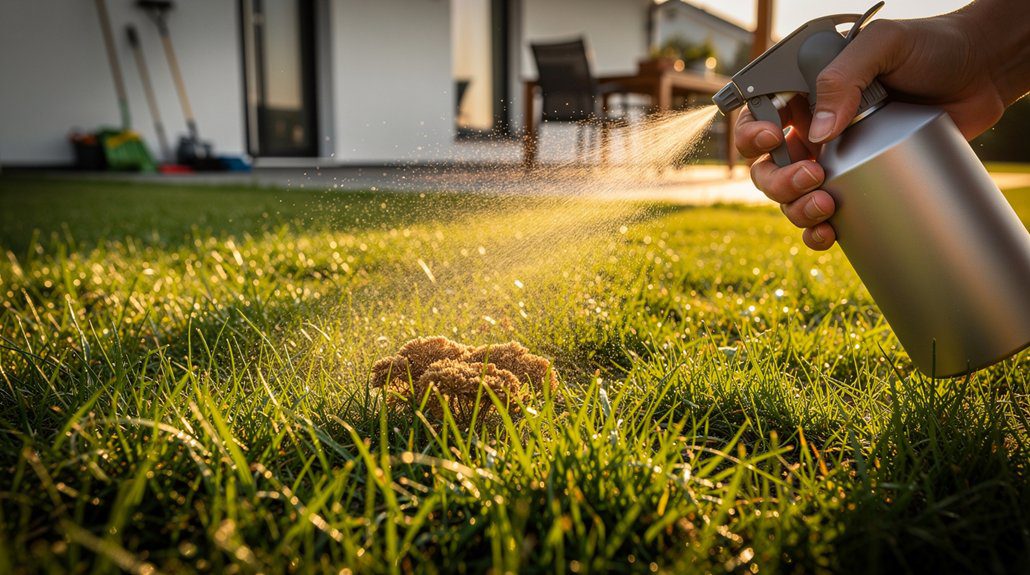
You want reliable, long‑lasting lawn disease control, so pick from these five: Scotts DiseaseEx granular for wide coverage, BioAdvanced ready‑to‑spray systemic for up to 30 days of protection, Spectracide Immunox hose‑end concentrate that also handles insects, Atticus Gunner (propiconazole) for fast root and foliar uptake, and Atticus Artavia 2 SC (azoxystrobin) for systemic, broad‑spectrum control up to 28 days; keep label directions and resistance rotation in mind if you want the full details.
| Scotts DiseaseEx Lawn Fungicide (10 lb 5,000 sq ft) |  | Best for Prevention | Use (Purpose): Lawn disease control and prevention | Coverage/Target Area: Treats up to 5,000 sq. ft. | Application Format: Granular (10 lb bag) | VIEW LATEST PRICE | Read Our Analysis |
| BioAdvanced Ready-to-Spray Lawn Fungus Control (32 oz) | 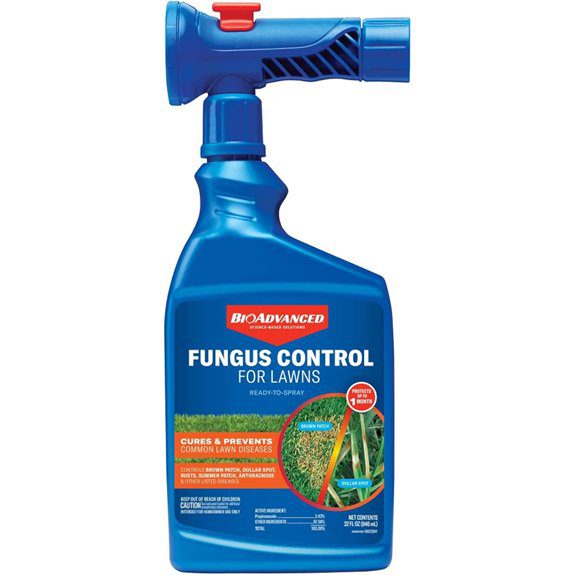 | Easiest to Use | Use (Purpose): Cures and prevents lawn diseases | Coverage/Target Area: Covers up to 5,000 sq. ft. | Application Format: Ready‑to‑spray liquid (hose‑end bottle) | VIEW LATEST PRICE | Read Our Analysis |
| Spectracide Immunox Fungus + Insect Control Hose-End Concentrate | 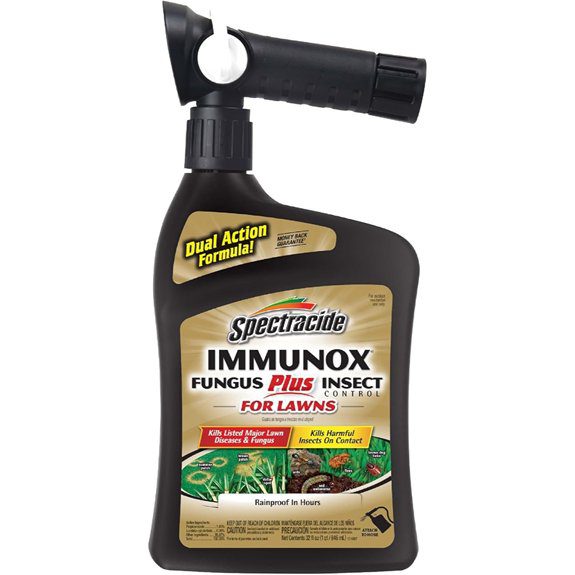 | Dual-Action Solution | Use (Purpose): Controls lawn fungi and damaging insects (fungus control) | Coverage/Target Area: Hose‑end application for lawn areas (coverage by spray; repeat every 2 weeks) | Application Format: Hose‑end concentrate (attach to garden hose) | VIEW LATEST PRICE | Read Our Analysis |
| Atticus Gunner Propiconazole Fungicide (32 oz) | 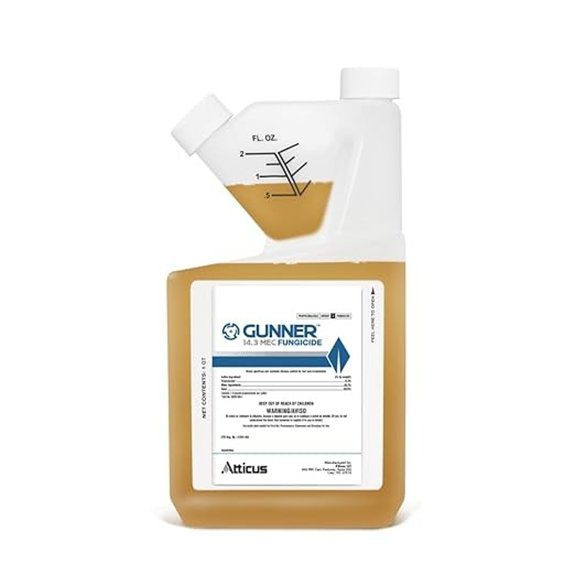 | Professional Strength | Use (Purpose): Broad‑spectrum fungus prevention for turf/landscape | Coverage/Target Area: Labeled for golf, landscape, nursery (area coverage per label) | Application Format: Liquid concentrate (32 fl oz bottle; requires mixing) | VIEW LATEST PRICE | Read Our Analysis |
| Atticus Artavia 2 SC Azoxystrobin Fungicide (16 oz) | 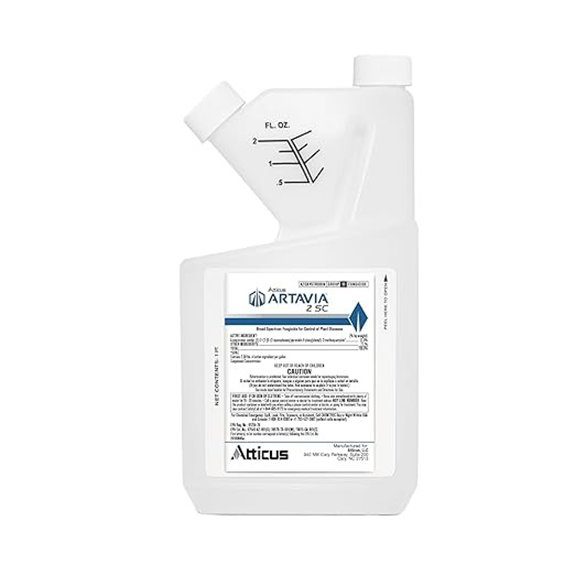 | Long-Lasting Protection | Use (Purpose): Broad‑spectrum fungicide for turf and ornamentals (lawn use) | Coverage/Target Area: Labeled for lawns, landscapes, golf courses (area coverage per label) | Application Format: Liquid concentrate (16 fl oz bottle; SC formulation) | VIEW LATEST PRICE | Read Our Analysis |
More Details on Our Top Picks
Scotts DiseaseEx Lawn Fungicide (10 lb 5,000 sq ft)
If you’re managing a medium-sized yard and want broad-spectrum protection, Scotts DiseaseEx Lawn Fungicide (10 lb) treats up to 5,000 sq. ft. and starts working within 24 hours to prevent or control 26 common lawn diseases—apply it before symptoms appear or at the first signs for best results. You’ll control issues like brown patch, pythium blight, rusts, snow molds, necrotic ring spot, red thread, powdery mildew, and anthracnose. It keeps working up to four weeks, fits all grass types when used as directed, and lets you prevent outbreaks or tackle early infections with reliable, straightforward coverage.
- Use (Purpose):Lawn disease control and prevention
- Coverage/Target Area:Treats up to 5,000 sq. ft.
- Application Format:Granular (10 lb bag)
- Protection Duration:Up to 4 weeks
- Turf Compatibility:Safe for all grass types when used as directed
- Rain/Water Resistance:Not specified as rainproof; follows label directions (effective within 24 hours)
- Additional Feature:Controls 26 diseases
- Additional Feature:Works within 24 hours
- Additional Feature:10 lb treats 5,000 sq ft
BioAdvanced Ready-to-Spray Lawn Fungus Control (32 oz)
Homeowners who want a ready-to-use, low-effort solution will find the BioAdvanced Ready-to-Spray Lawn Fungus Control ideal, since you just attach it to a garden hose and treat up to 5,000 sq ft without mixing. You’ll get a 32 fl oz systemic formula that cures and prevents listed diseases—Red Thread, Brown Patch, Dollar Spot, Rust, Summer Patch, and more—across all lawn types. It protects up to 30 days, resists wash-off by rain, and works for spot treatments or whole-yard applications. BioAdvanced’s science-based product gives reliable disease control when you follow label directions.
- Use (Purpose):Cures and prevents lawn diseases
- Coverage/Target Area:Covers up to 5,000 sq. ft.
- Application Format:Ready‑to‑spray liquid (hose‑end bottle)
- Protection Duration:Up to 30 days
- Turf Compatibility:Appropriate for all lawn types
- Rain/Water Resistance:Systemic formula resists wash‑off by rain
- Additional Feature:Ready-to-spray bottle
- Additional Feature:Systemic, rain-resistant
- Additional Feature:Connects to garden hose
Spectracide Immunox Fungus + Insect Control Hose-End Concentrate
Spectracide Immunox Fungus + Insect Control is best for busy yard-keepers who want quick, dual-action protection without mixing bottles. You attach the QuickFlip hose-end sprayer to a garden hose, flip the switch, and apply an even 32-ounce concentrate over your turf. The formula combats major fungal diseases preventatively and curatively while killing listed lawn insects on contact. Start treatments when grass greens up in spring and reapply every two weeks for optimal control. It becomes rainproof within hours, reducing loss from storms. Always follow the label for target pests, compatible turf types, safety, and reentry intervals.
- Use (Purpose):Controls lawn fungi and damaging insects (fungus control)
- Coverage/Target Area:Hose‑end application for lawn areas (coverage by spray; repeat every 2 weeks)
- Application Format:Hose‑end concentrate (attach to garden hose)
- Protection Duration:Repeat every 2 weeks (ongoing protection between applications)
- Turf Compatibility:Labeled for lawns (follow label for turf types)
- Rain/Water Resistance:Rainproof within hours; resistant to wash‑off
- Additional Feature:Dual-action (fungus+insect)
- Additional Feature:Hose-end QuickFlip sprayer
- Additional Feature:Apply every two weeks
Atticus Gunner Propiconazole Fungicide (32 oz)
Atticus Gunner Propiconazole (32 oz) is a strong choice for turf managers and serious homeowners who need a long-lasting, broad-spectrum fungicide—its 14.3% propiconazole MEC formulation gives fast root and foliar uptake and up to 28 days of protection against brown patch, dollar spot, rusts, and powdery mildew. You’ll get a 32 fl oz bottle of Atticus Gunner (14.3% propiconazole MEC) that mixes easily, resists separation, and tank-mixes with many products. Use foliar spray for leaf diseases and water in for soil-borne issues. Check the label for rates, intervals, state registrations, and safety precautions; not sold in AK, DC, HI, PR, or VT.
- Use (Purpose):Broad‑spectrum fungus prevention for turf/landscape
- Coverage/Target Area:Labeled for golf, landscape, nursery (area coverage per label)
- Application Format:Liquid concentrate (32 fl oz bottle; requires mixing)
- Protection Duration:Protection up to 28 days (label dependent)
- Turf Compatibility:Labeled for turf (golf/landscape/nursery uses)
- Rain/Water Resistance:Foliar sprays resist wash‑off after drying; soil applications may require watering in
- Additional Feature:14.3% propiconazole active
- Additional Feature:MEC microemulsion concentrate
- Additional Feature:Tank-mix compatible
Atticus Artavia 2 SC Azoxystrobin Fungicide (16 oz)
If you’re managing a turf or ornamental problem and want longer-lasting protection with fewer trips to the lawn, the Artavia 2 SC (22.9% azoxystrobin) delivers systemic, broad-spectrum control that moves through roots and leaves to protect new growth. You get a 16 oz liquid bottle of Atticus Artavia 2 SC (UPC 810117110055) formulated for turfgrass and ornamentals, including lawns, landscapes, golf courses, and nurseries. It targets over 20 turf and 30 ornamental fungi—anthracnose, brown patch, leaf spot, rhizoctonia, spring dead spot—and allows application intervals up to 28 days. Follow the EPA-registered label; availability varies.
- Use (Purpose):Broad‑spectrum fungicide for turf and ornamentals (lawn use)
- Coverage/Target Area:Labeled for lawns, landscapes, golf courses (area coverage per label)
- Application Format:Liquid concentrate (16 fl oz bottle; SC formulation)
- Protection Duration:Labeled intervals up to 28 days
- Turf Compatibility:Labeled for turfgrass and ornamentals (lawns included)
- Rain/Water Resistance:Systemic translocation provides protection (label notes; generally resists loss from normal irrigation)
- Additional Feature:22.9% azoxystrobin active
- Additional Feature:Systemic root-to-leaf translocation
- Additional Feature:Extended intervals up to 28 days
Factors to Consider When Choosing a Fungicide for Lawn
When choosing a fungicide for your lawn, consider the specific disease you’re facing and whether the product’s active ingredient and mode of action target it. Check that the formulation is labeled for your grass type, fits the optimal application timing window, and matches how long you need residual protection. Balancing these factors will help you pick an effective, safe treatment.
Lawn Disease Type
Because different pathogens behave very differently, the first thing you should do is identify the disease type—brown patch, dollar spot, rust, pythium blight, snow mold, or a root‑borne pathogen—so you can match a fungicide that’s actually labeled for that organism. Next, decide if the problem is foliar, soil‑borne, or root‑infecting; soil pathogens often need products meant for soil incorporation or root uptake and different application methods like watering‑in. Consider whether you need curative action to halt an active infection or preventive control for upcoming risk periods, since speed and duration vary by product. Check label spectrum and reapplication interval to confirm the fungicide lists your specific disease and provides adequate protection for the advertised 2–4 week window.
Active Ingredient Mode
After you identify the disease and where it attacks the plant, pay attention to how the fungicide’s active ingredient works inside or on the plant. You’ll choose between systemic actives, which roots or leaves absorb and translocate to protect new growth for weeks, and contact actives, which stay on surfaces for quick curative or preventive action but need more frequent reapplication. Check the mode of action class—DMI, QoI, SDHI, multisite, etc.—since each targets different fungal pathways and defines the control spectrum. Avoid repeated use of a single-site mode to reduce resistance risk; rotate or tank-mix products with different modes. Also consider how mode affects rainfastness, residual duration, and whether the product reaches soil-borne versus strictly foliar infections.
Lawn Grass Compatibility
If your grass isn’t listed on the fungicide label or the product lacks turf tolerance guidance, don’t use it—labels vary by species and application rates matter for avoiding phytotoxicity. Check that the label specifically names your grass (cool-season: Kentucky bluegrass, fescue, rye; warm-season: Bermudagrass, St. Augustine, zoysia). Look for turfgrass tolerance statements and maximum rates—sensitive species like bentgrass or St. Augustine tolerate less. Decide between systemic and contact modes: systemics translocate and protect new growth on actively growing turf, while contacts need thorough canopy coverage. Verify temperature and environmental restrictions to avoid damage or reduced efficacy on heat-, drought- or cold-stressed turf. Match recommended application intervals to your grass’s growth period to align protection with physiology.
Application Timing Window
When planning fungicide applications, time them to anticipate disease-favorable conditions—apply preventively before warm, humid weather or at the first sign of symptoms to get the best control. You’ll note many products act within 24 hours but protect only for a limited window, so follow label reapplication intervals (commonly 2–4 weeks) to maintain coverage. Avoid applying contact products if rain is likely within a few hours, unless the label says they’re rainfast; systemic options can tolerate some wash-off but still need proper timing. Align treatments with seasonal pathogen activity—start spring programs at green-up and apply fall treatments ahead of snowpack where snow mold is a risk. Rotate fungicide classes on a calendar-based schedule to minimize resistance while covering high-risk periods.
Residual Protection Duration
Because residual protection varies by product and conditions, choose a fungicide that matches how long you need coverage and how you’ll maintain the lawn. Residual protection usually runs about 2–4 weeks; some systemic products deliver up to 28–30 days per application. Contact fungicides often last only days to two weeks since they sit on leaf surfaces and wash off with rain or irrigation. Systemic or translocated products absorbed by roots or foliage give longer protection and cover new growth, stretching intervals between treatments. Environmental factors — rainfall, mowing, UV, soil microbes, temperature — can shorten labeled duration, so follow reapplication intervals on the label. Those intervals (commonly 14–28 days) also support resistance management, so stick to them for continuous control.
Application Method Ease
Though the chemistry and labeled intervals matter, how you apply a fungicide often determines how easily you’ll protect your lawn. Choose hose-end or ready-to-spray formulations if you want fast, even coverage over thousands of square feet without mixing; they cut prep time and measurement errors. Use granular products with a broadcast or drop spreader for large areas or where hose access is limited—uniform distribution depends on proper calibration. If you need precise dilution, concentrates applied with a pump or handheld sprayer give control but add measuring, mixing, and cleaning time. Pre-mixed and granular forms reduce direct handling of concentrated actives, simplifying use. Finally, pick products with longer residual control (around 28–30 days) to minimize application frequency and overall effort.
Safety And Restrictions
If you want to protect your lawn safely and legally, read and follow the fungicide label before purchase and application—it tells you approved uses, application rates, required PPE, re-entry intervals, and any turf-specific or seasonal limits. Check the active ingredient and verify its EPA registration and any state sale or use restrictions so you don’t buy an illegal product. Note toxicity classifications and wear required PPE—gloves, long sleeves, eye protection, or a respirator—especially when handling concentrates. Observe environmental precautions: keep treatments away from water bodies, pollinator-attractive plants, and follow instructions to prevent runoff or drift. Finally, stick to application intervals and seasonal maximums to avoid plant injury, spur resistance, and breach label-imposed limits.