
You’ll want pumps that match flow, lift, and noise needs: the ECO‑WORTHY 33‑Series diaphragm for quiet, pressure‑regulated garden use; 115V 1/10HP transfer kits (and VIVOSUN 330 GPH) for portable tank filling; Aquastrong 1 HP submersible for heavy high‑lift jobs; and the PANRANO 1/3 HP portable sump pump for moderate flow and debris. Pick corrosion‑resistant materials, proper hose sizes, and thermal protection to avoid surprises—keep going to see specs, hoses, and installation tips.
| ECO-WORTHY 33-Series 110V Diaphragm Water Pressure Pump | 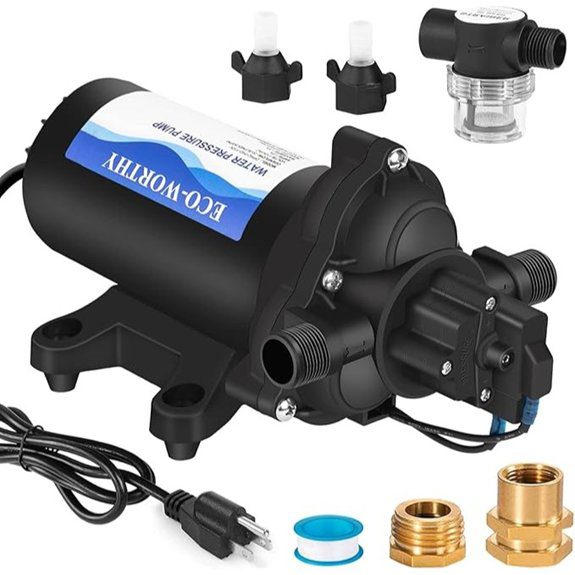 | Best for Pressure Control | Power Source: 110V AC (corded electric) | Application / Use: RV, marine, irrigation, sprinklers, faucets, fresh water systems | Flow Performance (rate): 4.0 GPM (≈240 GPH) | VIEW LATEST PRICE | Read Our Analysis |
| 115V 1/10HP Electric Water Transfer Pump Kit | 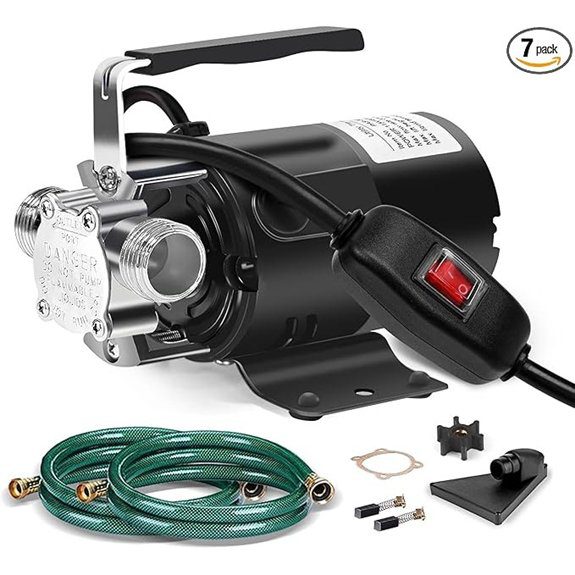 | Compact Utility Pick | Power Source: 115V AC (corded electric) | Application / Use: Water transfer for gardens, pools, aquariums, hot tubs, rain barrels, boats | Flow Performance (rate): 5.5 GPM (330 GPH) | VIEW LATEST PRICE | Read Our Analysis |
| Aquastrong 1 HP 4500 GPH Submersible Sump Pump | 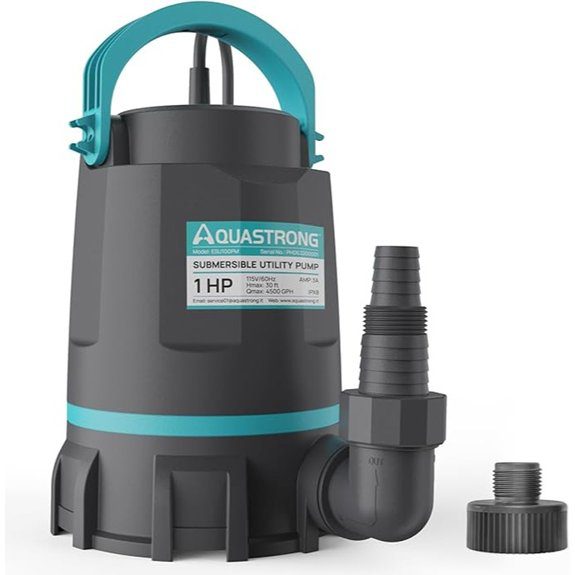 | High-Flow Powerhouse | Power Source: Plug-in submersible (corded electric) | Application / Use: Pool, garden, pond, basement, window wells, hot tub drainage | Flow Performance (rate): Up to 4,500 GPH (≈75 GPM) at 5 ft | VIEW LATEST PRICE | Read Our Analysis |
| 1/3 HP 2000 GPH Submersible Portable Sump Pump |  | Portable Workhorse | Power Source: 110V AC (corded electric) | Application / Use: Draining pools, hot tubs, basements, ponds, flooded areas | Flow Performance (rate): Up to 2,000 GPH (≈33 GPM) | VIEW LATEST PRICE | Read Our Analysis |
| VIVOSUN 115V 1/10HP 330 GPH Water Pump |  | Value Maintenance Pick | Power Source: 115V AC (corded electric) | Application / Use: Garden/yard water transfer, draining hot tubs, pools, ponds, aquariums | Flow Performance (rate): 330 GPH (≈5.5 GPM) | VIEW LATEST PRICE | Read Our Analysis |
More Details on Our Top Picks
ECO-WORTHY 33-Series 110V Diaphragm Water Pressure Pump
If you need a reliable, AC-powered pump for steady garden irrigation or RV water systems, the ECO-WORTHY 33-Series 110V diaphragm pump delivers consistent pressure (adjustable 45–70 PSI) and a 4.0 GPM flow rate, so you can run sprinklers or fill tanks without a battery or frequent restarts. You’ll appreciate its self-priming diaphragm design (up to 9.8 feet) and smart pressure switch that auto-starts at roughly 50 PSI, runs quietly, and protects against overheating above 95°C. The 110V corded unit lifts water effectively, includes garden-hose adapters, weighs 6.8 pounds, and supports continuous operation for routine irrigation tasks.
- Power Source:110V AC (corded electric)
- Application / Use:RV, marine, irrigation, sprinklers, faucets, fresh water systems
- Flow Performance (rate):4.0 GPM (≈240 GPH)
- Maximum Lift / Head:Max lift listed up to 131–148 ft (pressure activation ~50 PSI)
- Self-Priming / Suction Capability:Self-priming up to 9.8 vertical feet
- Protection / Overload Safeguard:Thermal overload protection (trips above 95°C / 203°F)
- Additional Feature:Garden hose adapters included
- Additional Feature:Smart pressure switch
- Additional Feature:Metal construction
115V 1/10HP Electric Water Transfer Pump Kit
Ideal for homeowners and campers who need a compact, reliable transfer solution, the 115V 1/10HP Electric Water Transfer Pump Kit delivers a steady 5.5 GPM and self-priming performance so you can quickly move water from pools, barrels, or boats without fuss. You’ll appreciate the zinc alloy volute, stainless steel parts, and copper motor for quiet, stable operation and corrosion resistance. It lifts to 42 feet, suctions to 1/8 inch, and includes two 6 ft hoses, strainer, and impeller kit. Use the waterproof switch, prime inlet/outlet before starting, and prefer edible oil for lubrication to extend service life.
- Power Source:115V AC (corded electric)
- Application / Use:Water transfer for gardens, pools, aquariums, hot tubs, rain barrels, boats
- Flow Performance (rate):5.5 GPM (330 GPH)
- Maximum Lift / Head:Maximum lifting height 42 ft
- Self-Priming / Suction Capability:Self-priming; low-suction removes down to 1/8 inch
- Protection / Overload Safeguard:Notes to avoid running dry; built-in waterproof on/off switch (motor protection guidance)
- Additional Feature:Includes replaceable impeller
- Additional Feature:Two 6 ft suction hoses
- Additional Feature:Waterproof on/off switch
Aquastrong 1 HP 4500 GPH Submersible Sump Pump
Choose the Aquastrong 1 HP 4500 GPH Submersible Sump Pump when you need powerful, portable drainage that can move up to 75 gallons per minute and handle small debris for tasks like pool, pond, basement, or hot-tub drainage. You’ll get a 1 HP motor with up to 4,500 GPH at 5 ft and 30 ft vertical lift, handling solids to 1/5 inch. Bottom-suction pulls water to 1/5 inch remaining. It’s plug-in portable with 10 ft cord, 1-1/4″ NPT discharge, elbow and snap adapters for common hose sizes. Durable thermoplastic housing, mechanical seal, thermal overload protection, and Aquastrong support round out reliability.
- Power Source:Plug-in submersible (corded electric)
- Application / Use:Pool, garden, pond, basement, window wells, hot tub drainage
- Flow Performance (rate):Up to 4,500 GPH (≈75 GPM) at 5 ft
- Maximum Lift / Head:Vertical lift up to 30 ft
- Self-Priming / Suction Capability:Bottom-suction (removes down to 1/5 inch)
- Protection / Overload Safeguard:Built-in thermal overload protector / quality mechanical seal
- Additional Feature:Bottom-suction design
- Additional Feature:Multiple adapter fittings
- Additional Feature:10 ft UL power cord
1/3 HP 2000 GPH Submersible Portable Sump Pump
For gardeners and DIYers who need a quick, portable solution for draining shallow water, the PANRANO 1/3 HP 2000 GPH submersible pump delivers strong flow (up to 2,000 GPH) in a compact, corrosion-resistant thermoplastic body. You get a 1/3 HP, 110V corded unit with a 16.4-foot cord, ergonomic handle, and retractable cord snap for storage. It lifts to 17 feet, handles solids up to 1/5 inch, and runs down to 1/5 inch water depth. Included adapters (1″ and 3/4″), Teflon tape, and a clamp let you match garden hose sizes. Use an incline start to purge air.
- Power Source:110V AC (corded electric)
- Application / Use:Draining pools, hot tubs, basements, ponds, flooded areas
- Flow Performance (rate):Up to 2,000 GPH (≈33 GPM)
- Maximum Lift / Head:Maximum head 17 ft
- Self-Priming / Suction Capability:Continues running down to 1/5 inch (minimum suction depth)
- Protection / Overload Safeguard:Built-in automatic thermal overload protector
- Additional Feature:Retractable cord snap
- Additional Feature:Two garden hose adapters
- Additional Feature:Ergonomic carry handle
VIVOSUN 115V 1/10HP 330 GPH Water Pump
If you need a compact, portable pump for routine garden and light cleanup tasks, the VIVOSUN 115V 1/10HP 330 GPH excels at quick water transfers with its 330 GPH flow and 39 ft max head. You’ll use the 1/10 HP motor on standard 115V power; just pre-fill the pump chamber before starting. The lightweight aluminum body and zinc alloy pump head resist wear and corrosion, and the premium PVC hose holds up to regular use. It’s easy to carry and operate—fill, attach the 6 ft suction hose, plug in—and replacement parts (impeller, brushes, gasket, filter) simplify maintenance.
- Power Source:115V AC (corded electric)
- Application / Use:Garden/yard water transfer, draining hot tubs, pools, ponds, aquariums
- Flow Performance (rate):330 GPH (≈5.5 GPM)
- Maximum Lift / Head:Maximum discharge head 39 ft
- Self-Priming / Suction Capability:Requires pre-fill of pump chamber (self-priming style)
- Protection / Overload Safeguard:Spare carbon brushes and parts (supports maintenance); instructions to pre-fill to avoid dry running
- Additional Feature:Includes spare carbon brushes
- Additional Feature:Lightweight aluminum body
- Additional Feature:Premium PVC hose included
Factors to Consider When Choosing a Water Pump for Garden Hose
Before you pick a pump, think about the flow rate you need and whether it matches your hose diameter so you get the pressure and volume your garden requires. Check the pump’s maximum lift height and power source type to make sure it can reach your water supply and works with your setup. Also confirm if the unit needs priming or has suction capabilities to avoid installation headaches.
Flow Rate Needed
Many gardeners underestimate how much flow their setup actually needs, so start by adding the GPM requirements of every open hose or sprinkler head you’ll run at once — typical handheld watering uses about 1–3 GPM, while multi-zone or high-pressure sprinklers often need 5+ GPM. Convert units correctly (1 GPM = 60 GPH) when comparing pump specs—a 330 GPH pump equals ~5.5 GPM. Add flows for simultaneous outlets to get total GPM, not just single-outlet demand. Then factor in head loss and friction: long runs and lift reduce usable flow, so pick a pump rated 10–30% above your ideal GPM. Finally check the pump’s operating range and minimum reliable flow to ensure adequate performance at expected pressure and height.
Hose Diameter Compatibility
After you total the flow needs and head losses, match the pump outlet to the hose inner diameter — or fit a properly sized adapter — so you don’t choke the flow or invite leaks. Use larger-diameter hose for long runs to cut friction losses and sustain higher GPM; a 1″ or 1-1/4″ line often outperforms 3/4″ over distance. Compare the pump’s discharge curve with expected hose restriction — a small hose can drop delivered GPM and effective head well below the pump’s rating. Make sure connectors, clamps, and fittings are pressure-rated for that diameter to avoid blow-offs or air ingress. For suction lines or long vertical draws, choose the largest practical hose to reduce cavitation risk and help self-priming.
Maximum Lift Height
Think about the pump’s maximum lift height as the vertical limit it can reliably push water — this rating tells you whether the unit will reach raised beds, roof sprinklers, or rooftop storage and how much flow you’ll actually get as elevation increases. You’ll see ratings in feet or meters showing theoretical static head; expect flow to drop as you approach that limit. Account for friction losses from long or narrow hoses, fittings and elbows—they can shave several feet off effective lift. For steady performance, pick a pump with 20–30% more maximum lift than your actual vertical rise. Also check suction limits: surface pumps are usually capped near 25 feet (7–8 m) suction lift and need adequate NPSH and priming to perform.
Power Source Type
Because the power source determines where and how long you can run a pump, pick one that matches your site and workload. If you have reliable household power, corded electric pumps give continuous operation and higher flow rates without fuel or batteries—ideal for steady garden irrigation. Battery pumps boost portability for remote spots but limit run time and require recharging, so reserve them for short tasks. Gasoline models deliver the most power and long runtimes for large-area watering but add noise, emissions, fuel storage, and maintenance burdens. Manual hand pumps need no fuel or power, are dependable for tiny volumes, and suit emergency use, though they demand sustained effort. Always check outlet access, charging options, or fuel availability at the installation point before buying.
Priming And Suction
When you’re choosing a pump, pay close attention to priming and suction since they determine whether the unit will reliably draw water from your source and how low it can empty a tank or pond. Verify whether the pump is self-priming; those models draw water without manual filling and often prime from several feet of lift, while non-self-priming pumps need the inlet pre-filled to avoid dry running. Check the rated maximum suction lift—exceeding it prevents priming. Consider minimum suction depth: bottom-suction or close-suction designs can pull water down to millimeters, others stop well above the surface. Use short, straight, correctly sized suction hose runs and foot valves/strainers to maintain prime. Protect motors with thermal overload or float/shutoff features and close downstream valves during startup.
Materials And Durability
Although durability often gets overlooked, choosing corrosion-resistant housings and rugged internal components will keep your pump running seasons longer. You should pick housings made from stainless steel, zinc alloy, or reinforced thermoplastics to resist outdoor moisture and corrosion. Inspect motor internals—copper windings, quality seals, and mechanical seals—to prevent wear, leakage, and failure during extended runs. Check impellers and volutes for abrasion and debris resistance; if you’ll pump from sediment-prone sources, confirm solids-handling ratings and maximum particle size. Consider thermal overload protection and strong insulation ratings to protect the motor under heavy or continuous use. Finally, evaluate included hoses and fittings—heavy-duty PVC or reinforced rubber with secure clamps or threaded adapters—to ensure UV, chemical, and pressure resistance and avoid premature leaks.
Noise And Thermal Protection
Durability matters, but noise levels and thermal protection will determine how comfortably and safely you can run a pump in your garden. Check for a specified thermal overload protector that trips around 95°C (203°F) so the motor won’t burn out or spark during prolonged or stalled operation. Look at noise ratings or descriptions—diaphragm pumps or well-balanced motors run noticeably quieter and suit close-proximity use.
Verify continuous-operation ratings to ensure the pump can handle your irrigation cycles without overheating. Self-priming and low-suction designs cut cavitation and harsh motor strain, which reduces noise and wear. Finally, review duty cycle and recommended run/stop intervals: excessive continuous duty raises noise and increases the chance of thermal cutouts, so match specs to your typical run times.
Included Accessories
Look over the accessories that come with a pump before you buy, because the right fittings and spare parts can save you trips to the hardware store and headaches during installation. Check whether the pump includes compatible hose adapters (3/4″, 1″, 1-1/4″) or standard garden-hose fittings so you can connect to existing hoses without extra couplers. Verify that suction and discharge hoses are provided and note their lengths—common kits include 6 ft hoses—to reach your water source without extensions. Look for intake strainers or filters to keep debris out and protect the impeller. Prefer kits that supply spare wear parts like impellers, carbon brushes, or gaskets for easier maintenance. Ensure clamps, Teflon tape and clear inlet/outlet labeling are included for proper sealing and assembly.