
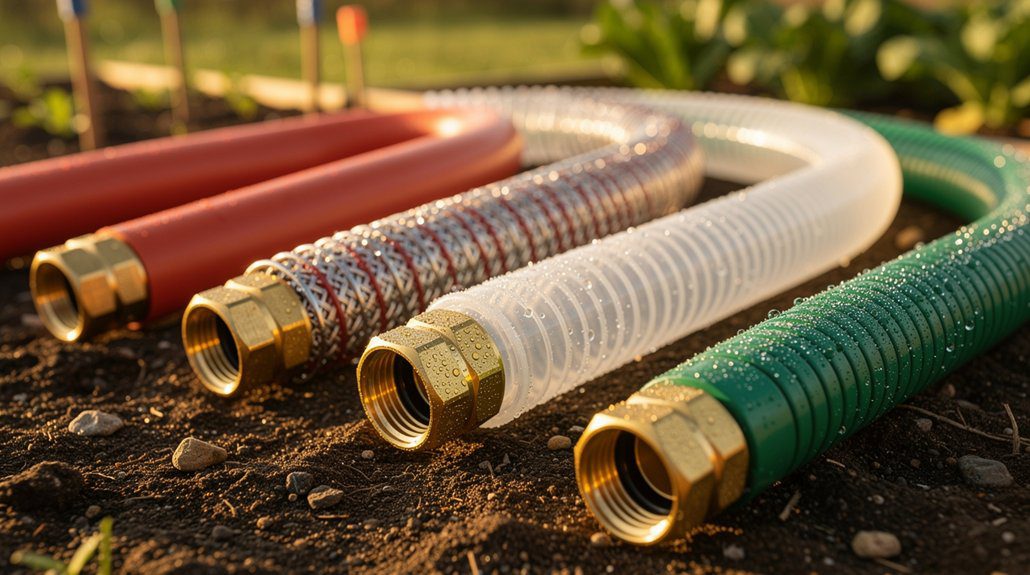
You’ll get reliable, water‑saving irrigation with five top 2026 picks: Hourleey’s 100 ft flat soaker for root‑level drip, Raindrip’s 1/4″ tubing for precise micro‑feeder lines, Jin&Bao’s 50 ft sprinkler hose for versatile spray or soak use, Winisok’s 100 ft three‑tube flat hose for broad gentle coverage, and RAINPOINT’s 100 ft durable flat soaker with swivel fittings. Each saves water and fits timers or faucets, and if you keep going you’ll find details to match your garden needs.
| Hourleey 100ft Flat Soaker Hose for Gardens | 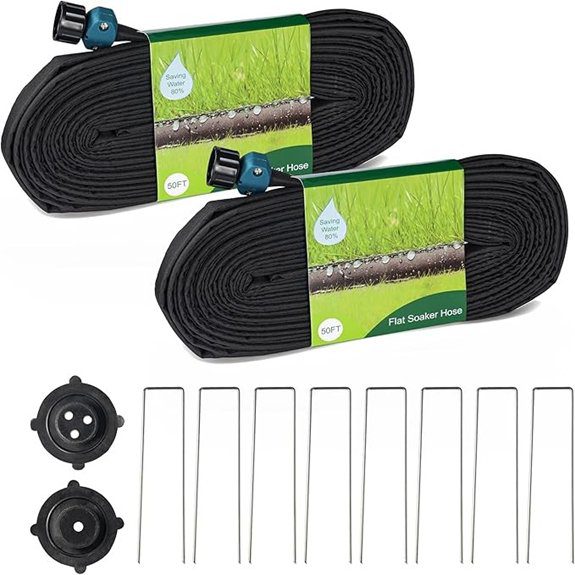 | Best for Water Savings | Length: 100 ft (2 × 50 ft) | Use type: Soaker/drip irrigation | Material / Construction: PVC inner + nylon fabric outer (dual-layer) | VIEW LATEST PRICE | Read Our Analysis |
| Raindrip 1/4″ Drip Irrigation Tubing 100-Foot | 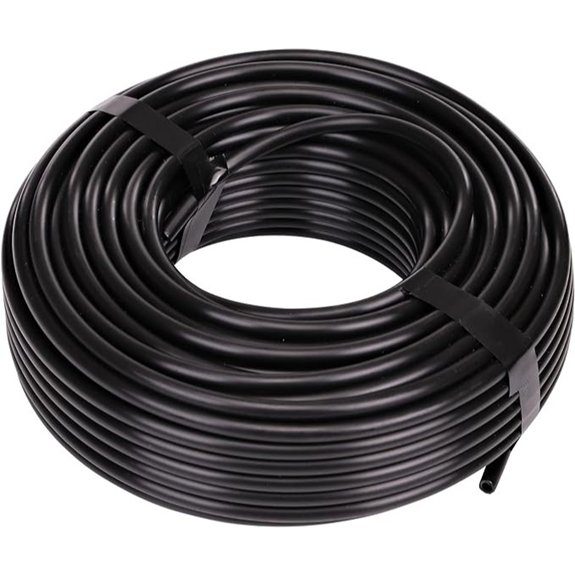 | Best for System Builders | Length: 100 ft | Use type: Drip/micro tubing (feeder line) | Material / Construction: Polyethylene (PE) | VIEW LATEST PRICE | Read Our Analysis |
| Jin&Bao 50FT Sprinkler Hose for Lawn and Garden | 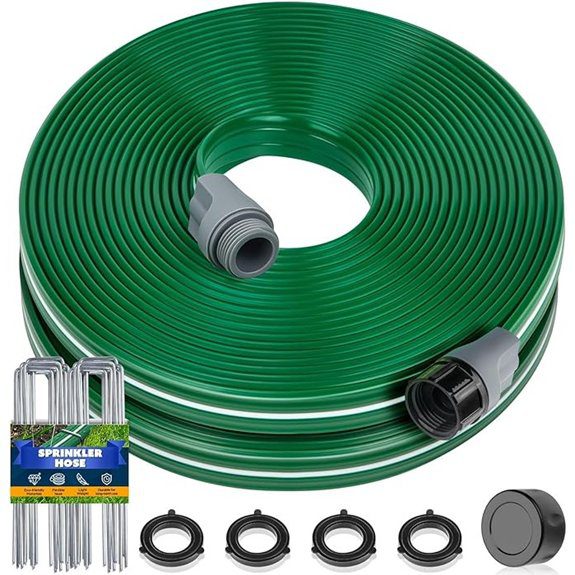 | Best for Lawn Spraying | Length: 50 ft | Use type: Sprinkler/soaker hose (holes up or down) | Material / Construction: PVC | VIEW LATEST PRICE | Read Our Analysis |
| Winisok 100FT Flat Soaker Hose 3-Tube Lawn Irrigation | 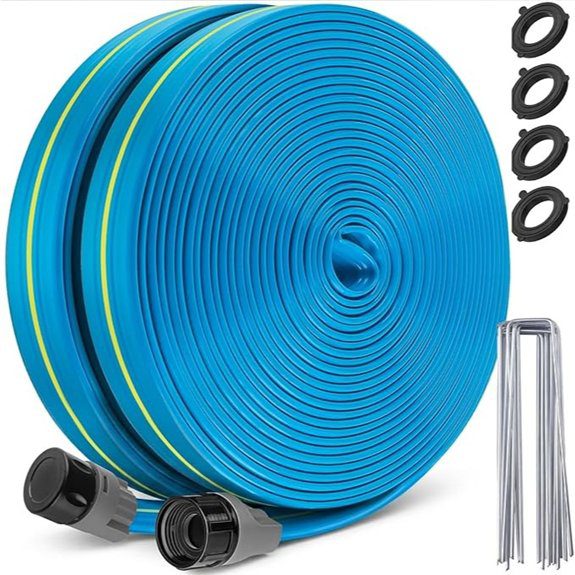 | Best Wide Coverage | Length: 100 ft (2 × 50 ft) | Use type: Flat sprinkler/soaker irrigation hose | Material / Construction: High-quality PVC (3-tube) | VIEW LATEST PRICE | Read Our Analysis |
| RAINPOINT 100FT Flat Soaker Hose (2-Pack Green) | 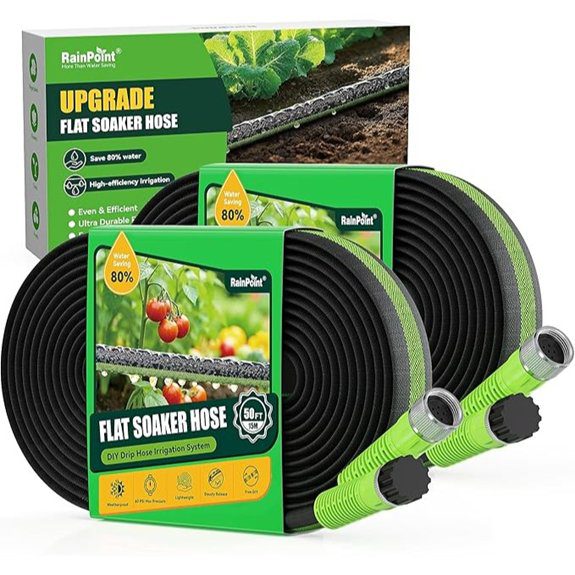 | Best Durable Connectors | Length: 100 ft (2 × 50 ft) | Use type: Flat soaker/drip hose | Material / Construction: Thickened rubber inner tube + high-density fabric outer + PVC components | VIEW LATEST PRICE | Read Our Analysis |
More Details on Our Top Picks
Hourleey 100ft Flat Soaker Hose for Gardens
If you want a low‑maintenance, water‑saving solution for garden beds and seedlings, the Hourleey 100 ft flat soaker hose is a great choice — it delivers steady, root‑level irrigation through a clog‑resistant fabric cover and evenly spaced drip holes, so you’ll spend less time watering and more time gardening. You’ll get two 50 ft sections that link end‑to‑end, stakes, and a dual‑layer PVC core with nylon fabric for kink resistance and flexibility. Install above ground or under mulch, connect to a faucet or timer, and expect efficient watering that can cut use by up to 80% while remaining easy to store.
- Length:100 ft (2 × 50 ft)
- Use type:Soaker/drip irrigation
- Material / Construction:PVC inner + nylon fabric outer (dual-layer)
- Connectable / Linkable:End-to-end connectable (link multiple hoses)
- Pressure guidance / Max pressure:Max (burst) 150 PSI; ideal 60–80 PSI
- Includes securing/accessory items:Stakes included
- Additional Feature:Dual-layer PVC/Nylon
- Additional Feature:Clog-resistant fabric cover
- Additional Feature:Rolls up for storage
Raindrip 1/4″ Drip Irrigation Tubing 100-Foot
The Raindrip 1/4″ drip tubing is ideal for gardeners who want a simple, low-flow feeder line to run water precisely to trees, shrubs, vegetable beds, or planters. You’ll get 100 feet of 0.25-inch OD, 0.170-inch ID black polyethylene tubing that serves as a micro feeder or main line for small systems. It connects with standard 1/4-inch micro fittings and delivers water directly to emitters for steady root-zone moisture. Layered construction uses virgin material outside and inside with recycled content middle for UV resistance; max pressure is 5 bars. Raindrip backs it with a one-year satisfaction warranty.
- Length:100 ft
- Use type:Drip/micro tubing (feeder line)
- Material / Construction:Polyethylene (PE)
- Connectable / Linkable:Connects via 1/4″ micro fittings to emitters/main line
- Pressure guidance / Max pressure:Maximum pressure ~5 bar (~72.5 PSI)
- Includes securing/accessory items:Tubing only (shrink-wrapped coil) — intended to use with fittings (no stakes)
- Additional Feature:0.170″ internal diameter
- Additional Feature:100% virgin outer/inner
- Additional Feature:Shrink-wrapped coil
Jin&Bao 50FT Sprinkler Hose for Lawn and Garden
Choose the Jin&Bao 50FT Sprinkler Hose when you want a simple, water-saving solution for even lawn coverage—its three-tube, small-hole design lets you run it as a sprinkler (holes up) or soaker (holes down) and produces a 3–6 foot spray for efficient watering. You’ll get a durable 50-foot PVC hose rated for 20–60 psi, best used between 30–60 psi. Start with low flow, let outlets equalize, then increase to avoid bursts. Use splitters or avoid long chains to prevent pressure drop. It includes detachable end cap, landscape staples for securing, and a 30-day voluntary return guarantee.
- Length:50 ft
- Use type:Sprinkler/soaker hose (holes up or down)
- Material / Construction:PVC
- Connectable / Linkable:Detachable end cap to join/clean/connect hoses
- Pressure guidance / Max pressure:Max recommended 60 PSI; recommended 30–60 PSI
- Includes securing/accessory items:Landscape staples included (number varies by length) + detachable end cap
- Additional Feature:Three-tube configuration
- Additional Feature:Detachable end cap
- Additional Feature:3–6 ft spray height
Winisok 100FT Flat Soaker Hose 3-Tube Lawn Irrigation
Perfect for homeowners who need wide, even coverage without kinking, the Winisok 100FT Flat Soaker Hose uses a three-tube PVC design to deliver gentle, flat sprays across lawns and flower beds. You’ll get two 50ft blue hoses (100ft total) with detachable end caps and 40 landscape staples. Lay the textured side up for spraying, textured side down when wet, and connect hoses easily. Operate between 20–60 psi (max 60 psi), expect 1.0–1.8m spray height and 1.2–2.4m width, and water 2–4 hours as needed. Remove faucet aerators, drain for winter, and check gaskets to prevent leaks.
- Length:100 ft (2 × 50 ft)
- Use type:Flat sprinkler/soaker irrigation hose
- Material / Construction:High-quality PVC (3-tube)
- Connectable / Linkable:Detachable end cap for joining two hoses
- Pressure guidance / Max pressure:Maximum 60 PSI; operating 20–60 PSI
- Includes securing/accessory items:40 landscape staples included + detachable end cap
- Additional Feature:Textured side orientation
- Additional Feature:Blue color option
- Additional Feature:1.0–1.8 m spray height
RAINPOINT 100FT Flat Soaker Hose (2-Pack Green)
If you want a simple, water‑saving solution for beds and borders, the RAINPOINT 100ft flat soaker hose (two 50ft sections) delivers even root-level soaking while cutting water use up to 80%. You’ll get a flat soaker made from a thickened rubber inner tube and high-density fabric sheath with PVC parts and anodized aircraft aluminum 360° rotating inlet/outlet fittings. Lay it flat or hang it for drip use, keeping pressure between 40–60 PSI (max 60). It’s lightweight, kink-resistant, linkable, and uses standard 3/4-inch threads for timers and faucets. Warranty and a 30-day return are provided.
- Length:100 ft (2 × 50 ft)
- Use type:Flat soaker/drip hose
- Material / Construction:Thickened rubber inner tube + high-density fabric outer + PVC components
- Connectable / Linkable:Linkable end-to-end; standard 3/4″ threaded fittings
- Pressure guidance / Max pressure:Maximum 60 PSI; recommended 40–60 PSI for even soaking
- Includes securing/accessory items:Anodized inlet/outlet connectors (360° rotating); fittings included (no staples listed)
- Additional Feature:Anodized aluminum fittings
- Additional Feature:360° rotating inlet
- Additional Feature:Thickened rubber inner tube
Factors to Consider When Choosing an Irrigation Hose for Garden
When picking an irrigation hose for your garden, you’ll want to consider the material and durability to ensure it stands up to sun, abrasion, and kinks. Check that the hose matches your water pressure, size needs, and flow requirements so plants get the right amount of water. Also think about installation compatibility with your fittings and how easy the hose will be to maintain for long-term use.
Hose Material And Durability
Choose a hose that matches how you’ll use it and the conditions it’ll face: PVC gives you flexibility and affordability for general watering, while polyethylene (PE) holds up better to UV and long-term outdoor exposure. Look for multi-layer constructions—an inner core plus fabric or an outer UV-resistant layer—to improve puncture resistance, reduce kinking, and help prevent clogging from soil or debris. Reinforced or thicker-walled hoses tolerate repeated handling, abrasions, and higher stress better than thin-walled tubing. Match hose type to placement: buryable or fabric-covered soaker hoses endure soil contact and mulch, while exposed PE micro‑tubing works well for feeder lines that face sunlight. Finally, pick hoses rated above your system’s normal operating pressure for reliable, long-lasting performance.
Water Pressure Compatibility
Because water pressure determines how well your irrigation performs, you should match a hose’s working-pressure range to your supply so flow, spray height, and emitter function stay reliable. Choose hoses rated for typical household pressure (about 40–80 PSI) so they don’t underperform or get damaged. Compare working pressure to burst pressure and pick hoses with a burst rating well above your normal supply for safety and longevity. For long runs or chained hoses, account for pressure drop—distance lowers flow and spray height, so raise initial pressure or change line diameter if needed. Low-pressure dripper tubing needs tubing rated for low pressures (roughly up to 75 PSI) and may require pressure-compensating emitters. If supply can spike or get hot, add regulators or relief valves.
Hose Size And Flow
Match your hose diameter to the flow your system needs, since internal size directly controls how much water can pass and how far it will travel under pressure. You’ll use tiny 1/4″ microtubing for single emitters and 1/2″–3/4″ supply lines for multiple emitters or sprinklers. Calculate total gph of all emitters, then pick supply tubing that handles peak flow plus a safety margin. Remember pressure and diameter work together: higher PSI raises output, but friction losses grow with length and small diameters, cutting flow at the far end. For long runs, upsize the hose to reduce pressure drop; a short 1/4″ feeder can serve one planter, but it won’t perform over several dozen feet. Match size to intended use for even distribution.
Installation And Compatibility
When installing a garden irrigation hose, check that your faucet, timer, and existing supply lines use the same thread sizes and connector types so fittings mate securely without improvising adapters. Verify whether you need 3/4″ garden thread, quick‑connect, or barbed fittings, and match hose diameter to supply lines — small drip uses 1/4″ tubing, garden hoses commonly 1/2″–3/4″ ID — to avoid flow restriction or leaks. Confirm the hose is rated for above‑ground, burial, or both; installation method changes placement, anchoring, and durability needs. Plan runs and join points so end caps and couplers stay accessible and you avoid excessively long continuous runs that harm uniformity. Secure layout with stakes, landscape staples, or manufacturer‑recommended mounting hardware to prevent shifting.
Maintenance And Longevity
After you’ve picked fittings, sizes, and layout, think about how you’ll care for the hose to keep it working reliably over time. Inspect hoses seasonally for cracks, splits, fabric fraying, or UV damage; replace brittle PVC sections to prevent leaks and bursts. Drain and store hoses indoors when freezing temperatures threaten, and flush lines before storage and after long idle periods to remove sediment that clogs emitters and wears materials. Use hoses rated for your system pressure and avoid sustained pressures above the recommended operating range to prevent seam failure and premature bursting. Secure hoses with stakes, avoid sharp bends or kinks, and roll them loosely for storage to preserve flexibility and fitting integrity, extending service life.