
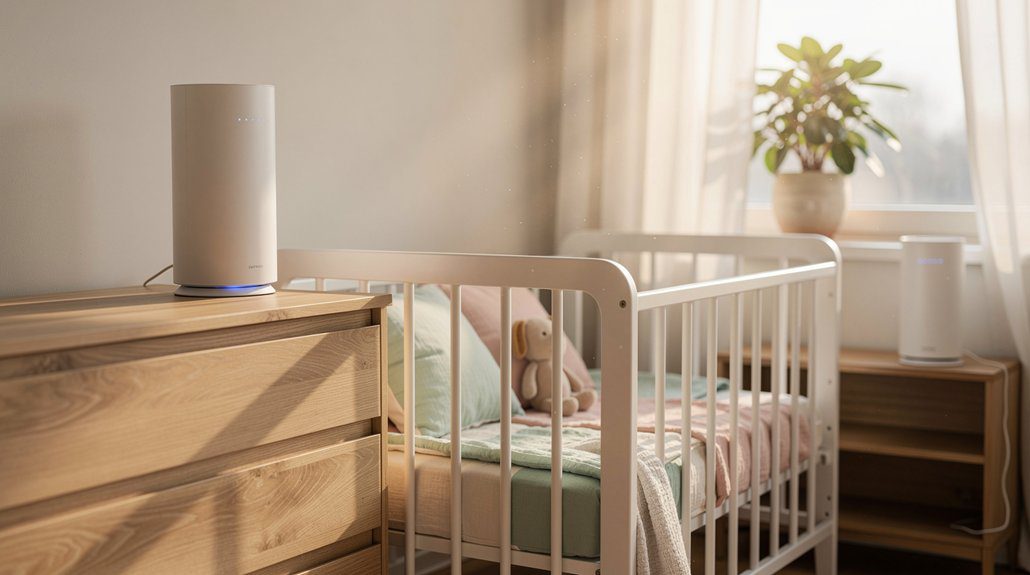
You’ll want a quiet, certified HEPA purifier that clears ultrafine particles and VOCs while running near‑silent overnight. Top picks: LEVOIT Core Mini‑P for energy‑efficient, touch‑control use; Frida Baby 3‑in‑1 with sound‑machine features; Momcozy 4‑in‑1 for smart auto PM control and dimmable night light; FULMINARE H13 for true HEPA and low sleep noise; AromaRoom H13 for compact H13 filtration and fragrance pad. Keep filters fresh and check ACH, CADR, and sleep‑mode noise to choose the best fit—keep going to see full specs and tips.
| LEVOIT Core Mini-P Air Purifier for Bedroom |  | Compact Powerhouse | Filtration type: 3-in-1 filter (pre-filter + main HEPA + activated carbon) | Coverage / room size: ~255 sq ft | Sleep / quiet mode (noise suitability): Sleep mode; noise 25–45 dB (spec lists 25 dB) | VIEW LATEST PRICE | Read Our Analysis |
| Frida Baby 3‑in‑1 Baby Air Purifier with Sound Machine |  | Sleep-Soothing Combo | Filtration type: HEPA filter (easy-change HEPA) | Coverage / room size: 3,126.5 cm² (≈0.34 sq ft — small/near-crib use) [spec listed] | Sleep / quiet mode (noise suitability): Designed for nursery use with sound machine; noise listed 50 dB | VIEW LATEST PRICE | Read Our Analysis |
| Momcozy 4-in-1 HEPA Air Purifier for Nursery | 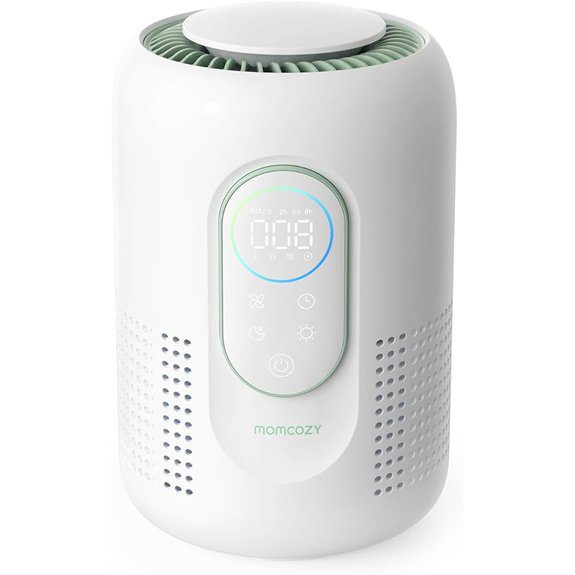 | Smart Nursery Essential | Filtration type: Quad-layer with H13 HEPA (pre-filter + H13 HEPA + activated carbon + protective layer; silver ion finish) | Coverage / room size: ~250 sq ft | Sleep / quiet mode (noise suitability): Ultra-quiet sleep mode at 21 dB | VIEW LATEST PRICE | Read Our Analysis |
| FULMINARE H13 True HEPA Portable Bedroom Air Purifier | 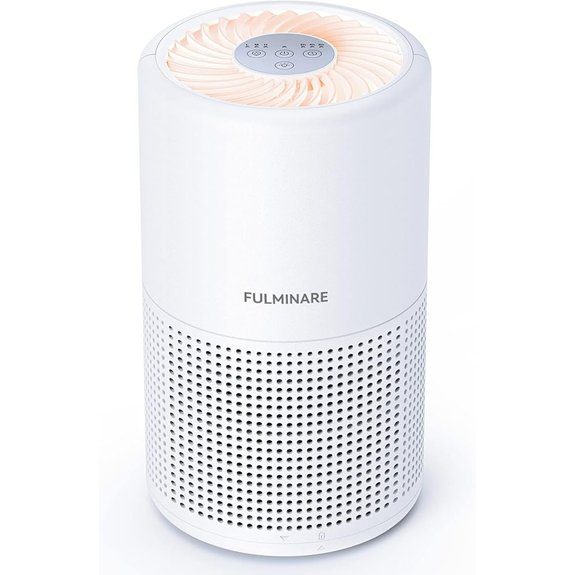 | Quiet Performance | Filtration type: H13 True HEPA filter | Coverage / room size: up to 215 sq ft (refreshes 5×/hr in 215 ft²) | Sleep / quiet mode (noise suitability): Near-silent sleep mode ≈24 dB | VIEW LATEST PRICE | Read Our Analysis |
| AromaRoom H13 HEPA Air Purifier for Home | 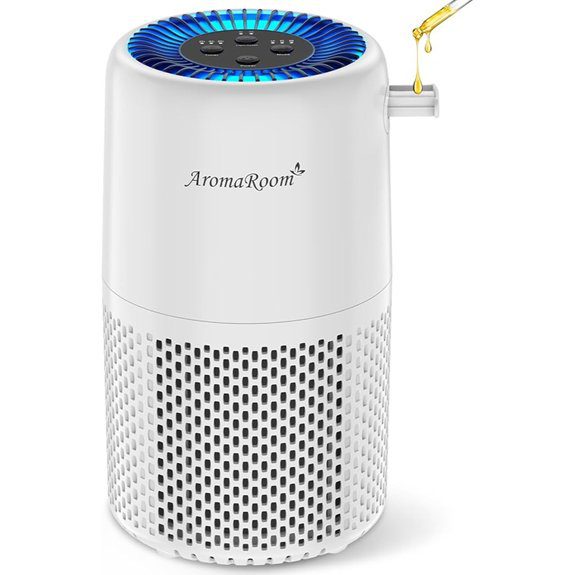 | Aromatherapy Hybrid | Filtration type: H13 HEPA (3-in-1 filter) | Coverage / room size: ~123 sq ft (refreshes twice/hr in 123 ft²) | Sleep / quiet mode (noise suitability): Sleep mode noise ≈22 dB | VIEW LATEST PRICE | Read Our Analysis |
More Details on Our Top Picks
LEVOIT Core Mini-P Air Purifier for Bedroom
If you need a compact, quiet purifier for a nursery or small bedroom, the LEVOIT Core Mini-P delivers—clearing particles down to 0.1 µm across up to 255 sq ft while running as low as 25–27 dB, so it won’t disturb naps or nighttime feeding. You’ll get a 3-in-1 filter (pre-filter, main HEPA-style, activated carbon) that captures dust, pet dander, smoke, odors, and allergens. It’s AHAM, ETL, and ENERGY STAR certified, uses 7 W, and measures 6.5×6.5×10.4 in. Controls are touch/button with sleep mode and an aromatherapy pad—use only 2–3 drops. Keep genuine Core Mini-RF filters.
- Filtration type:3-in-1 filter (pre-filter + main HEPA + activated carbon)
- Coverage / room size:~255 sq ft
- Sleep / quiet mode (noise suitability):Sleep mode; noise 25–45 dB (spec lists 25 dB)
- Nightlight / lighting feature:Aromatherapy pad (not a nightlight but has low-display/auto-off display; aroma feature can act as scent)
- Timer / auto-off or auto modes:Auto-off display (basic timer/auto-off)
- Replacement filter guidance:Uses Genuine Levoit replacement filters (Core Mini‑RF); recommend genuine filters
- Additional Feature:Aromatherapy pad included
- Additional Feature:ENERGY STAR certified
- Additional Feature:Adapter stores inside
Frida Baby 3‑in‑1 Baby Air Purifier with Sound Machine
Designed for parents who want a compact, multi‑tasking nursery device, the Frida Baby 3‑in‑1 combines HEPA filtration with a sound machine and nightlight so you can clean the air and soothe your baby with one plug‑in unit. You’ll get true HEPA filtration certified by AHAM, an easy-change filter that lasts about 90 days, and three fan speeds to suit small rooms (3,126.5 cm² coverage) while keeping noise near 50 dB. Touch controls, two white-noise options, color nightlight and an auto-off timer simplify bedtime. It’s lightweight, AC‑powered, includes a filter and manual, and carries Frida Baby support.
- Filtration type:HEPA filter (easy-change HEPA)
- Coverage / room size:3,126.5 cm² (≈0.34 sq ft — small/near-crib use) [spec listed]
- Sleep / quiet mode (noise suitability):Designed for nursery use with sound machine; noise listed 50 dB
- Nightlight / lighting feature:Color nightlight (adjustable)
- Timer / auto-off or auto modes:Auto-off timer
- Replacement filter guidance:HEPA filter, easy-change, lasts ~90 days
- Additional Feature:Built-in sound machine
- Additional Feature:Color nightlight options
- Additional Feature:90‑day replaceable filter
Momcozy 4-in-1 HEPA Air Purifier for Nursery
Parents who want quiet, reliable air cleaning for a small nursery will appreciate the Momcozy 4‑in‑1 HEPA, which pairs true H13 filtration and activated carbon with ultra‑quiet operation and real‑time PM2.5 monitoring so you can trust the air while you sleep or check on the baby at night. You’ll get a quad‑layer filter (prefilter, H13 HEPA, activated carbon, protective layer) with a silver‑ion finish, coverage for about 250 sq ft, and a max‑fan refresh in roughly 15 minutes. Smart Auto adjusts fan speed from four levels using PM2.5 readings, a three‑color ring shows status, and sleep mode runs at 21 dB with a dimmable night light.
- Filtration type:Quad-layer with H13 HEPA (pre-filter + H13 HEPA + activated carbon + protective layer; silver ion finish)
- Coverage / room size:~250 sq ft
- Sleep / quiet mode (noise suitability):Ultra-quiet sleep mode at 21 dB
- Nightlight / lighting feature:Soft-glow dimmable night light
- Timer / auto-off or auto modes:Smart Auto Mode (PM2.5‑driven automatic fan speeds)
- Replacement filter guidance:Replaceable quad-layer/H13 filter (periodic replacement implied)
- Additional Feature:Real-time PM2.5 readout
- Additional Feature:Smart Auto Mode
- Additional Feature:Silver‑ion antimicrobial finish
FULMINARE H13 True HEPA Portable Bedroom Air Purifier
Choose the FULMINARE H13 True HEPA if you want a compact, near-silent purifier that refreshes air in nursery-sized rooms up to 215 ft² and captures fine particles with an H13 True HEPA filter. You’ll get dual-channel airflow with a 360° outlet that cycles room air up to five times hourly, plus a portable design for easy placement. Sleep mode runs at about 24 dB, quiet enough for light sleepers, and an independent night light suits babies. Set timers for 2, 4, 8, 10, or 12 hours. Remember to remove filter plastic, access the charging adapter under the base, and replace the filter every three months.
- Filtration type:H13 True HEPA filter
- Coverage / room size:up to 215 sq ft (refreshes 5×/hr in 215 ft²)
- Sleep / quiet mode (noise suitability):Near-silent sleep mode ≈24 dB
- Nightlight / lighting feature:Independent night light function
- Timer / auto-off or auto modes:Five timer settings (2,4,8,10,12 hours)
- Replacement filter guidance:Replace filter typically every 3 months; compatible FULMINARE PU‑P05
- Additional Feature:Dual‑channel 360° outlet
- Additional Feature:Five timer settings
- Additional Feature:Portable/compact design
AromaRoom H13 HEPA Air Purifier for Home
If you want a quiet purifier that also lets you add a gentle scent, the AromaRoom H13 HEPA is a strong pick for baby rooms thanks to its H13 HEPA filter and built‑in fragrance pad. You’ll get a CADR of 32.4 CFM (55 m³/h), refreshing air twice per hour in a 123 ft² (30 m²) room. Its H13 3‑in‑1 filter captures ≥99.97% of 0.1–0.3 micron particles (dust, pollen, dander, smoke). Sleep mode runs at 22 dB, with 2/4/8 hour timers. Remove the PE bag before use, change filters every 3–6 months, and avoid high‑humidity spots.
- Filtration type:H13 HEPA (3-in-1 filter)
- Coverage / room size:~123 sq ft (refreshes twice/hr in 123 ft²)
- Sleep / quiet mode (noise suitability):Sleep mode noise ≈22 dB
- Nightlight / lighting feature:Fragrance pad included (combines aroma with unit); implied ambient/night use
- Timer / auto-off or auto modes:Timer settings (2 / 4 / 8 hours)
- Replacement filter guidance:Replace genuine AromaRoom filter every 3–6 months
- Additional Feature:Built‑in fragrance pad
- Additional Feature:CADR specified (32.4 CFM)
- Additional Feature:Local 24/7 support
Factors to Consider When Choosing an Air Purifier for Baby Room
When choosing an air purifier for your baby’s room, you’ll want to match the unit’s room size coverage and CADR to the nursery square footage. Check filtration efficiency ratings (true HEPA), look for quiet night modes and low decibel performance for sleep, and prefer models with reliable auto mode and sensors. Also consider sleep‑friendly features like dimmable lights, timer options, and fan speed memory.
Room Size Coverage
While you’re sizing a purifier for your baby’s room, match the unit’s recommended square-foot coverage to the nursery floor area and check ACH or CADR ratings so the device can deliver about 4–5 air changes per hour for rapid pollutant removal. For most standard nurseries, a ~250 sq ft-rated unit is appropriate; smaller ratings suit compact spaces. If the room opens to hallways or living areas, pick higher coverage to account for air mixing. When the door stays closed, a unit rated for the nursery will meet expectations; if doors are open often, increase target coverage by about 20–30%. For heavy pollution sources like wildfire smoke or strong odors, choose a purifier with higher-than-needed coverage or faster CADR to keep air consistently clean.
Filtration Efficiency Rating
Because tiny particles pose the biggest risk to infant lungs, you’ll want a purifier with a high-efficiency filter—ideally True HEPA or certified H13/H14—so it captures the smallest smoke, pollen, and dander particles (around 0.1–0.3 µm) at 99.95–99.995% effectiveness; pair that with a strong CADR so the unit actually delivers clean air quickly, and remember that filter age matters too, since a clogged high-efficiency filter won’t perform as promised. Choose certified H13/H14 over “HEPA-like” labels to guarantee minimum capture rates. Verify the filter’s rated particle size and match CADR to your room size for real-world efficiency. Track replacement intervals and costs, and replace filters per manufacturer guidance to maintain stated performance.
Noise Level For Sleep
If you want your baby to sleep soundly, pick a purifier whose sleep/quiet mode sits around 20–25 dB so it won’t intrude on typical nursery quiet (about 20–30 dB). Check manufacturer noise ratings for each fan speed—sleep/low should read about 20–27 dB; medium/high often hit 40–50 dB and may disturb naps or night sleep. Seek units with a clearly labeled “sleep” or “quiet” mode and published decibel figures rather than vague marketing. Remember continuous white-noise near 40–50 dB can mask household sounds but might be too loud for some infants, so aim for the lowest effective level that still achieves desired air changes. Placement matters: position the purifier away from the crib and use lower speeds to reduce perceived noise.
Auto Mode And Sensors
When your purifier runs in auto mode, its onboard particle sensors detect PM0.1–PM2.5 levels and adjust fan speed so the nursery air stays clean without you having to fiddle with settings. You’ll want sensors sensitive to 0.1–2.5 µm so the unit responds to smoke, dust, and allergens common in baby rooms. Prefer models with proven automation algorithms that ramp up through graduated speeds and then return to low power. Real-time readouts or multi-color indicators let you verify what triggered a speed change. Ensure the auto adjustments happen smoothly and quietly—especially at night—so increases won’t disturb sleep; aim for sleep-mode noise under about 25 dB. Reliable sensing and calm reactions keep air quality steady with minimal babysitting.
Sleep‑Friendly Features
Auto mode keeps pollutants in check, but you also want a purifier that won’t wake the baby at night. Choose a unit with documented low sleep‑mode noise around 20–30 dB; ultra‑quiet models (about 21–25 dB) are ideal so you can run continuous filtration without startling light sleepers. Pick one with multiple fan speeds so you can lower sound overnight while still moving air. Prefer timers or auto schedules that reduce fan speed at night and only ramp up when sensors detect issues. Make sure night‑light functions are dimmable or independently controlled, and confirm displays, alarms, aromatherapy pads, and other extras can be turned off or muted to prevent light leaks, scents, or intermittent noises from disrupting infant sleep.
Filter Replacement Cost
Plan for ongoing costs before you buy, because replacement filters are a recurring expense that can add substantially to a purifier’s lifetime cost. Expect HEPA-style filters to need changing every 3–6 months; true HEPA or higher-grade media often land on the shorter end because they capture finer particles. Check replacement prices: basic prefilters are low to moderate, while genuine H13/H14 HEPA or activated‑carbon combos cost more. If your unit uses a 3‑in‑1 cartridge, you’ll replace all layers at once, raising periodic expense versus swapping a single layer. Factor in shipping or subscription fees if you use automatic delivery—convenient, but it ups annual cost. Confirm stated filter lifetime and that the purifier has a filter‑change indicator so you replace on schedule.
Safety And Materials
Because babies’ lungs and nervous systems are still developing, you should pick purifiers whose filters, housings, and any scent pads are made from non‑toxic, low‑offgassing materials and certified filtration media (H13/True HEPA or equivalent) that capture ultrafine particles; also check that aroma features limit essential‑oil use and that any protective plastics are removed before first use to avoid irritating vapors. Verify filters and airflow surfaces lack toxic coatings or volatile plastics. Choose units that state capture efficiency (≥99.97% at 0.1–0.3 µm). Prefer sealed power adapters or internal storage to reduce electrical risk and keep cords out of reach. Ensure finishes are rated for continuous indoor use and won’t off‑gas. Finally, confirm ultra‑quiet sleep modes (≤25 dB) and independent night‑light controls so safety and materials won’t disturb the baby.
Extra Functions (Aroma/Sound)
Look for purifiers that add aroma or sound without getting in the way of clean air: scent pads should sit outside the main airflow with clear dosing guidance (only a few drops) to avoid excess oils that can damage plastics or release irritants, and sound features should offer multiple tones, volume control, and timers so you can mask noise or soothe sleep without running either function nonstop or reducing filtration performance. You should prefer units that physically separate fragrance chambers from the filter path and specify safe oil dosages. Choose sound options that span quiet sleep levels (~21–27 dB) up to moderate volumes, include timers/auto-off, and offer varied tones. Ensure scent and sound are optional and independently controlled so filtration and airflow stay effective.