
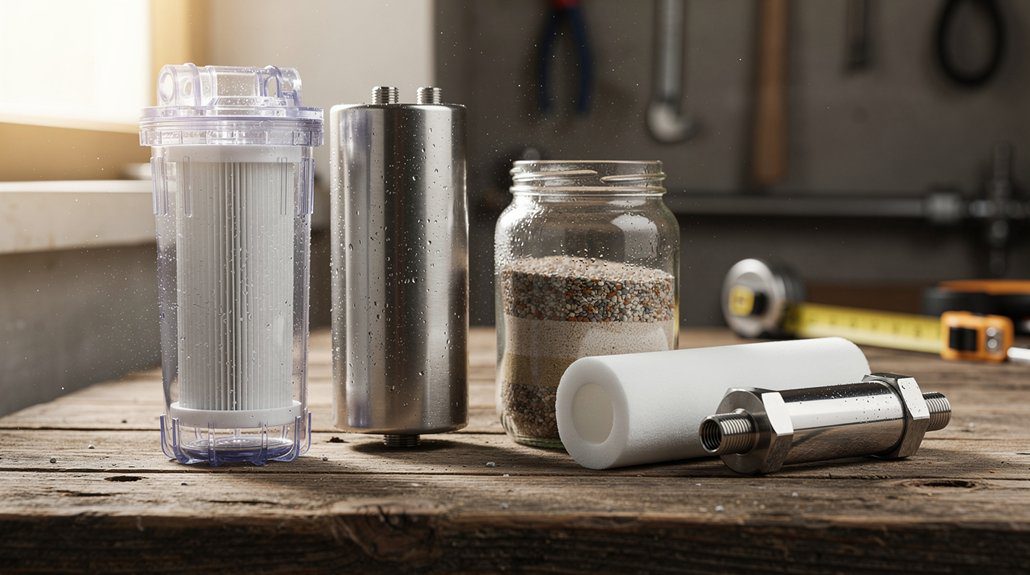
For well water, you’ll want a high‑flow spin‑down or pleated 5–500 µm system matched to your sediment type and peak GPM. Top picks are PSF1 and Waterdrop for heavy grit, iSpring WSP‑50 for reliable 50 µm screening, and PUREPLUS or Membrane Solutions 5 µm cartridges for finer silt and rust. Prioritize stainless mesh or forged brass heads, low pressure drop, and easy flushing or cartridge swaps — keep going to see sizing, staging, and maintenance tips.
| PSF1 Spin-Down Whole House Sediment Pre-Filter | 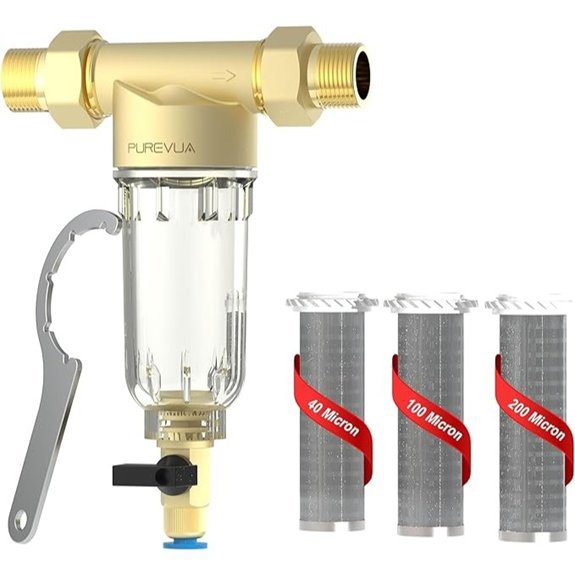 | Low-Maintenance Marvel | Purpose: Whole-house sediment pre-filter for well/municipal water | Sediment Removal Rating / Type: Mesh screens (40, 100, 200 micron options) | Reusability / Flushable: Spin-down design with flush valve; reusable stainless screens | VIEW LATEST PRICE | Read Our Analysis |
| iSpring WSP-50 Spin Down Sediment Whole-House Prefilter | 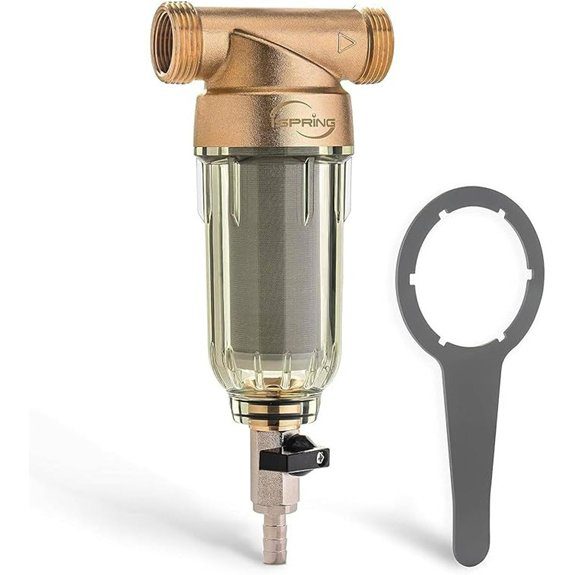 | Reliable Standard | Purpose: Whole-house spin-down sediment prefilter for well water | Sediment Removal Rating / Type: 50-micron stainless steel mesh (model WSP-50) | Reusability / Flushable: Flushable/reusable spin-down screen | VIEW LATEST PRICE | Read Our Analysis |
| Membrane Solutions 5 Micron Whole House Sediment Filters (6-Pack) | 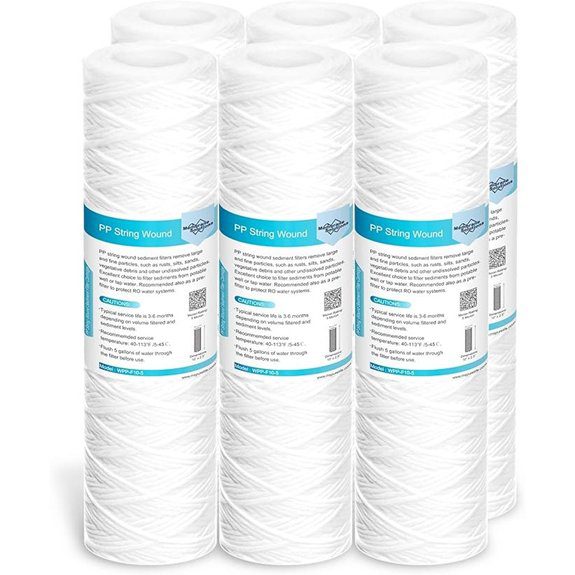 | RO Prep Pack | Purpose: Whole-house/RO sediment replacement cartridge (prefilter) | Sediment Removal Rating / Type: 5-micron string-wound polypropylene cartridges | Reusability / Flushable: Replacement cartridges (not flushable) — disposable replaceable elements | VIEW LATEST PRICE | Read Our Analysis |
| Waterdrop Mega Spin Down Whole House Sediment Filter | 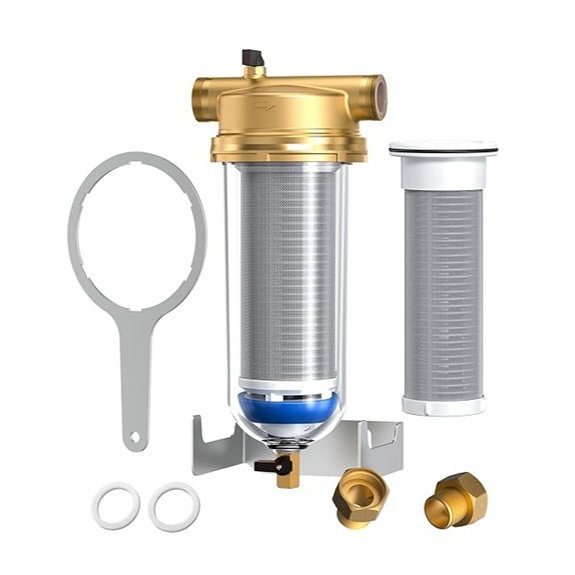 | Heavy-Duty Performer | Purpose: Whole-house spin-down sediment filter for muddy well water | Sediment Removal Rating / Type: Dual mesh (500 µm outer + 200 µm inner) | Reusability / Flushable: Manual 2-way bypass and 360° power flush for cleaning (reusable) | VIEW LATEST PRICE | Read Our Analysis |
| PUREPLUS 5-Micron 10″x4.5″ Whole House Sediment Filters | 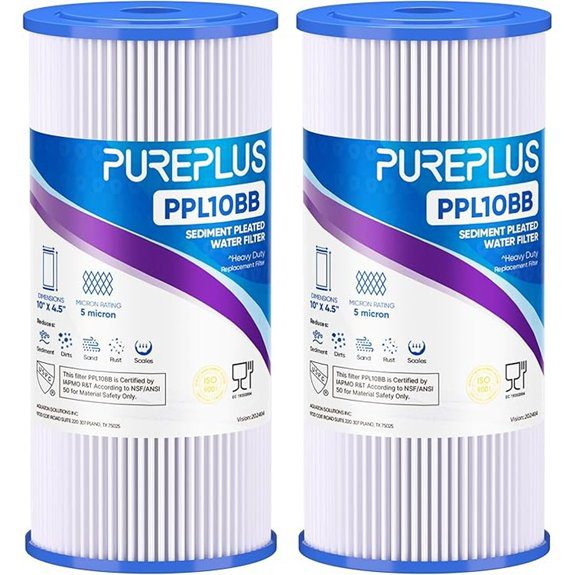 | High-Capacity Replacement | Purpose: Whole-house sediment pleated cartridge for well/house use | Sediment Removal Rating / Type: 5-micron pleated sediment cartridge | Reusability / Flushable: Washable/pleated (designed for multiple uses until replacement recommended) | VIEW LATEST PRICE | Read Our Analysis |
More Details on Our Top Picks
PSF1 Spin-Down Whole House Sediment Pre-Filter
If you’re dealing with sandy, rusty, or particulate-laden well water and want to protect your whole house plumbing and appliances, the PSF1 spin-down pre-filter is a smart choice — its reusable stainless steel mesh (40/100/200 µm) and spin-down flush let you clear debris in seconds without replacing cartridges. You’ll fit it to standard US plumbing using the dual-thread head (1″ MNPT + 3/4″ FNPT) and optional 3/4″ adapter, then monitor sediment through the transparent, BPA-free housing. It handles up to 20 GPM with low pressure drop, uses reinforced O-rings for sealing, and includes a 24″ drain hose.
- Purpose:Whole-house sediment pre-filter for well/municipal water
- Sediment Removal Rating / Type:Mesh screens (40, 100, 200 micron options)
- Reusability / Flushable:Spin-down design with flush valve; reusable stainless screens
- Housing / Head Visibility or Material:Transparent BPA-free high-impact housing (visual monitoring)
- Protects Downstream Equipment:Protects plumbing, water heaters, washers, RO systems
- Compatibility / Connections:Dual-thread head 1″ MNPT + 3/4″ FNPT; includes 3/4″ MNPT adapter; mounting bracket optional
- Additional Feature:Three mesh micron options
- Additional Feature:Transparent BPA-free housing
- Additional Feature:24″ drain hose included
iSpring WSP-50 Spin Down Sediment Whole-House Prefilter
Choose the iSpring WSP-50 when you need a simple, reusable whole-house prefilter that traps larger sand, rust, and dirt before they reach your plumbing or finer filters. You get a 50-micron stainless steel mesh screen in a see-through housing so you can monitor buildup and flush it away via the garden-hose barb valve. Its lead-free brass head and 1″ MNPT/3/4″ FNPT connections make installation straightforward indoors; wrench and manual are included. It handles 15–115 psi and 40–100°F. For very heavy sediment, consider larger micron screens or bigger models, since 50- or 100-micron screens can clog.
- Purpose:Whole-house spin-down sediment prefilter for well water
- Sediment Removal Rating / Type:50-micron stainless steel mesh (model WSP-50)
- Reusability / Flushable:Flushable/reusable spin-down screen
- Housing / Head Visibility or Material:See-through housing for visual monitoring
- Protects Downstream Equipment:Protects entire plumbing and downstream finer filters/RO
- Compatibility / Connections:1″ MNPT and 3/4″ FNPT threaded ends; garden-hose barb on flush valve
- Additional Feature:Lead-free brass head
- Additional Feature:Garden-hose flush barb
- Additional Feature:Indoor-use specification
Membrane Solutions 5 Micron Whole House Sediment Filters (6-Pack)
Homeowners with high-sediment well water will appreciate that the Membrane Solutions 5-micron string-wound cartridges capture up to 99% of rust, silt, sand, and other particulates while offering a longer service life than standard polypropylene filters. You get six 10″x2.5″ food-grade polypropylene, lead- and BPA-free cartridges with a deep graded honeycomb design that traps large particles outward and finer debris near the core. They serve as robust prefilters for whole-house or RO systems, boast up to 15,000–20,000 gallons of service life, and hold four times more dirt at double the flow of standard PP filters. Replace every six months.
- Purpose:Whole-house/RO sediment replacement cartridge (prefilter)
- Sediment Removal Rating / Type:5-micron string-wound polypropylene cartridges
- Reusability / Flushable:Replacement cartridges (not flushable) — disposable replaceable elements
- Housing / Head Visibility or Material:Cartridge form (no housing included; fits housings) — material is food-grade PP
- Protects Downstream Equipment:Protects RO systems, appliances, pipes, faucets, shower fittings
- Compatibility / Connections:Standard 10″ x 2.5″ cartridge size compatible with common housings (listed models)
- Additional Feature:100% food-grade polypropylene
- Additional Feature:Deep-graded string-wound
- Additional Feature:NSF certified materials
Waterdrop Mega Spin Down Whole House Sediment Filter
For wells that kick up lots of grit and rust, the Waterdrop Mega Spin Down is built to handle heavy, muddy feed water without choking your system. You get dual mesh (500 μm outer, 200 μm inner) that captures pebbles, coarse and fine sand, silt, rust flakes, leaf debris, insects, and algae fragments. Its 20× larger chamber and high-flow 25 GPM capacity use outer and inner meshes significantly larger than standard to reduce clogging. The 3.2 lb forged brass head resists corrosion and water hammer; magnetic scale control attracts ferrous particles. Use the 2-way bypass and 360° power flush; clean biweekly.
- Purpose:Whole-house spin-down sediment filter for muddy well water
- Sediment Removal Rating / Type:Dual mesh (500 µm outer + 200 µm inner)
- Reusability / Flushable:Manual 2-way bypass and 360° power flush for cleaning (reusable)
- Housing / Head Visibility or Material:Forged brass head with nano-coating; large chamber (housing details implied)
- Protects Downstream Equipment:Prevents coarse/fine debris reaching downstream equipment; reduces scale and buildup
- Compatibility / Connections:Designed for whole-house plumbing; large chamber fits high-flow systems (brass head compatible with standard plumbing)
- Additional Feature:Dual-mesh (500µm/200µm)
- Additional Feature:25 GPM high-flow
- Additional Feature:Magnetic ferrous capture
PUREPLUS 5-Micron 10″x4.5″ Whole House Sediment Filters
If you need a rugged, high-capacity sediment solution for well water, the PUREPLUS 5-micron 10″x4.5″ pleated cartridge delivers—capturing up to 99% of sand, rust, and sediment while supporting high flow and long life (up to ~30,000 gallons depending on water quality). You’ll get food-grade, BPA-free materials meeting EC1935-2004, Australia Water Mark, REACH, and ISO 9001/14000 production. The pleated 3D weave boosts capture area and maintains flow. It fits standard 10″x4.5″ housings and many OEM models, installs easily, and comes in multi-packs. Expect suggested replacements every 3–6 months based on household use.
- Purpose:Whole-house sediment pleated cartridge for well/house use
- Sediment Removal Rating / Type:5-micron pleated sediment cartridge
- Reusability / Flushable:Washable/pleated (designed for multiple uses until replacement recommended)
- Housing / Head Visibility or Material:Pleated cartridge (fits standard housings) made from certified food-grade materials
- Protects Downstream Equipment:Protects downstream equipment and matches OEM housings for leak-free performance
- Compatibility / Connections:Standard 10″ x 4.5″ cartridge dimensions compatible with many heavy-duty housings and OEM equivalents
- Additional Feature:Pleated 3D weaving
- Additional Feature:30,000-gallon capacity
- Additional Feature:Broad OEM compatibility
Factors to Consider When Choosing a Sediment Filter for Well Water
When choosing a sediment filter for your well, you’ll want to match the filter’s micron rating to the typical particle size you’re dealing with. Check your well’s flow rate to ensure the filter won’t restrict water pressure, and pick a durable filter material that stands up to your water conditions. Also consider how often you’re willing to perform maintenance, since some media and micron ratings clog faster than others.
Sediment Particle Size
Although sediment in well water spans a wide range—from gravel and coarse sand down to fine silt and colloidal clay—you’ll usually address it with a staged approach that matches filter micron ratings to the particle sizes present. Sediment size is measured in microns (µm); common well sediments exceed 500 µm (gravel, pebbles) down to under 5 µm (fine silt, colloidal clay). Use a coarse prefilter (100–500 µm) to trap large debris and protect downstream cartridges. Install finer cartridges (1–10 µm) to remove silt, rust flakes, and most suspended solids that cause turbidity and foul equipment. Remember: lower micron ratings load faster and need more frequent service, so match micron size to measured sediment load. Particle-size testing guides ideal staging and micron choices.
Water Flow Rate
Sizing your sediment filter by particle ratings is only part of the picture; you also have to match the filter’s flow performance to how your household actually uses water. You should size the filter’s maximum GPM to your household peak demand—most single-family homes need 10–25 GPM—to avoid pressure drops during high use. Check the manufacturer’s pressure-drop spec at your expected flow (for example, <2 psi at 20 GPM); higher drops will weaken pressure and can harm appliances. Confirm port size and connection type because 3/4" or 1" fittings often limit practical GPM and create bottlenecks. Factor dirt-holding capacity so flow stays steady between cleanings. If you have variable or high instantaneous flows, pick a filter rated above peak GPM or use parallel/staged filters.
Filter Micron Rating
Because the micron rating tells you what particle sizes a filter will remove, it’s the key spec to match to your well’s sediment and downstream needs. Check your sediment size: heavy sand and grit need coarser screens (tens to hundreds of microns) so filters don’t clog instantly, while protecting sensitive equipment or RO systems calls for finer 1–10 µm filtration. Remember nominal versus absolute ratings—absolute (e.g., 99.9% at X µm) gives a reliable retention metric; nominal is approximate. Finer-micron filters hold dirt better but cut flow and require more frequent replacement or flushing. For whole-house setups, stage filtration: start with a spin-down or flushable coarse prefilter, then step down to progressively finer cartridges ahead of point-of-use devices.
Filter Material Durability
When you pick a sediment filter, focus on materials that stand up to your well’s chemistry, pressure cycles, and maintenance needs; stainless-steel mesh, polypropylene cartridges, pleated media, and compatible elastomers each offer different durability and service-life trade-offs. Stainless-steel mesh resists corrosion, cleans easily, and can last years under normal conditions. Polypropylene string-wound cartridges handle chemicals and maintain structural integrity, delivering tens of thousands of gallons depending on sediment load. Pleated media boosts surface area and mechanical strength, extending dirt-holding capacity and flow life versus depth-wound types. Ensure elastomer seals and O-rings use compatible compounds (EPDM, Viton) to avoid chemical degradation and leaks. Avoid brittle plastics and low-grade housings; pick units rated for your pressure, temperature, and hammer-cycle exposures.
Maintenance Frequency Needed
Durability affects how often you’ll need to service a filter, but the actual maintenance frequency depends on your well’s sediment load, filter type, and how you monitor performance. If your water carries heavy sand or silt, plan on flushing or cleaning cartridges every 1–2 weeks to avoid clogging and loss of flow. Moderate sediment typically requires cleaning or cartridge changes every 1–3 months. Fine 5–10 micron disposable cartridges generally last 3–6 months under average use, but replace sooner if you see a pressure drop of roughly 5–10 psi. Installing a spin-down prefilter with a flush valve ahead of finer filters can push service intervals to every two months or longer when flushed routinely. Always act immediately on increased differential pressure or visible turbidity.
Connection And Compatibility
If you’re swapping or adding a sediment filter, start by confirming the physical and threaded connections so you won’t need custom fittings at install. Check pipe thread types and sizes (1″ NPT, 3/4″ NPT, garden-hose barb) and whether the filter head offers dual-thread or adapter options to match your plumbing. Verify inlet/outlet orientation and overall dimensions so the unit fits available space and you can remove cartridges. Match cartridge length and diameter (10″ x 2.5″, 10″ x 4.5″) to your housing for easy replacements. Confirm housing pressure and temperature ratings and that threaded materials and O-rings suit your water chemistry. If adding to an existing system, ensure compatibility with valves, bypasses, and downstream equipment to preserve flow direction and serviceability.
Capacity And Longevity
Because a sediment filter’s useful life hinges on both its design and your well’s sediment load, pick a cartridge by balancing micron rating, dirt‑holding capacity, and serviceability. You’ll see capacity listed in gallons (often 10,000–30,000 gal); that’s the treated volume before restriction or breakthrough. Choose micron ratings thoughtfully: finer ratings trap smaller particles but clog sooner than coarser ones. Prefer pleated or large‑area elements when you want longer intervals between changes — greater surface area raises dirt‑holding capacity and delays pressure drop. Match service life expectations to your water: high sand or turbidity may force changes every few weeks, while cleaner sources can go 3–6 months or more. Consider maintenance style too: flushable spin‑down screens can be cleaned repeatedly, extending practical longevity versus disposable cartridges.
Special Contaminant Control
When you’re tailoring a sediment filter to specific well contaminants, match the filter type and micron rating to the particle size and composition—use spin‑down or coarse‑mesh prefilters (200–500 µm) for visible sand and pebbles, magnetic or iron‑targeting pretreatment for ferrous particulates, and depth or pleated 1–10 µm cartridges for fine silt, rust flakes, and turbidity. Choose larger-capacity housings and reusable or easily flushed screens if you face high sediment loads or episodic surges so you maintain flow rates and cut replacement frequency. If iron is present, add magnetic or oxidation pretreatment to prevent fouling of downstream media and membranes. For wells with microbes or high organic content, pair sediment filtration with disinfection or carbon/antimicrobial treatments because sediment filters won’t reliably remove bacteria or dissolved organics.