
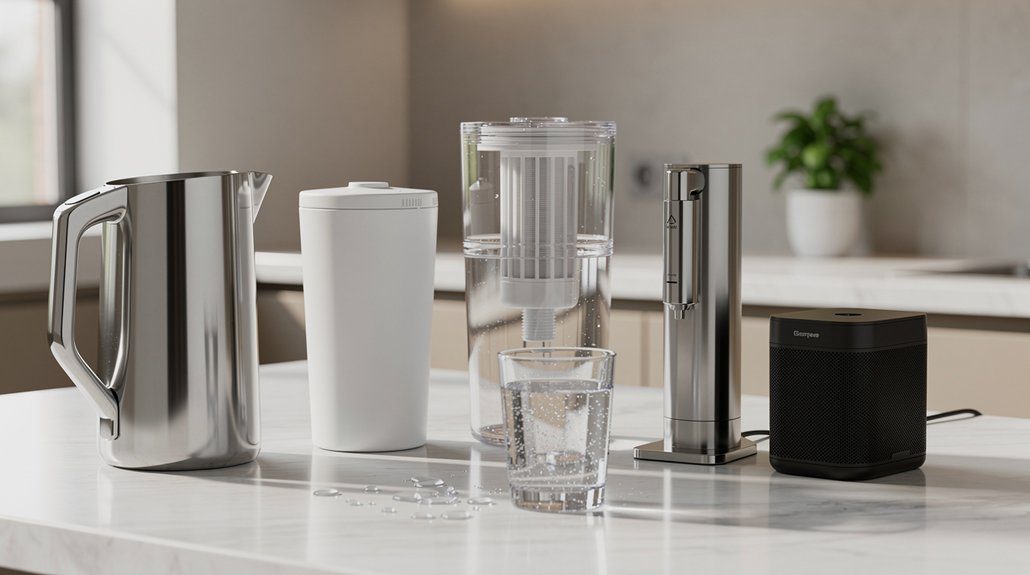
Looking for a top countertop water filter in 2026? You’ll want options that balance purity, waste, and convenience: DREO’s 7-stage RO with 3:1 recovery and autofill pitcher; SimPure Y7P-BW’s 5-stage RO+UV (NSF‑58) and 4:1 efficiency; Bluevua RO100ROPOT adds remineralization; Aigerri’s portable 5:1 RO+UV for travel; and Brita UltraMax’s 27‑cup gravity dispenser for no‑power simplicity. Pick by TDS needs, wastewater ratio, and whether you need UV or remineralization — keep going to see details.
More Details on Our Top Picks
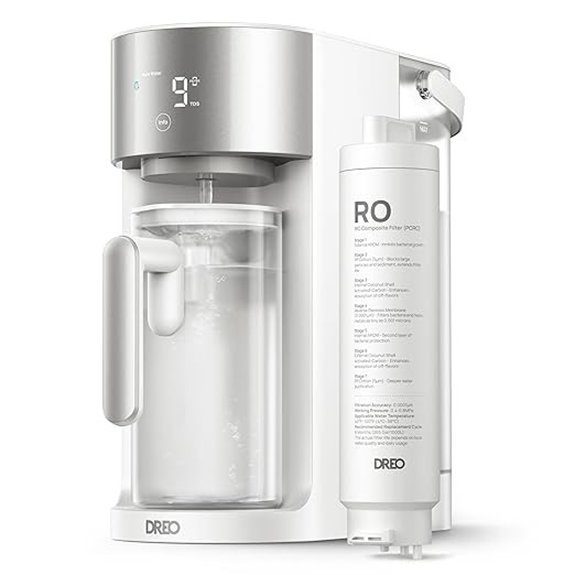
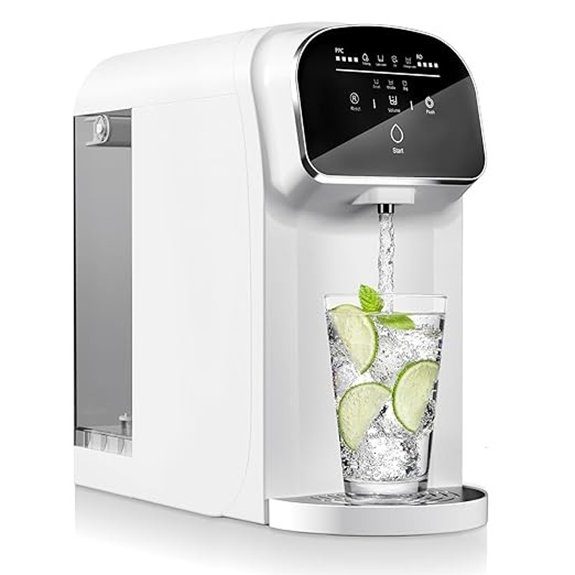
DREO Reverse Osmosis Water Filter Countertop RO Filtration System 3:1 Pure to Drain TDS & Filter Life & Autofill Pitcher Installation-Free Self-Cleaning Water Purifier RO Water Filter
If you want near–tap‑water purity without installing plumbing, the DREO countertop reverse‑osmosis system is ideal: it delivers NSF/ANSI 58‑rated, 7‑stage RO filtration with a compact, plug‑in design and a 3:1 pure‑to‑drain ratio, so you’ll get high‑quality, low‑TDS water for one to two people while cutting plastic bottle use and avoiding a complicated setup. You’ll monitor raw and purified TDS in real time, get filter‑life reminders, and enjoy self‑cleaning auto‑flush cycles. The 3.0 L tank plus 1.1 L autofill pitcher fits small kitchens or offices. Filters twist in for easy replacement every 6–12 months.
- Filtration Type:Reverse osmosis (7-in-1 RO)
- Installation Style:Countertop, no plumbing (plug-in, installation-free)
- Power Requirement:Requires power (plug-in)
- Self-Care / Monitoring:TDS real-time monitoring, filter-life reminders, self-cleaning (auto-flush)
- Target Contaminant Reduction / Claim:Removes 1,000+ impurities (up to 99.99%); reduces TDS, PFOA/PFOS, chlorine, fluoride
- Intended Placement / Use Case:Kitchen countertop, living room, bedroom, office; for 1–2 people
- Additional Feature:Autofill pitcher included
- Additional Feature:Real-time TDS display
- Additional Feature:Self-cleaning auto-flush
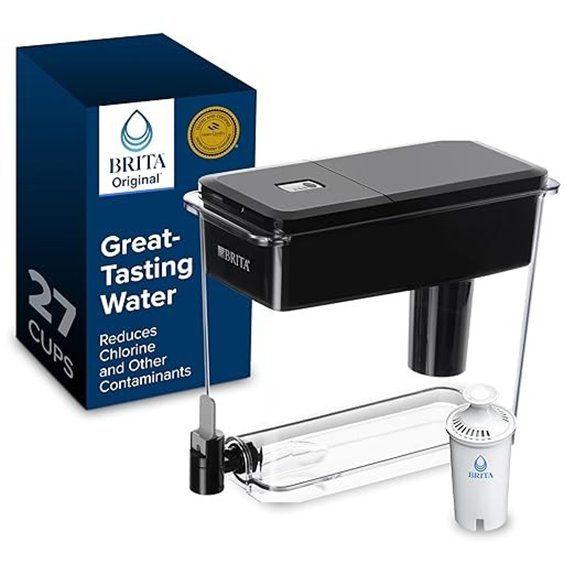
Brita UltraMax Large Water Dispenser With Standard Filter BPA-Free Reduces Copper Cadmium and Mercury Impurities Lasts 2 Months or 40 Gallons Includes 1 Filter Kitchen Accessories Large 27-Cup
For households that want high-capacity, no-fuss filtration, the Brita UltraMax 27-cup dispenser is a smart pick: it’s a fridge-friendly, gravity-fed system that uses a carbon block filter to cut chlorine taste and reduce metals like copper, cadmium, and mercury, and it holds enough filtered water for families who don’t want to refill constantly. You’ll get a BPA-free, polystyrene container with an easy-lock lid, precision-pour spigot, and a sticker reminder for filter changes. The included Standard filter lasts about 40 gallons (~2 months); you can upgrade to an Elite filter for roughly 120 gallons (~6 months). No power or installation needed.
- Filtration Type:Carbon block, gravity-fed filtration
- Installation Style:Countertop/dispensed, freestanding (no power required)
- Power Requirement:No power required (gravity-fed)
- Self-Care / Monitoring:Sticker filter-change indicator (basic reminder)
- Target Contaminant Reduction / Claim:Reduces chlorine taste/odor, copper, cadmium, mercury (carbon block)
- Intended Placement / Use Case:Kitchen countertop / fridge-friendly dispenser; household use
- Additional Feature:Fridge-friendly design
- Additional Feature:Precision-pour spigot
- Additional Feature:Sticker filter indicator
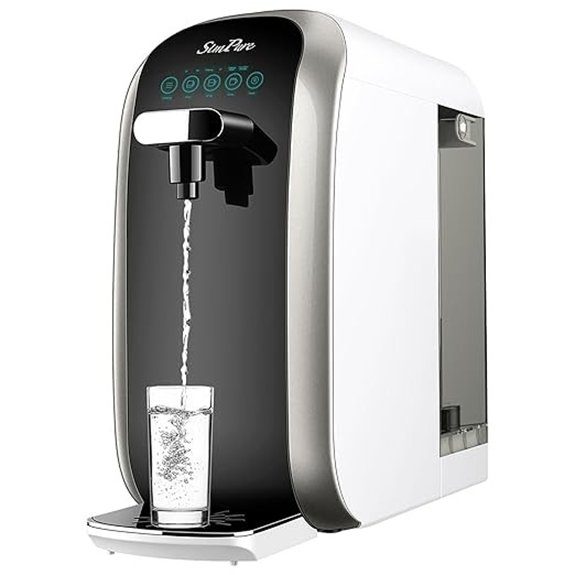
SimPure Y7P-BW UV Countertop Reverse Osmosis Water Filter NSF/ANSI 58 Certified 5 Stage RO Water Filtration System Water Purifier for Home No Installation 4: 1 Pure to Drain Classic Pure Taste
Choose the SimPure Y7P-BW if you want laboratory-grade RO performance on your countertop without a plumber — it delivers NSF/ANSI 58–certified removal of 99.99% of 1,000+ contaminants (including PFAS and heavy metals) using a 0.0001 μm RO membrane plus UV for extra microbial safety. You’ll get five-stage RO+UV filtration, chemical-free UV disinfection, and a classic pure taste. The unit runs plug-and-play with quick-change cartridges, dispenses room-temperature water at ~418 GPD (about 15 seconds per cup), and wastes at a 4:1 pure-to-drain ratio. It yields ~528 gallons per filter set and helps reduce bottled-water use.
- Filtration Type:Reverse osmosis + UV (5-stage RO + UV)
- Installation Style:Countertop, no installation (plug-in)
- Power Requirement:Requires power (plug-in; UV)
- Self-Care / Monitoring:Filter life monitoring; quick-change cartridges
- Target Contaminant Reduction / Claim:Removes 1,000+ contaminants (99.99%) including PFAS, heavy metals, chlorine, fluoride
- Intended Placement / Use Case:Countertop/desktop for home, apartments, kitchens, offices, RVs/camping
- Additional Feature:Built-in UV sterilizer
- Additional Feature:418 GPD fast flow
- Additional Feature:528-gallon filter yield
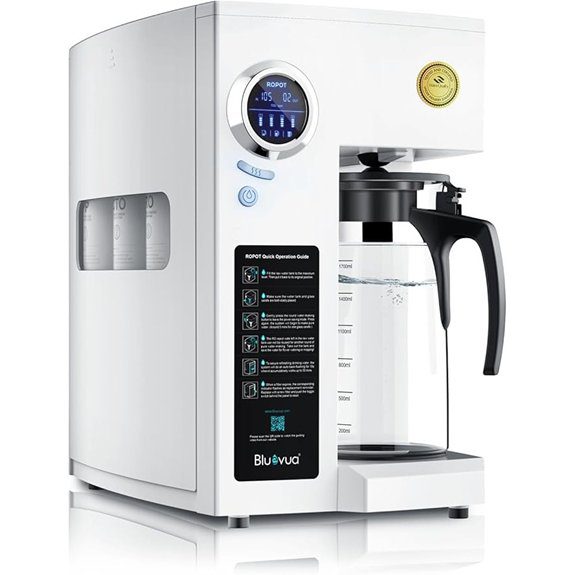
Bluevua RO100ROPOT Countertop Reverse Osmosis Water Filter System Portable RO Filtration with Remineralization No Installation WQA Certified – ROPOT 5-Stage RO
Got consistent, bottled-quality water at home without plumbing by using the Bluevua RO100ROPOT countertop RO system—perfect if you want a portable, plug-in unit that removes up to 99.9% of contaminants while adding back essential minerals. You’ll get five-stage RO with a remineralization filter, corded electric operation, and a 2:1 pure-to-drain ratio. The glass 1.7 L carafe reduces plastic contact, and the unit supports feed TDS up to 1000 ppm at 0.26 L/min. Filters last 12–24 months, a life monitor tracks status, and WQA plus ClimatePartner certifications back performance. It’s compact, no-install, and includes spare filters.
- Filtration Type:Reverse osmosis (5-stage RO with remineralization)
- Installation Style:Countertop, portable, no plumbing (plug-in)
- Power Requirement:Requires power (corded electric)
- Self-Care / Monitoring:Filter life monitor / service-life display
- Target Contaminant Reduction / Claim:Removes up to 99.9% of contaminants; bottled-quality water, remineralizes
- Intended Placement / Use Case:Countertop portable (carafe included); home, travel, small spaces
- Additional Feature:Glass borosilicate carafe
- Additional Feature:Remineralization stage included
- Additional Feature:Power-saving standby
Aigerri Portable Countertop Reverse Osmosis Water Filter with UV 5-Stage RO Filtration System No Installation Needed 5:1 Pure to Drain Ratio Compact Water Purifier for Home Office & RV
If you live in a small space or travel often and want lab-grade purification without plumbing, the Aigerri portable countertop RO delivers: it combines a 5-stage reverse osmosis stack with UV sterilization to turn tap or well water (TDS <500 ppm) into safe drinking water while fitting on a kitchen island, RV counter, or office desk. You get a 5L raw tank and 2L purified tank, 5:1 pure-to-drain efficiency, and about 529 gallons of filtered water from supplied filters. It’s plug-and-use, self-cleaning, BPA-free, compact (≈16.4×7.4×16.2 in), and includes necessary filters and manual.
- Filtration Type:Reverse osmosis + UV (5-stage RO + UV)
- Installation Style:Countertop, no installation (plug-and-use)
- Power Requirement:Requires power (plug-in; UV)
- Self-Care / Monitoring:Filter change indicator; self-cleaning feature
- Target Contaminant Reduction / Claim:Reduces TDS, heavy metals, chlorine, sediments, PFAS (RO + UV)
- Intended Placement / Use Case:Countertop for home, office, RV, camping, tea table/kitchen island
- Additional Feature:5L raw tank
- Additional Feature:5:1 pure-to-drain
- Additional Feature:Compact pitcher-style unit
Factors to Consider When Choosing a Water Filter for Countertop
When choosing a countertop water filter, you’ll want to compare filtration technology, contaminant removal claims, and any certifications or test results to make sure it actually treats what concerns you. Also consider installation and portability so it fits your space and routines, plus capacity and flow rate to match how much water you use. These factors together help you pick a safe, convenient system that meets your needs.
Filtration Technology Type
Decide which filtration technologies matter most for your water by matching each method’s strengths to the contaminants you’re worried about: reverse osmosis excels at removing dissolved salts and heavy metals but wastes water, activated carbon is great for chlorine, VOCs, taste, and odor yet won’t touch dissolved minerals or most pathogens, UV inactivates microbes without affecting taste but won’t remove chemicals or particulates, and multi-stage systems combine these approaches to cover gaps—so check pore-size ratings and certified NSF/ANSI removal claims to ensure the system actually addresses your specific concerns.
If your water tests high for TDS or lead, RO’s ~0.0001 µm membrane is best, despite a 3:1–5:1 waste ratio. Use carbon for chlorine and VOCs. Add UV where microbial risk exists. Multi-stage setups let you balance performance, maintenance, and footprint.
Contaminant Removal Claims
Because different filters target different pollutants, you should verify any contaminant‑removal claim before you buy. Check the specific contaminants listed and the claimed percentage reductions—common targets include chlorine, lead, mercury, PFAS/PFOA/PFOS, fluoride, nitrates, and TDS. Match those claims to the filtration technology: carbon for chlorine and organics, reverse osmosis for dissolved solids and heavy metals, UV for microbes, ion exchange for nitrates and softening. Don’t accept vague statements; look for test conditions (influent concentration, flow rates) because “99.9%” depends on starting levels and operating conditions. Prefer third‑party lab reports or NSF/ANSI test references that show contaminant lists and reduction data rather than manufacturer‑only assertions to confirm real‑world performance.
Certification And Testing
Although certifications and test reports might seem like paperwork, they’re the most reliable way to verify a countertop filter actually removes the contaminants you care about. You should look for NSF/ANSI standards relevant to your goals—NSF/ANSI 58 for RO, 53 for health‑related reductions (lead, cysts), and 42 for chlorine taste/odor. Confirm independent third‑party testing lists specific contaminants and percent removal under defined conditions. Read test‑report conditions—input TDS, temperature, flow rates, and methodologies—because performance shifts with source water and operating parameters. Verify lifespan and capacity claims are backed by standardized testing (gallons or months) with post‑treatment quality data so you know when to replace cartridges. If microbial control matters, confirm validated tech (ultrafiltration, RO pore specs, or UV) and reported log‑reduction values.
Installation And Portability
When choosing a countertop filter, start by confirming whether it’s truly installation‑free or needs plumbing—plug‑and‑play and gravity models let you set up instantly, while RO and UV systems often require an outlet and occasional hookups that change where you can place them. Next, check power needs: battery‑free gravity units offer maximum placement freedom, while plug‑ins may need nearby outlets and can have standby draw. Measure vertical height, footprint, and lid clearance so the unit fits under cabinets and you can access filters easily. For mobility, prefer integrated handles, lightweight construction, and low total weight if you’ll move it between rooms, RVs, or temporary locations. Finally, pick quick‑change or twist‑install filters and self‑clean/auto‑flush features to simplify maintenance.
Capacity And Flow Rate
Think about how much purified water you’ll actually need each day and how quickly you want it: match the tank and storage capacity to your household (2–4 L for one person, 8–12+ L for a family) and check the unit’s delivery rate and dispense speed so you won’t be waiting for cups or cooking pots to fill. Verify pure-water delivery rate (flow or GPD) and choose higher rates if multiple users or fast fills matter. Factor raw-water storage plus any secondary pitcher or carafe so you know how long treated water lasts between cycles. Check dispense speed (seconds per cup or L/min) and whether the system gives continuous flow versus batch fills to match drinking, cooking, or appliance needs. Consider recovery efficiency to limit refills.
Wastewater Efficiency
You’ve matched capacity and flow to your household needs, but you also need to consider how much water is wasted during purification. Check the pure-to-drain ratio: a 5:1 system wastes one gallon per five purified, while a 2:1 wastes much more per output. Higher-efficiency units (4:1 or better) cut waste and lower operating costs, especially with metered water or limited supply. Look for self-cleaning or auto-flush features that maintain membrane performance and prevent frequent inefficient flush cycles. Verify allowable feed-water TDS and expected reject quality, since high input TDS raises reject volume and reduces efficiency. Finally, compare daily production (GPD or liters/day) against wastewater generation to estimate long-term usage and environmental impact.
Maintenance And Filter Life
Regularly maintaining your countertop filter and tracking cartridge life will keep water quality high and prevent costly damage. Check each cartridge’s rated lifespan—usually months or gallons (e.g., 6–12 months or 40–528 gallons)—and set reminders to replace them before performance drops. If your unit has real-time TDS or filter-life displays, monitor those and swap filters when TDS rises or an alert appears. Follow self-cleaning, auto-flush, or manual-flushing schedules to prevent biofilm and extend membranes. Replace pre-filters and sediment cartridges on schedule to protect downstream RO membranes and prolong the system. Keep concise records of installation dates, replacements, and source-water TDS so you can adjust change intervals based on actual usage and water quality.
Additional Features And Sensors
Look for countertop units with smart sensors and automated features that take the guesswork out of upkeep and safety. You’ll want real-time TDS sensors that show feed and purified TDS so you can confirm reduction performance and spot membrane degradation before taste changes. Filter-life indicators estimate remaining service time from usage or TDS trends and prompt timely cartridge changes, usually every 6–12 months for RO pre/post-filters. Auto-flush and self-cleaning cycles, triggered by onboard sensors, cut biofilm and scale, extending membrane life. Built-in UV sensors and timers monitor lamp status and warn when replacement’s needed to keep disinfection active. Leak, tank-full, and autofill sensors protect against overflows and plumbing faults and enable automatic pitcher refills or shutoff at capacity.