
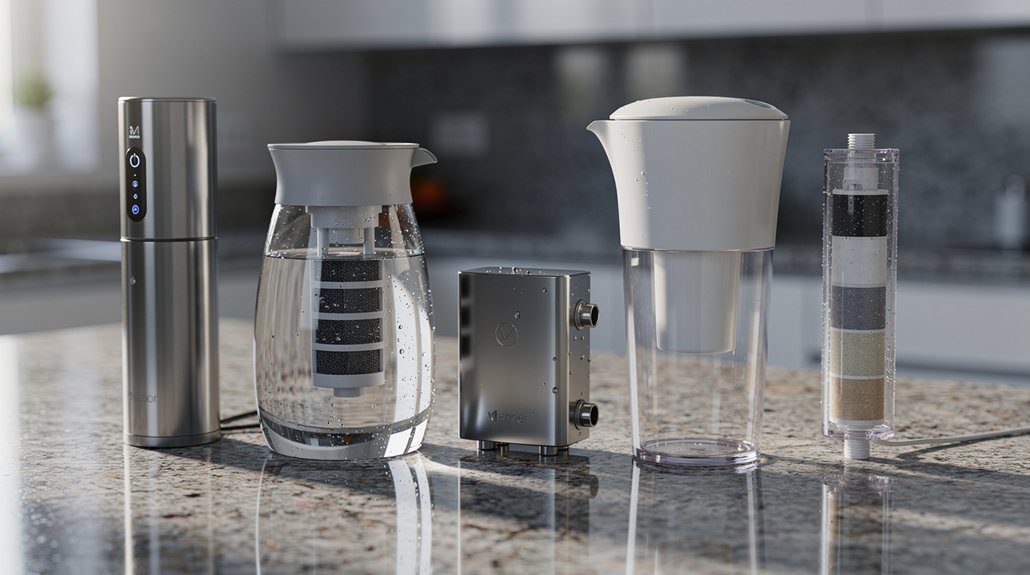
You’ll want certified, proven PFAS removers: the Waterdrop 10UA under‑sink (NSF/ANSI 42, coconut carbon, year‑long cartridge), CuZn UC‑200 (three‑stage, long life, inline fit), Aquagear pitcher (PFAS/lead-tested, 120‑gal life), Clearly Filtered No.1 pitcher (targets 365+ contaminants, includes 100‑gal filter), and Express Water 3‑stage whole‑house (treats PFAS, chlorine, metals). They balance PFAS performance, lifespan, and installation; continue for specifics on tech, testing, and costs.
| Waterdrop 10UA Under Sink Water Filter System Reduces PFAS PFOA/PFOS Lead Chlorine Bad Taste & Odor Under Counter Water Filter Direct Connect to Kitchen Faucet NSF/ANSI 42 Certified 1 Year | 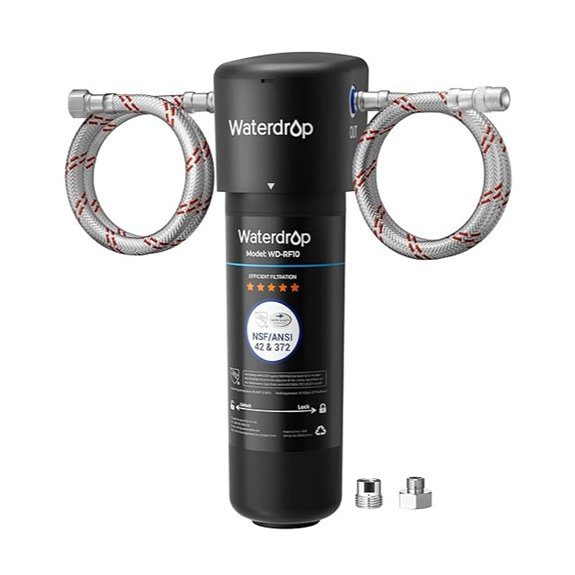 | Best Under-Sink | PFAS Reduction: Reduces PFAS / PFOA / PFOS | Certified Materials / Standards: NSF/ANSI 42 and 372 certified | Retains Beneficial Minerals: Retains calcium, potassium, sodium, magnesium | VIEW LATEST PRICE | Read Our Analysis |
| CuZn Under Sink Water Filter for Sink Faucet 5 Year Filter Life NSF/ANSI 42 & 372 Certified Reduces PFAs PFOS Lead Chlorine Inline Faucet Connection Improves Tap Water Taste | 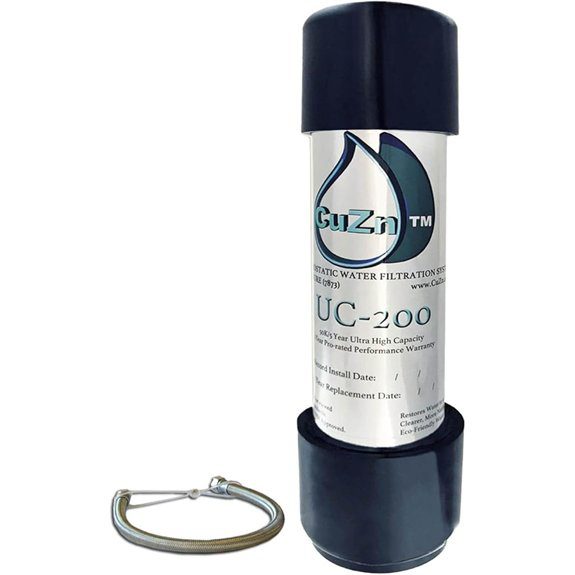 | Longest Lifespan | PFAS Reduction: Reduces PFAs / PFOA / PFOS | Certified Materials / Standards: NSF/ANSI 42 and 372 certified components/materials | Retains Beneficial Minerals: Purifies while retaining beneficial minerals | VIEW LATEST PRICE | Read Our Analysis |
| Aquagear Water Filter Pitcher – Lead Chlorine PFOA/PFOS Microplastics Filter 10 Cup 120 Gallon Filter Life – Filter Media Made in USA | 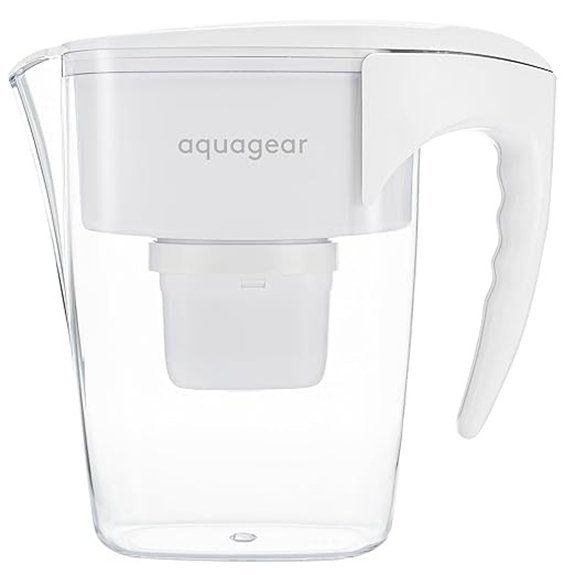 | Best Pitcher Performance | PFAS Reduction: Removes PFOA / PFOS (pitcher tested for PFAS) | Certified Materials / Standards: Third‑party tested (filter media made in USA) — manufacturing/QA standards noted | Retains Beneficial Minerals: Preserves healthy minerals (calcium, magnesium) | VIEW LATEST PRICE | Read Our Analysis |
| Clearly Filtered No.1 Filtered Water Pitcher/Updated Model/Targets 365+ Contaminants e.g. Fluoride Chlorine PFAS Microplastics Lead Arsenic BPA/BPS Free (Pitcher Includes 1 Filter) | 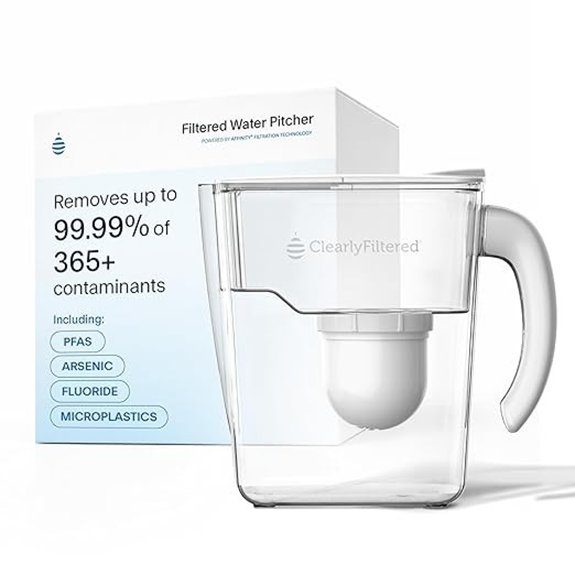 | Most Comprehensive Removal | PFAS Reduction: Targets PFAS / PFOA (listed among 365+ contaminants) | Certified Materials / Standards: Conforms to NSF/ANSI standards (42, 53, 401, 473) per testing | Retains Beneficial Minerals: Preserves beneficial minerals while removing contaminants | VIEW LATEST PRICE | Read Our Analysis |
| Express Water 3-Stage Whole House Water Filter System Reduces Heavy Metals Scale Chloramine Chlorine PFAs Lead & Arsenic Free-standing Stainless Steel Frame & 3 Pressure Gauges | 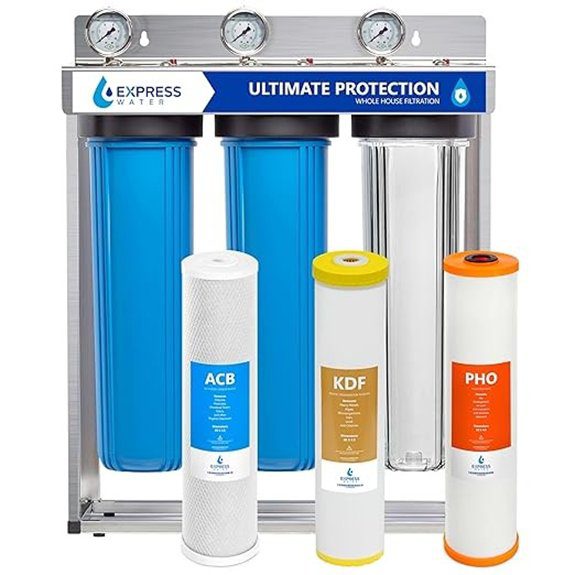 | Whole-House Protection | PFAS Reduction: Reduces PFAs | Certified Materials / Standards: Manufacturer specifies tested contaminant reductions (system specs); includes pressure gauges and materials details (commercial/consumer system standards implied) | Retains Beneficial Minerals: Does not reduce TDS (so minerals/TDS retained); recommends RO if TDS reduction desired | VIEW LATEST PRICE | Read Our Analysis |
More Details on Our Top Picks
Waterdrop 10UA Under Sink Water Filter System Reduces PFAS PFOA/PFOS Lead Chlorine Bad Taste & Odor Under Counter Water Filter Direct Connect to Kitchen Faucet NSF/ANSI 42 Certified 1 Year
If you want a simple, low‑maintenance under‑sink system proven to cut PFAS, PFOA/PFOS and lead from municipal tap water, the Waterdrop 10UA is a strong choice—its NSF/ANSI 42 certification, coconut‑shell activated carbon stage, and year‑long cartridge life (8,000–11,000 gallons) make it ideal for households seeking effective contaminant reduction without removing beneficial minerals. You’ll connect it to a standard 3/8 or 1/2 feed, install in minutes with push‑to‑connect fittings, and swap cartridges in seconds. It reduces chlorine, bad taste and odor, keeps beneficial minerals, and supports upgrades to UF or MZ filters.
- PFAS Reduction:Reduces PFAS / PFOA / PFOS
- Certified Materials / Standards:NSF/ANSI 42 and 372 certified
- Retains Beneficial Minerals:Retains calcium, potassium, sodium, magnesium
- Intended Point-of-Use or Point-of-entry Type:Under‑sink / under‑counter (point‑of‑use)
- Filter Lifespan / Capacity:Up to 8,000–11,000 gallons or ~12 months (municipal water)
- Use Cases / Applications:Residential kitchen, bathroom, RV, office; drinking/cooking/skincare/cleaning
- Additional Feature:Twist-and-lock cartridge
- Additional Feature:3/8–1/2 connector included
- Additional Feature:Coconut-shell activated carbon
CuZn Under Sink Water Filter for Sink Faucet 5 Year Filter Life NSF/ANSI 42 & 372 Certified Reduces PFAs PFOS Lead Chlorine Inline Faucet Connection Improves Tap Water Taste
Choose the CuZn UC-200 if you want a low-maintenance under‑sink filter that lasts up to five years and tackles PFAS, PFOS, lead, and chlorine without stripping beneficial minerals. You’ll get a direct-connect inline design that fits tight spaces, needs no drilling, and includes all parts plus clear instructions and a how-to video. Its three-stage system—micro-sediment membranes, KDF-55, and coconut-shell carbon—has independent testing for listed contaminants and improves taste while leaving TDS intact. NSF/ANSI 42 and 372 certified materials back its safety. With a long service life and responsive customer support, it delivers strong value per year.
- PFAS Reduction:Reduces PFAs / PFOA / PFOS
- Certified Materials / Standards:NSF/ANSI 42 and 372 certified components/materials
- Retains Beneficial Minerals:Purifies while retaining beneficial minerals
- Intended Point-of-Use or Point-of-entry Type:Under‑sink / inline for sink faucet (point‑of‑use)
- Filter Lifespan / Capacity:5‑year filter life (single filter)
- Use Cases / Applications:Kitchen or bathroom sink, inline for faucet; residential use emphasized
- Additional Feature:5-year filter life
- Additional Feature:Compact inline design
- Additional Feature:KDF-55 + sediment
Aquagear Water Filter Pitcher – Lead Chlorine PFOA/PFOS Microplastics Filter 10 Cup 120 Gallon Filter Life – Filter Media Made in USA
Homeowners who want an easy, countertop solution will appreciate the Aquagear pitcher’s proven PFAS and lead removal—it’s third-party tested to capture PFOA/PFOS, lead, chlorine, and microplastics while leaving beneficial minerals like calcium and magnesium intact. You’ll get a 10-cup pitcher whose filter lasts 120 gallons, roughly three times longer than typical pitcher filters, and removes about 20× more contaminants than standard pitchers. The filter media’s made in the USA in an ISO 9000 facility, and Aquagear includes a postage-paid recycling program to keep used filters out of landfills. It’s a simple, effective choice for PFAS reduction.
- PFAS Reduction:Removes PFOA / PFOS (pitcher tested for PFAS)
- Certified Materials / Standards:Third‑party tested (filter media made in USA) — manufacturing/QA standards noted
- Retains Beneficial Minerals:Preserves healthy minerals (calcium, magnesium)
- Intended Point-of-Use or Point-of-entry Type:Countertop pitcher (point‑of‑use)
- Filter Lifespan / Capacity:120 gallons per filter
- Use Cases / Applications:Home countertop drinking water (pitcher) — drinking/refill use
- Additional Feature:10-cup pitcher capacity
- Additional Feature:120-gallon filter life
- Additional Feature:Filter recycling program
Clearly Filtered No.1 Filtered Water Pitcher/Updated Model/Targets 365+ Contaminants e.g. Fluoride Chlorine PFAS Microplastics Lead Arsenic BPA/BPS Free (Pitcher Includes 1 Filter)
The Clearly Filtered No.1 pitcher is ideal for anyone who wants proven PFAS removal in a simple, countertop-ready package — perfect for renters, dorm dwellers, or small households that need lab-grade contaminant reduction without plumbing changes. You get an updated August 2024 model that targets 365+ contaminants—fluoride, chlorine, PFAS/PFOA, microplastics, lead, arsenic, pharmaceuticals—using proprietary Affinity Filtration Technology that preserves beneficial minerals. The 80 fl oz Tritan pitcher is BPA/BPS-free, manual-fill, and includes one 100-gallon filter (about four months). It’s third-party tested to NSF/ANSI standards, reduces taste/odor issues, and cuts single-use plastic reliance.
- PFAS Reduction:Targets PFAS / PFOA (listed among 365+ contaminants)
- Certified Materials / Standards:Conforms to NSF/ANSI standards (42, 53, 401, 473) per testing
- Retains Beneficial Minerals:Preserves beneficial minerals while removing contaminants
- Intended Point-of-Use or Point-of-entry Type:Countertop pitcher (point‑of‑use)
- Filter Lifespan / Capacity:~100 gallons per filter (~4 months)
- Use Cases / Applications:Home/office/dorm/RV countertop drinking water
- Additional Feature:Affinity Filtration Technology
- Additional Feature:Medical-grade Tritan pitcher
- Additional Feature:Targets 365+ contaminants
Express Water 3-Stage Whole House Water Filter System Reduces Heavy Metals Scale Chloramine Chlorine PFAs Lead & Arsenic Free-standing Stainless Steel Frame & 3 Pressure Gauges
If you need whole-house PFAS reduction without sacrificing flow, this 3-stage Express Water system delivers treated water to every tap while cutting PFAs, chlorine, chloramine, and heavy metals like lead and arsenic. You get a free-standing stainless steel frame, pressure release buttons for easier cartridge changes, and three pressure gauges to monitor performance. The stages remove sediment, reduce heavy metals and disinfectants, and apply polyphosphate anti-scale treatment to protect pipes and appliances. Expect 0.25 gallons per second at 45–80 PSI and change filters every 6–12 months or ~100,000 gallons. It won’t lower TDS; consider RO for that.
- PFAS Reduction:Reduces PFAs
- Certified Materials / Standards:Manufacturer specifies tested contaminant reductions (system specs); includes pressure gauges and materials details (commercial/consumer system standards implied)
- Retains Beneficial Minerals:Does not reduce TDS (so minerals/TDS retained); recommends RO if TDS reduction desired
- Intended Point-of-Use or Point-of-entry Type:Whole‑house system (point‑of‑entry)
- Filter Lifespan / Capacity:Recommended replacement every 6–12 months or up to ~100,000 gallons (depending on usage)
- Use Cases / Applications:Whole‑home supply — protects pipes, appliances, faucets; drinking and household use
- Additional Feature:Free-standing stainless frame
- Additional Feature:Polyphosphate anti-scale treatment
- Additional Feature:Three pressure gauges
Factors to Consider When Choosing a Water Filter for Pfas
When picking a PFAS filter, you’ll want to check exactly which contaminants it removes and what filtration technology it uses. Look for third-party certification and lab testing, plus information on filter lifespan and capacity so you know when replacements are needed. Also consider flow rate and water pressure to make sure the system meets your household’s needs.
Contaminant Coverage
Because PFAS come in many forms and behave differently in water, you’ll want a filter that’s specifically tested and certified for PFAS/PFOA/PFOS removal with documented percent reductions and test conditions. Check third‑party lab reports showing removal rates and the influent concentrations used. Prefer proven media—high‑quality GAC (coconut shell), PAC, or ion‑exchange/adsorptive resins—since simple sediment or basic carbon may miss PFAS. Note rated capacity (gallons/months) and the breakthrough point: PFAS adsorption is finite and performance can fall before nominal lifespan if influent levels are high. Confirm whether the filter preserves beneficial dissolved minerals or lowers TDS (as RO does). Finally, review your water’s PFAS, TDS, chlorine, and organics because competing contaminants and disinfectants can cut efficiency and shorten filter life.
Filtration Technology Type
Although choosing the right technology can feel technical, focusing on how each method removes PFAS and under what conditions makes the decision simple: GAC adsorbs many PFAS but varies by carbon type, contact time, and chain length; ion‑exchange resins swap out PFAS anions and often cut both short‑ and long‑chain PFAS to lower levels than GAC; RO membranes physically reject PFAS and—when paired with proper prefiltration—deliver the highest consistent removal; and staged systems combine strengths to boost overall performance, extend service life, and reduce breakthrough risk. You should weigh contact time, flow rate, media capacity, influent PFAS speciation and concentration, and maintenance needs. Choose GAC or IX for point-of-entry cost-effectiveness, RO where maximum reduction is required, and staged setups when longevity and reliability matter.
Certification And Testing
If you want reliable PFAS reduction, don’t just rely on marketing—look for independent lab reports or certifications that explicitly test for PFAS and list measured reduction rates, detection limits, and the specific congeners analyzed. You should verify the certification scope: NSF/ANSI 53 doesn’t automatically cover PFAS, so require test reports or standards that name PFAS compounds. Check reported reduction rates alongside testing conditions—influent concentration, flow rate, temperature, and number of congeners tested—to see if results match your water scenario. Confirm the testing lab’s accreditation (ISO/IEC 17025) to ensure traceable methods and realistic detection limits. Finally, review longevity data tied to PFAS performance so you know how long the stated reduction remains effective before breakthrough.
Filter Lifespan Capacity
Now that you know how to verify PFAS test results and certifications, you should also check how long a filter can actually maintain that performance. PFAS removal capacities vary, so compare rated service life expressed as gallons and/or months to match your household use. Remember that higher influent PFAS levels and heavier use shorten effective life, so convert gallons to your weekly consumption to estimate replacement timing. Different technologies—activated carbon, ion exchange, specialized adsorption—show distinct adsorption capacities and breakthrough profiles; review manufacturer breakthrough data or lab tests when available. Replace filters before rated end-of-life and watch for pressure or flow changes or sensor alerts, because once adsorption is exhausted PFAS removal can fall off quickly.
Flow Rate And Pressure
Because PFAS removal depends on contact time with adsorptive media, you’ll want to pay close attention to flow rate and household pressure when choosing a filter. Check manufacturer-rated flow rates and the test conditions (pressure, temperature, contaminant levels) and compare them to your home’s typical pressure—many systems assume 40–80 psi. Lower flow (about 0.5–1.0 gpm) increases contact time with activated carbon and improves PFAS removal versus high flow. Cartridge size and media bed area matter: larger, higher-capacity cartridges maintain removal at higher flows and delay breakthrough. If you boost flow to meet demand, expect shorter service life and earlier PFAS breakthrough; plan for peak demand with parallel units or pre-filtration to preserve performance.
Installation And Compatibility
Lower flow rates and proper pressure help filters remove PFAS, but they won’t matter if the unit won’t fit your plumbing or tolerate your water supply. Check connection types and thread sizes (for example, 3/8″, 1/2″ push-to-connect, or 1/2″ female threads) so the filter mates with supply valves and faucet fittings. Confirm the intended water source and temperature limits—many PFAS-targeting units are for municipal cold tap water only and cap at about 100°F. Measure installation space and choose the right form factor (under-sink, inline, countertop, or whole-house) for cartridge access. Prefer twist-and-lock cartridges, push-fit fittings, and included adapter kits to avoid drilling. Verify replacement cartridge compatibility and that manufacturer support covers unique hookups.
Maintenance And Cost
When you’re weighing PFAS-filter options, factor in both routine upkeep and long-term costs: certified PFAS-removal cartridges usually need replacing every 6–12 months (sooner with high PFAS or organic/particulate loads), and replacement prices can push annual costs from under $50 to several hundred dollars depending on media type and capacity. You should calculate yearly cost as unit price times replacements per year, and remember higher TDS or organic load shortens service life for adsorption media. Plan 10–30 minutes per service for cartridge swaps, prefilter checks, and housing sanitizing to maintain efficiency and flow. Also budget for O-rings, disposal or recycling of spent PFAS-laden cartridges, and possible plumber labor ($100–$300) for complex installs.