

You need a purifier that actually captures gases, not just particles. Pick the IQAir HealthPro GC Multigas XE for extreme VOC/formaldehyde control, Wyze Smart HEPA 13 with a formaldehyde-rated cartridge for value and sensors, the high‑CFM large‑room unit for fast air exchanges in open spaces, or the Airpura V700 with a deep carbon bed for heavy VOCs and wildfire smoke. Below you’ll find details on sensors, carbon types, CADR vs. sorbent depth, and upkeep tips.
| IQAir HealthPro Series (7. GC Multigas XE 1 Pack) |  | Professional Grade | Filtration Type: HyperHEPA + multigas/chemical (specialized gas/charcoal stages) | Targets VOCs/Chemicals: Yes — removes harmful chemicals including formaldehyde | Coverage / Room Suitability: Intended for homes, offices, schools, hospitals, commercial sites (broad use) | VIEW LATEST PRICE | Read Our Analysis |
| Wyze Smart HEPA 13 Air Purifier with Formaldehyde |  | Best Value | Filtration Type: True HEPA 13 + specialized formaldehyde/charcoal options | Targets VOCs/Chemicals: Yes — premium filter targets formaldehyde and heavy odors | Coverage / Room Suitability: Up to ~500 ft² (cleans 500 ft² multiple times/hour) | VIEW LATEST PRICE | Read Our Analysis |
| Air Purifier for Large Rooms up to 3500 ft² | 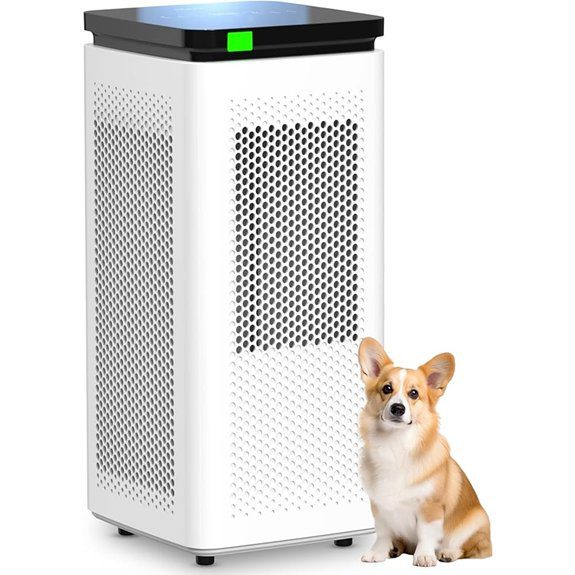 | Best for Large Spaces | Filtration Type: H13 True HEPA + activated carbon | Targets VOCs/Chemicals: Yes — activated carbon removes VOCs and odors | Coverage / Room Suitability: Covers up to 3,500 ft² (cleans 500 ft² in 15 min) | VIEW LATEST PRICE | Read Our Analysis |
| Airpura V700 Air Purifier good for VOCs Chemicals and Wildfires – White |  | VOC Specialist | Filtration Type: HEPA (99.97% down to 0.3 µm) + heavy activated carbon | Targets VOCs/Chemicals: Yes — 18-lb enhanced carbon adsorbs common VOCs/chemicals | Coverage / Room Suitability: Purifies up to 2,500 ft² (two air exchanges/hour) | VIEW LATEST PRICE | Read Our Analysis |
More Details on Our Top Picks
IQAir HealthPro Series (7. GC Multigas XE 1 Pack)
Who needs the IQAir HealthPro GC Multigas XE? You do if you want near-perfect particle capture and strong VOC/formaldehyde control. Its HyperHEPA filter removes 99.995% of particles down to 0.003 microns, tackling dust, pollen, smoke, and chemicals like formaldehyde. You’ll benefit from a redesigned fan that’s up to three times more energy-efficient and three smart modes that auto-adjust filtration to extend filter life. Connect to IQAir’s AirVisual app for real-time air quality monitoring and remote control. Made in Switzerland and backed by a 10-year limited warranty, it suits homes, schools, offices, and clinical settings.
- Filtration Type:HyperHEPA + multigas/chemical (specialized gas/charcoal stages)
- Targets VOCs/Chemicals:Yes — removes harmful chemicals including formaldehyde
- Coverage / Room Suitability:Intended for homes, offices, schools, hospitals, commercial sites (broad use)
- Auto / Smart Air Sensing:Yes — air quality sensor + automatic smart modes; app integration
- Noise / Night Mode Considerations:Energy-efficient fan with smart modes (quieter operation implied)
- Heavy-Duty / Professional Use:Built for high-performance use (homes to hospitals/industrial); Swiss-made, durable
- Additional Feature:Swiss-made construction
- Additional Feature:10-year limited warranty
- Additional Feature:AirVisual app integration
Wyze Smart HEPA 13 Air Purifier with Formaldehyde
If you want a budget-friendly purifier that tackles formaldehyde in larger rooms, the Wyze Smart HEPA 13 is a strong pick—its premium filter is specifically rated for formaldehyde and heavy odors while the HEPA 13 layer captures fine particles. You’ll get 350 m³/h CADR, enough to clean a 500 ft² room over three times an hour, and quiet operation from 21 dB (sleep) to 54 dB (high). A laser dust sensor scans particles to 0.3 microns and adjusts automatically. Smart WiFi, Alexa/Google support, remote control, and detailed air-quality readouts make it easy to manage.
- Filtration Type:True HEPA 13 + specialized formaldehyde/charcoal options
- Targets VOCs/Chemicals:Yes — premium filter targets formaldehyde and heavy odors
- Coverage / Room Suitability:Up to ~500 ft² (cleans 500 ft² multiple times/hour)
- Auto / Smart Air Sensing:Yes — laser dust sensor with precision scanning + auto mode
- Noise / Night Mode Considerations:Explicit low noise: 21 dB (low) to 54 dB (high)
- Heavy-Duty / Professional Use:Consumer smart/home use but suitable for large rooms (bedrooms, kitchens, basements)
- Additional Feature:Alexa/Google compatible
- Additional Feature:Laser dust sensor
- Additional Feature:Very low 21 dB sleep level
Air Purifier for Large Rooms up to 3500 ft²
Choose this air purifier when you need powerful, whole-room VOC and formaldehyde removal for very large spaces—its H13 True HEPA plus activated carbon combo and 235 CFM CADR handle particles down to 0.1 μm and neutralize odors and gases across open-concept areas up to 3,500 ft², while dual-inlet airflow circulates air twice as fast so you’ll see cleaner air in minutes. You’ll remove dust, pollen, pet dander, smoke and VOCs; clean 500 ft² in 15 minutes. Auto Mode and PM2.5 display adjust performance; Sleep Mode drops noise to 30 dB. Child lock, timer, dimmer, and CARB/DOE/EPA/UL certifications ensure safe, daily use.
- Filtration Type:H13 True HEPA + activated carbon
- Targets VOCs/Chemicals:Yes — activated carbon removes VOCs and odors
- Coverage / Room Suitability:Covers up to 3,500 ft² (cleans 500 ft² in 15 min)
- Auto / Smart Air Sensing:Yes — built-in PM2.5 display and Auto Mode adjusts speed
- Noise / Night Mode Considerations:Sleep Mode down to 30 dB; dimmer for night
- Heavy-Duty / Professional Use:Suited for large homes, offices, pet areas — daily heavy use
- Additional Feature:Dual-inlet airflow design
- Additional Feature:CARB/DOE/EPA/UL certified
- Additional Feature:Floor-standing with timer
Airpura V700 Air Purifier good for VOCs Chemicals and Wildfires – White
The Airpura V700 is ideal for people who need heavy-duty VOC and chemical removal in large spaces—its 18‑lb enhanced activated carbon bed adsorbs most common VOCs, harmful chemicals, and wildfire smoke while the HEPA stage traps 99.97% of particles down to 0.3 microns. You’ll get 360° air distribution and coverage up to 2,500 sq. ft with two air exchanges per hour (8‑ft ceilings), making it suitable for homes, offices, medical settings, and industrial spaces. The white finish blends into decor, and maintenance is straightforward. If you need robust chemical filtration and particle control for large areas, this unit delivers.
- Filtration Type:HEPA (99.97% down to 0.3 µm) + heavy activated carbon
- Targets VOCs/Chemicals:Yes — 18-lb enhanced carbon adsorbs common VOCs/chemicals
- Coverage / Room Suitability:Purifies up to 2,500 ft² (two air exchanges/hour)
- Auto / Smart Air Sensing:Yes — (designed for professional/medical use; implied active circulation and performance controls)
- Noise / Night Mode Considerations:Designed for medical/workplace use with 360° distribution (quiet/night specifics not listed)
- Heavy-Duty / Professional Use:Intended for homes, offices, hospitals, dental and industrial environments (professional-grade)
- Additional Feature:18-lb enhanced carbon
- Additional Feature:360° air distribution
- Additional Feature:Medical/workplace suitable
Factors to Consider When Choosing an Air Purifier for VOCs and Formaldehyde
When choosing an air purifier for VOCs and formaldehyde, you’ll want to focus on targeted chemical filtration and the specific filter media types used. Check CADR and coverage to ensure the unit can exchange room air quickly, and look for formaldehyde removal ratings or proven catalytic/impregnated filters. Don’t forget to consider airflow and exchange rates to match your room size and pollutant load.
Targeted Chemical Filtration
If you want an air purifier that actually reduces VOCs and formaldehyde, focus on its chemical filtration specs—not just HEPA CADR—and check for heavy, treated carbon or chemisorption media, rated adsorption capacity or breakthrough time, and a carbon-bed depth that matches the unit’s airflow so you get sufficient contact time. You should pick activated carbon or chemisorption filters with high carbon weight and specialized impregnations (potassium permanganate or amine treatments) because plain carbon often only masks odors. Insist on manufacturer VOC/formaldehyde metrics—mg/g adsorption, standardized chamber results, or breakthrough curves—so you can compare performance. Match CADR/room coverage to carbon-bed depth to avoid fast flow through shallow media. Finally, factor replacement intervals and ongoing cost; saturated media won’t remove gases effectively.
Filter Media Types
You’ve already learned to prioritize carbon-bed depth and rated adsorption performance; now look at the specific filter media you’ll choose, because different chemistries handle VOCs and formaldehyde very differently. Plain activated carbon removes many VOCs by adsorption; effectiveness rises with carbon weight, surface area, and contact time, so heavy-duty filters can contain pounds of carbon. Impregnated carbon (potassium permanganate, amines) chemically binds or oxidizes formaldehyde and outperforms plain carbon for reactive gases. Catalytic oxidation media convert formaldehyde to CO2 and water at room temperature without saturating, ideal for continuous control. Molecular sieves and zeolites target specific VOC families—pick pore sizes matched to small, polar molecules. Remember media performance depends on airflow, residence time, humidity, and pollutant concentration; higher flow and humidity reduce removal.
CADR And Coverage
Although CADR is a handy shorthand for particle removal, you should treat it cautiously for gases like VOCs and formaldehyde: instead focus on the unit’s airflow (CFM or m³/h) combined with the type and volume of gas-phase media, then convert that airflow into air changes per hour (ACH) for your room to estimate removal speed. CADR measures particles, not gases, so use reported CFM/m³·h plus an effective sorbent (activated carbon or catalytic media). Calculate ACH = (CFM × 60) ÷ room cubic feet to see how often air is exchanged; aim for 2–4 ACH in occupied spaces and 4+ ACH for elevated contamination. Also check sorbent volume and replacement interval—high airflow with minimal carbon exhausts media quickly, lowering long-term VOC/formaldehyde performance.
Formaldehyde Removal Ratings
Having checked airflow and sorbent volume, you’ll next want to read formaldehyde removal ratings carefully because formaldehyde behaves differently than larger VOCs and particles. Formaldehyde is a tiny, reactive gas that standard HEPA can’t catch; you need chemisorption or catalytic oxidation. Compare activated carbon ratings in mg adsorbed per gram and note carbon type, surface area, pore distribution, and any impregnation (e.g., KMnO4). Prefer tests reporting percent reduction over time or breakthrough time at specified concentrations and flow rates—longer breakthrough equals greater capacity. Make sure ratings list test conditions (initial ppm or µg/m³, flow/CADR, temperature, humidity) since performance shifts with them. Favor independent-lab results showing sustained reduction using impregnated carbon or formaldehyde-specific catalytic media.
Airflow And Exchange
When you’re targeting VOCs and formaldehyde, airflow and exchange rate matter as much as sorbent chemistry because faster air changes lower concentrations more quickly. Aim for a purifier with CADR or airflow that yields 2–4 ACH for your room; higher ACH cuts gas levels faster. Balance flow and residence time by matching CFM to sorbent bed size so gases contact the media long enough to be captured. For large or open areas, pick dual-inlet or high-CFM designs to avoid dead zones and ensure even circulation. Calculate required CFM as CFM = (room area × ceiling height × desired ACH) ÷ 60. Finally, favor units with adjustable fan speeds so you can raise exchange during emission events and save energy otherwise.
Sensor And Auto Modes
Airflow and correct ACH only work if the purifier actually responds to the pollutants you’re trying to remove, so pay close attention to sensors and auto modes. You should choose units with VOC- or formaldehyde-specific sensors — PM2.5/laser dust sensors won’t detect gaseous HCHO. Prefer fast-response, auto-calibrating sensors so spikes from cooking, new furniture, or cleaning products trigger prompt action. Auto mode must raise fan speed based on real-time VOC/formaldehyde readings and maintain a sustained boost when concentrations exceed health-based thresholds (tens–hundreds of ppb), with clear cutoff and hysteresis to avoid frequent on/off cycling. Finally, pick models that report numeric VOC or formaldehyde values or an indexed reading so you can track trends and confirm reductions over time.
Maintenance And Costs
Because carbon and HEPA media wear out with use, you should budget for regular replacements and basic upkeep to keep VOC and formaldehyde removal effective. Replace activated carbon or specialty formaldehyde cartridges every 6–12 months (or sooner if odor returns) since adsorption capacity declines. Expect HEPA filters to need swapping roughly every 12–18 months; smoky or heavily polluted homes require faster changes. Factor replacement costs—typically $30–$300 per filter set annually—into total ownership. Vacuum pre-filters every 1–3 months and wipe sensors and housings to maintain efficiency and extend filter life. Also consider electricity from continuous or high-speed operation: check unit wattage because 24/7 use at higher speeds can noticeably increase energy bills.